
Discuss the various impediments in India’s way to a permanent seat in the Security Council. (2018/15 marks)
How the answer moves
The flow snapshot — the routes in, the body, the counter-view and the routes out.
Route 1 credentials strong, support wide → yet seat blocked → impediments are structural/political, not merit
Route 2 Council frozen since 1945 → India’s case overwhelming yet unrealised → obstacles lie in law and politics, not qualification
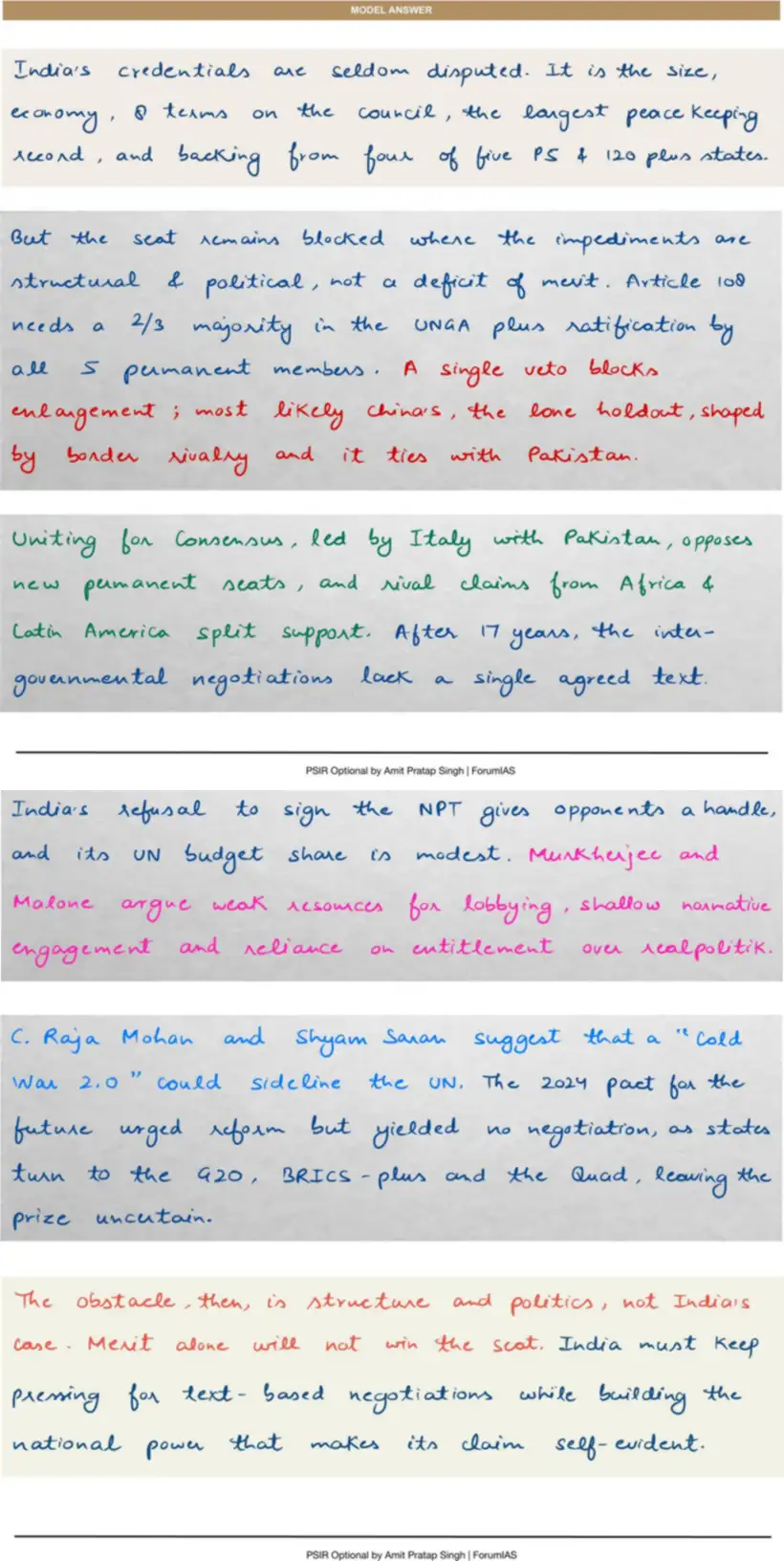
Charter rigidity (Art. 108: 2/3 GA + all-P5 ratification) → China the lone holdout (border rivalry, Pakistan tie) → divided membership: Uniting for Consensus (Italy, Pakistan) + rival Africa/Latin-America claims → Africa’s own split (Ezulwini’s veto demand vs G4 deferral) → 17 years of IGN, still no single text → India-specific: NPT non-signature + modest UN budget share + Mukherjee & Malone (thin resources, shallow normative engagement, entitlement over realpolitik)
the larger doubt: Raja Mohan & Saran on “Cold War 2.0” sidelining the UN → 2024 Pact for the Future urged but delivered no negotiation → drift to G20/BRICS-plus/Quad → the prize itself is uncertain
Route 1 obstacle is structure + politics, not India’s case → merit alone will not win the seat
Route 2 keep pressing text-based negotiations + build concrete national power so the claim becomes self-evident, not merely just
Model answer
Handwritten, in the form it would be written in the examination hall.
Also asked on this head
India and the UN System — 9 questions in the Vault.
- “India must strive to become a semi-permanent member of the UNSC, rather than a permanent member without the right to veto.” Comment. (2024/10 marks)
- Discuss the importance of India’s role in UN
- Explain the factors which justify India’s claim for a permanent seat at the UN security council. (2022/15 marks)
How this is taught
The same flow snapshot, built for every head of the syllabus, with the answer written in class.
The first session of Foundation 2027 is published in full.
Six programmes across three levels.