
Critically analyze China’s role in international politics against India’s demand for permanent seat in UN Security Council. (2016/15 marks)
How the answer moves
The flow snapshot — the routes in, the body, the counter-view and the routes out.
Route 1 India’s credentials strong → four of five P5 back it → only China non-committal → Article 108 makes one refusal decisive → China is the obstacle
Route 2 the paradox: broad support but a single veto point → China’s non-commitment converts into structural blockage through Article 108
strategic motive (sole Asian/non-Western P5, guards prestige, won’t admit a co-equal rival, border) → Kantha (assurance + obstruction) → Jaishankar “duality” (NSG + UNSC pattern) → tactics: Pakistan → UfC regional link → G4 wedge (drop Japan) → “package solution”/no agreed text (procedural delay)
irony: Chinese assertiveness (South China Sea) proves a 1945 Council unfit → strengthens India’s reform case, but gives China reason to keep the Council shut → China decisive but not sole barrier (regional claims + veto persist) → Raja Mohan caution (don’t be bargained by the West)
Route 1 China is the proximate, decisive veto guarding its Asian primacy → India must build concrete power, not rest on entitlement
Route 2 reform held hostage to one P5 holdout → India’s path is coalition plus capability, making the claim self-evident rather than merely just
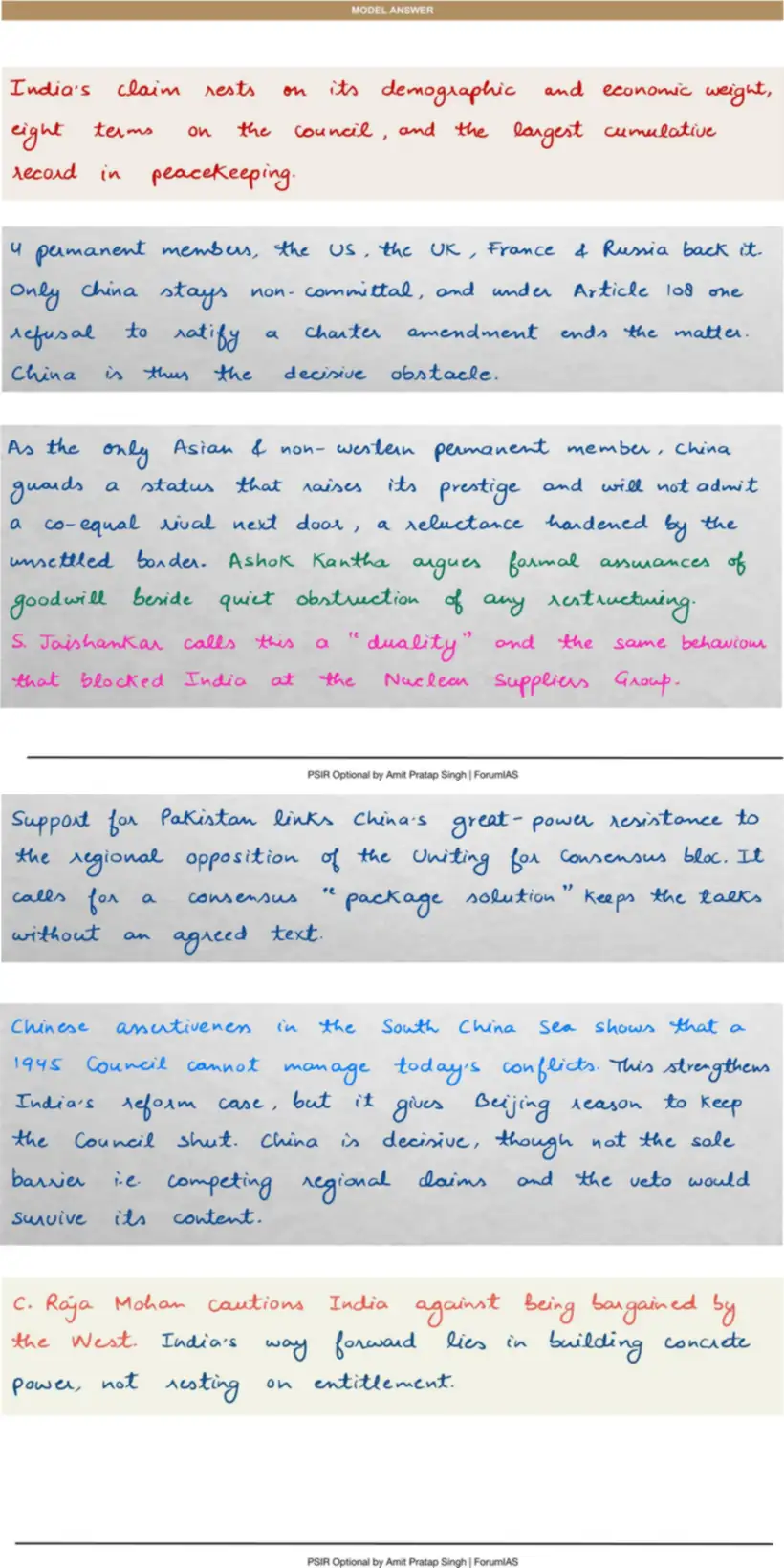
Model answer
Handwritten, in the form it would be written in the examination hall.
Also asked on this head
India and the UN System — 9 questions in the Vault.
- “India must strive to become a semi-permanent member of the UNSC, rather than a permanent member without the right to veto.” Comment. (2024/10 marks)
- Discuss the importance of India’s role in UN
- Explain the factors which justify India’s claim for a permanent seat at the UN security council. (2022/15 marks)
How this is taught
The same flow snapshot, built for every head of the syllabus, with the answer written in class.
The first session of Foundation 2027 is published in full.
Six programmes across three levels.