
Comment on India’s contribution to Non-Alignment Movement and contemporary relevance.
How the answer moves
The flow snapshot — the routes in, the body, the counter-view and the routes out.
Route 1 India not a member but an author → Belgrade 1961, Nehru with Tito and Nasser → contribution normative, norm outlasts forum
Route 2 non-alignment as India’s own idea, exported into a movement → co-founding at Belgrade → India gave NAM principle, not power
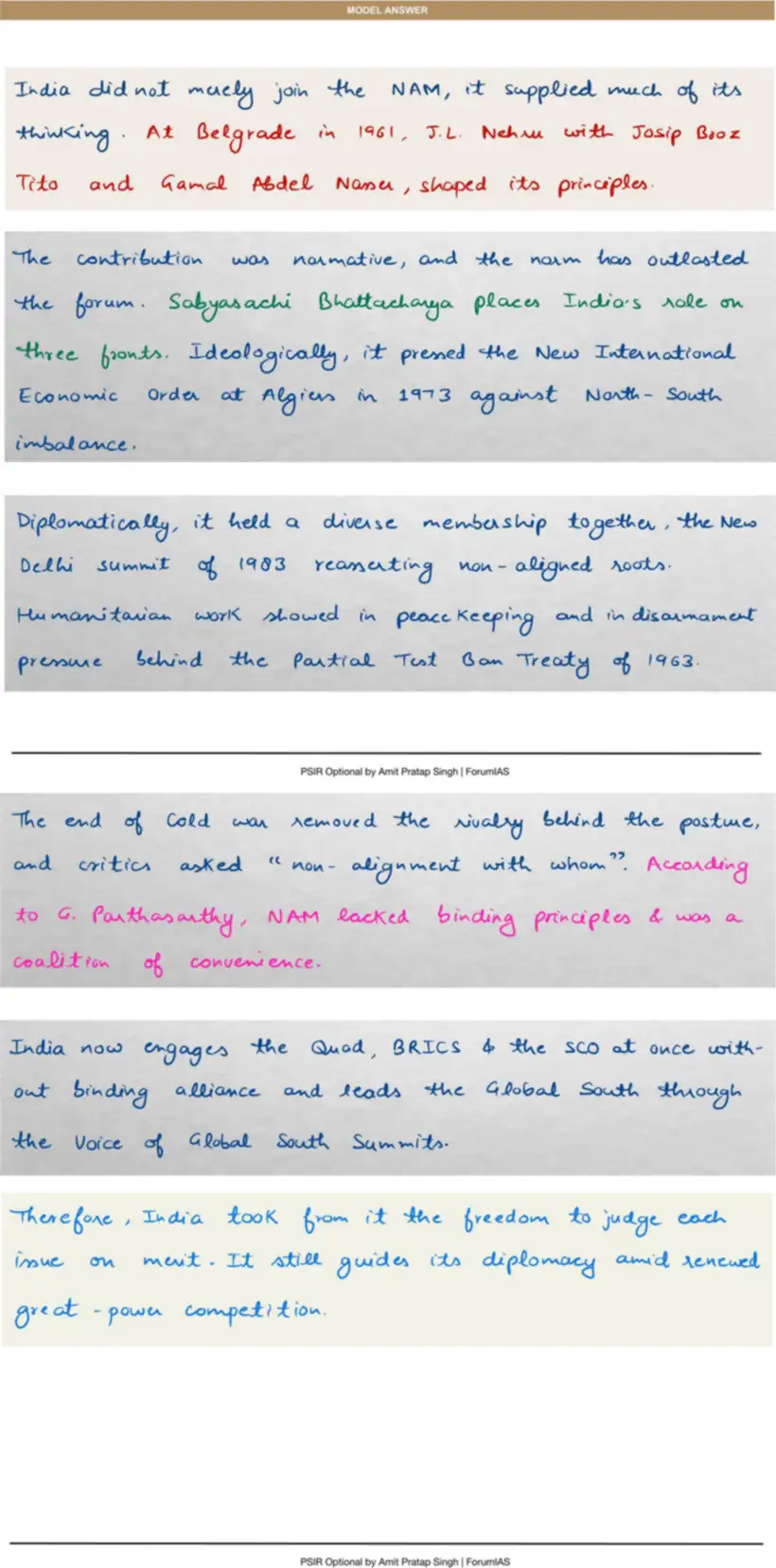
Bhattacharya’s three fronts → ideological: NIEO at Algiers 1973 vs North–South imbalance → diplomatic: diverse membership held together, New Delhi summit 1983 reasserts roots → humanitarian: peacekeeping + disarmament pressure behind Partial Test Ban Treaty 1963 → Cold War’s close removes the rivalry → “non-alignment with whom” → independence of judgment outlives the movement’s purpose → today: Quad + BRICS + SCO at once, no binding alliance → Global South leadership, Voice of Global South Summits
Parthasarathy: no binding principles, coalition of convenience → charge fits the movement, not the policy
Route 1 freedom to judge each issue on merit still guides Indian diplomacy amid renewed great-power competition
Route 2 the forum needs reform, the principle already works → India’s contribution survives as its own method, not as NAM’s machinery
Model answer
Handwritten, in the form it would be written in the examination hall.
Also asked on this head
India and the Non-Aligned Movement — 7 questions in the Vault.
- Non-Alignment 2.0 underscores India’s unique aspiration to emerge as a site for an alternative universality. Comment.
- Does the Non-Aligned Movement have any future in the wake of India’s growing indifference towards it?
- “India has of late, chosen to debunk non-alignment in its pursuit of multi-alignment.” Comment.
How this is taught
The same flow snapshot, built for every head of the syllabus, with the answer written in class.
The first session of Foundation 2027 is published in full.
Six programmes across three levels.