
Does the Non-Aligned Movement have any future in the wake of India’s growing indifference towards it?
How the answer moves
The flow snapshot — the routes in, the body, the counter-view and the routes out.
Route 1 NAM born 1961 → new states clear of both blocs → sovereignty + equitable development → India’s absence real, future turns on NAM’s own reform
Route 2 absence from recent summits = post-1991 shift to multi-alignment → the question is NAM’s condition, not India’s attendance
decline predates India’s drift → C. Raja Mohan: meaning lost before the Cold War ended, failed to shape events → 120-plus members, fragmented priorities → no permanent secretariat → agenda absorbed by African Union / ASEAN / BRICS → but small and marginalised states still need a voice → M.K. Narayanan: collective voice on global issues → global governance + UN reform → T.V. Paul: space for soft balancing, onus on smaller countries → future conditional on reform → Harsh V. Pant: “old shibboleths”, no new goals → Keethaponcalan: permanent secretariat + selective engagement in place of non-cooperation
NAM a spent force (no achievement, no machinery, regional bodies took over the agenda) vs NAM the one collective platform left to weaker states
Route 1 a future exists, but a reformed one → India’s absence weakens the platform, does not decide it
Route 2 the decline was NAM’s own → reform of agenda and structure settles the question, not India’s return
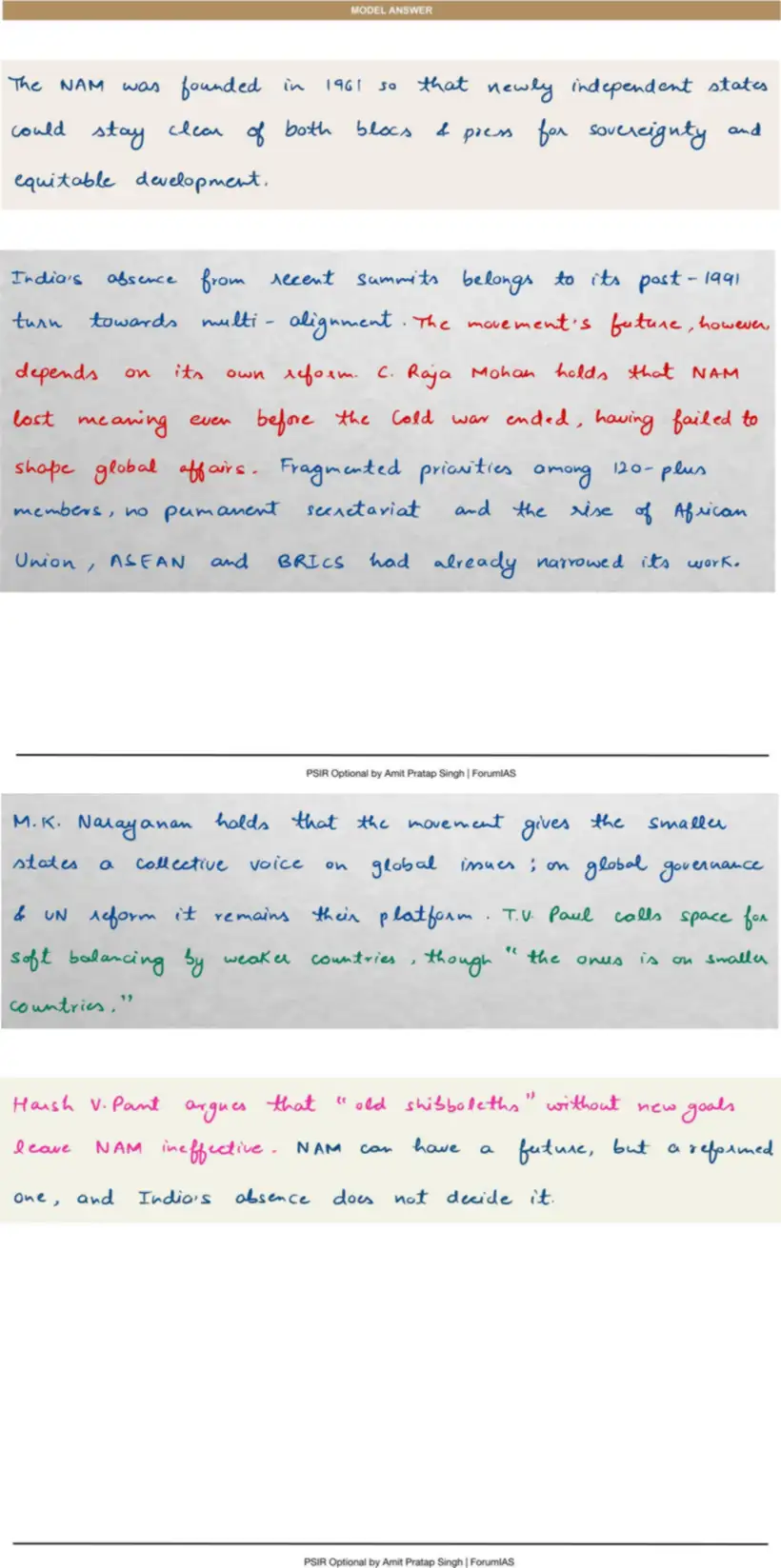
Model answer
Handwritten, in the form it would be written in the examination hall.
Also asked on this head
India and the Non-Aligned Movement — 7 questions in the Vault.
- Non-Alignment 2.0 underscores India’s unique aspiration to emerge as a site for an alternative universality. Comment.
- “India has of late, chosen to debunk non-alignment in its pursuit of multi-alignment.” Comment.
- “Non-alignment was little more than a rational strategy on the part of a materially weak India to maximise its interests with a bipolar distribution of global...
How this is taught
The same flow snapshot, built for every head of the syllabus, with the answer written in class.
The first session of Foundation 2027 is published in full.
Six programmes across three levels.