
“Non-alignment was little more than a rational strategy on the part of a materially weak India to maximise its interests with a bipolar distribution of global power.” Comment.
How the answer moves
The flow snapshot — the routes in, the body, the counter-view and the routes out.
Route 1 not neutrality, not equidistance → independent policy = no alliances + freedom of judgment → the calculation is read correctly, “little more than” is the weak word
Route 2 1947, little military or economic weight → alliance = obligation without adequate defence → autonomy of policy inside bipolarity, not distance from it
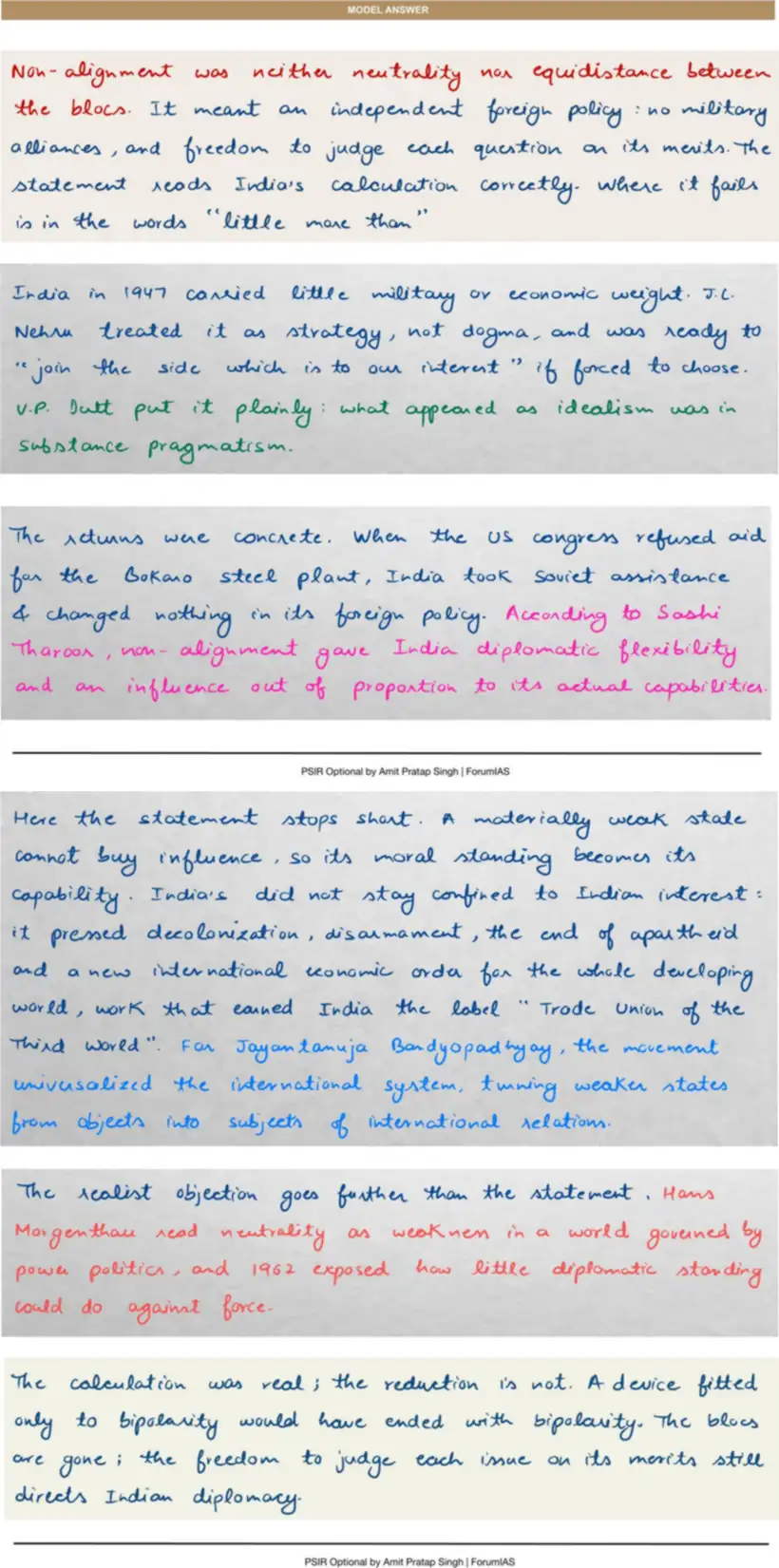
material weakness → alliance meant obligation without defence + quarrels serving no Indian purpose → Nehru: strategy, not dogma, ready to “join the side which is to our interest” → V.P. Dutt: idealism in appearance, pragmatism in substance → returns concrete: Bokaro, US Congress refuses, Soviet aid taken, policy unchanged → Tharoor: flexibility + influence beyond actual capability → turn: a weak state cannot buy influence, so moral standing becomes capability → agenda outruns Indian interest: decolonization, disarmament, apartheid, NIEO → “Trade Union of the Third World” → Bandyopadhyaya: universalized the international system, weaker states from objects into subjects
Morgenthau: neutrality as weakness where power politics governs → 1962: what diplomatic standing could not do against force
Route 1 calculation real, reduction false → a device fitted only to bipolarity would have ended with bipolarity → blocs gone, freedom of judgment still directs Indian diplomacy
Route 2 strategy and ethic were not rivals → for a weak state the norms were the instrument, and they outgrew the purpose they were built for
Model answer
Handwritten, in the form it would be written in the examination hall.
Also asked on this head
India and the Non-Aligned Movement — 7 questions in the Vault.
- Non-Alignment 2.0 underscores India’s unique aspiration to emerge as a site for an alternative universality. Comment.
- Does the Non-Aligned Movement have any future in the wake of India’s growing indifference towards it?
- “India has of late, chosen to debunk non-alignment in its pursuit of multi-alignment.” Comment.
How this is taught
The same flow snapshot, built for every head of the syllabus, with the answer written in class.
The first session of Foundation 2027 is published in full.
Six programmes across three levels.