
“India has of late, chosen to debunk non-alignment in its pursuit of multi-alignment.” Comment.
How the answer moves
The flow snapshot — the routes in, the body, the counter-view and the routes out.
Route 1 non-alignment ≠ withdrawal → Nehru’s “best judgment” → freedom of choice, not equidistance → method changes, idea holds
Route 2 test the verb “debunk” → posture vs principle → grammar of policy shifts, core survives
departure is real: LEMOA/COMCASA, PM absent from NAM summits, Jaishankar’s engage–manage–cultivate–reassure → but neither recent nor complete: Nehru ready to join the side of interest, 1971 Indo-Soviet Treaty, Ganguly’s realist turn after 1962, deepened 1991 → the constant is strategic autonomy: Non-Alignment 2.0 → defining value, “maximum options” → multi-alignment spreads commitments (Quad, BRICS, SCO, Russia) so no partner decides for India → Saran: substance vs posture
Pant → no rigid non-aligned pigeonhole → but the charge lands on NAM as institution and Cold War idiom, not on freedom of judgment → Global South leadership carries it forward
Route 1 “debunk” overstates → Sood → reinterpretation, not abandonment
Route 2 from avoiding sides to maximising options → autonomy is the continuity, alignment only the instrument
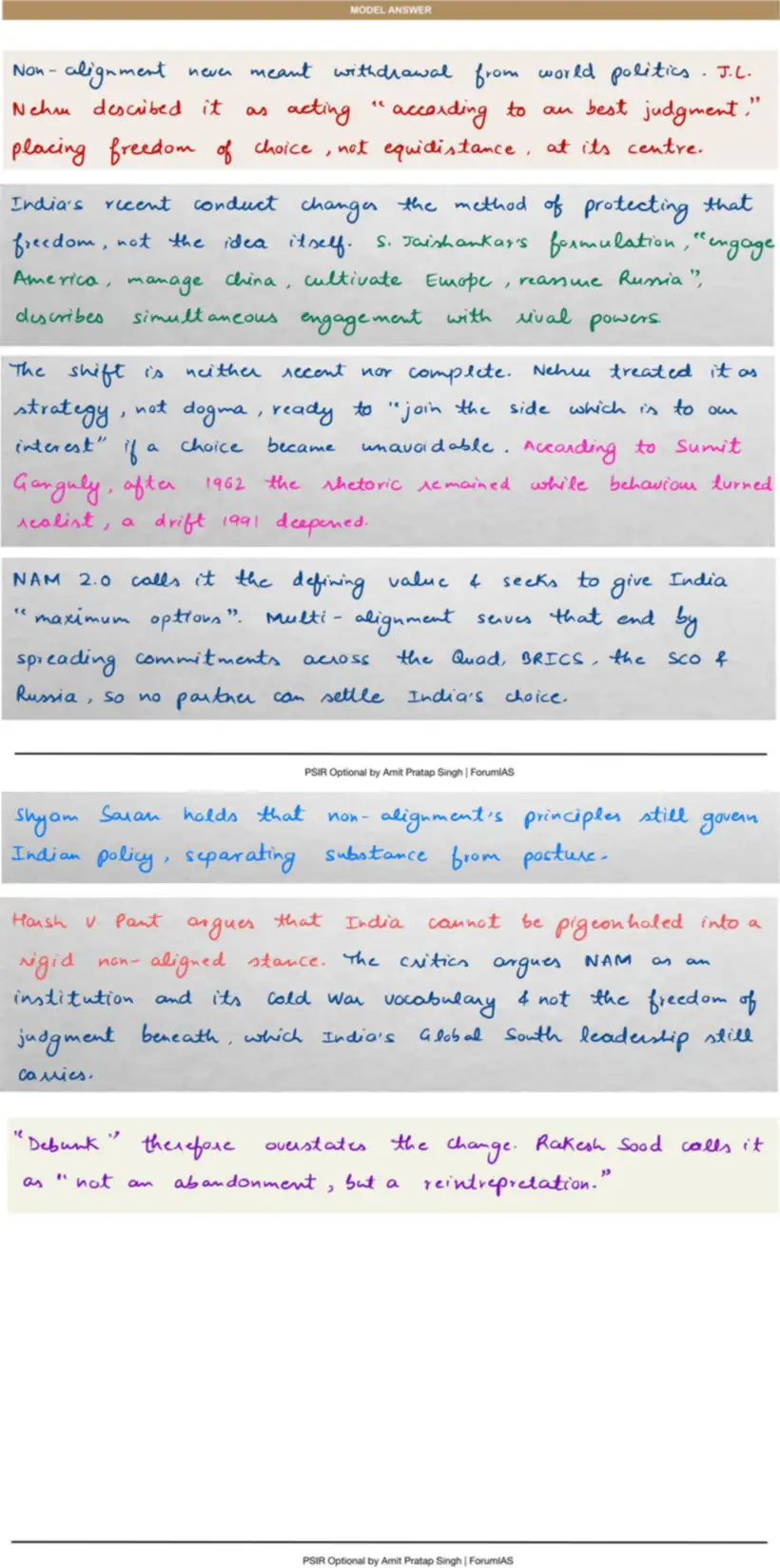
Model answer
Handwritten, in the form it would be written in the examination hall.
Also asked on this head
India and the Non-Aligned Movement — 7 questions in the Vault.
- Non-Alignment 2.0 underscores India’s unique aspiration to emerge as a site for an alternative universality. Comment.
- Does the Non-Aligned Movement have any future in the wake of India’s growing indifference towards it?
- “Non-alignment was little more than a rational strategy on the part of a materially weak India to maximise its interests with a bipolar distribution of global...
How this is taught
The same flow snapshot, built for every head of the syllabus, with the answer written in class.
The first session of Foundation 2027 is published in full.
Six programmes across three levels.