
Non-Alignment 2.0 underscores India’s unique aspiration to emerge as a site for an alternative universality. Comment.
How the answer moves
The flow snapshot — the routes in, the body, the counter-view and the routes out.
Route 1 NA 2.0, 2012, twelve experts → what order should a rising India want → autonomy + openness, not hegemony or blocs → claim of universality sits here
Route 2 incumbent universal = Western liberal hegemony → other pole = rigid bloc politics → NA 2.0 positions India as a third site
strategic autonomy as defining value → “maximum options” → polycentric world, networks not fixed alliances → so the universal offered is a method, not a creed for export → pedigree: Bandyopadhyaya, weaker states from objects to subjects → same claim restated for multipolarity → Voice of Global South Summits + AU into G20 under India’s presidency = building the site
Karnad: regressive roadmap → ideational and moral influence overweighted against material power → a site that cannot deliver remains only an intention
Route 1 aspiration real and distinctly Indian → universality turns on converting convening power into usable outcomes
Route 2 1.0 universalised by making weak states subjects → 2.0’s test is the same work done by delivery, not declaration
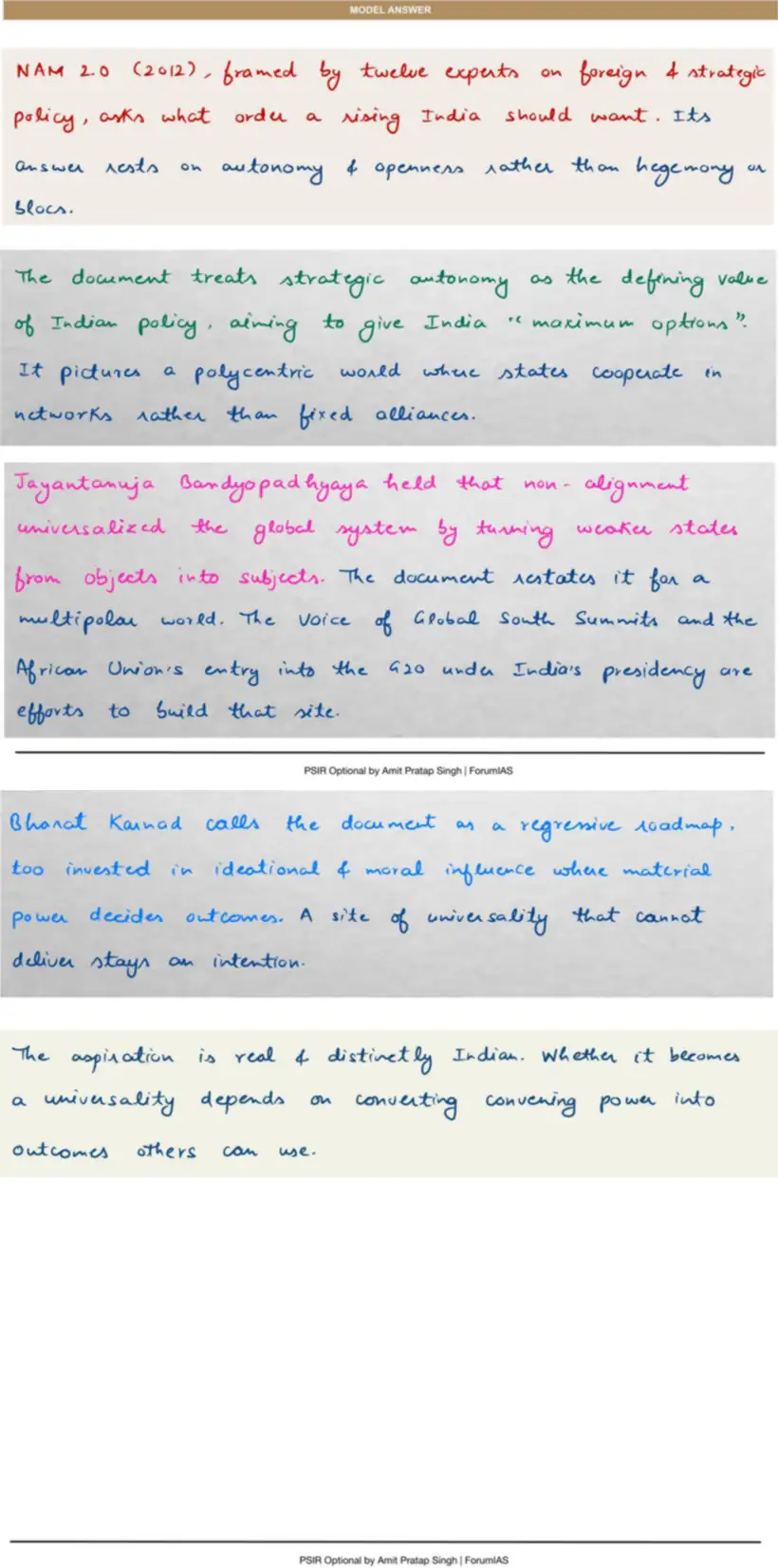
Model answer
Handwritten, in the form it would be written in the examination hall.
Also asked on this head
India and the Non-Aligned Movement — 7 questions in the Vault.
- Does the Non-Aligned Movement have any future in the wake of India’s growing indifference towards it?
- “India has of late, chosen to debunk non-alignment in its pursuit of multi-alignment.” Comment.
- “Non-alignment was little more than a rational strategy on the part of a materially weak India to maximise its interests with a bipolar distribution of global...
How this is taught
The same flow snapshot, built for every head of the syllabus, with the answer written in class.
The first session of Foundation 2027 is published in full.
Six programmes across three levels.