
‘Non-alignment’ has been the basic principle of India’s foreign policy since independence. Discuss its relevance in the contemporary context.
How the answer moves
The flow snapshot — the routes in, the body, the counter-view and the routes out.
Route 1 non-alignment ≠ neutrality → Nehru’s “best judgment” → blocs ruled out, engagement not → relevance judged on two tracks: principle + movement
Route 2 Belgrade 1961, 25 states, bipolar setting → that setting gone → question is which part of non-alignment has dated
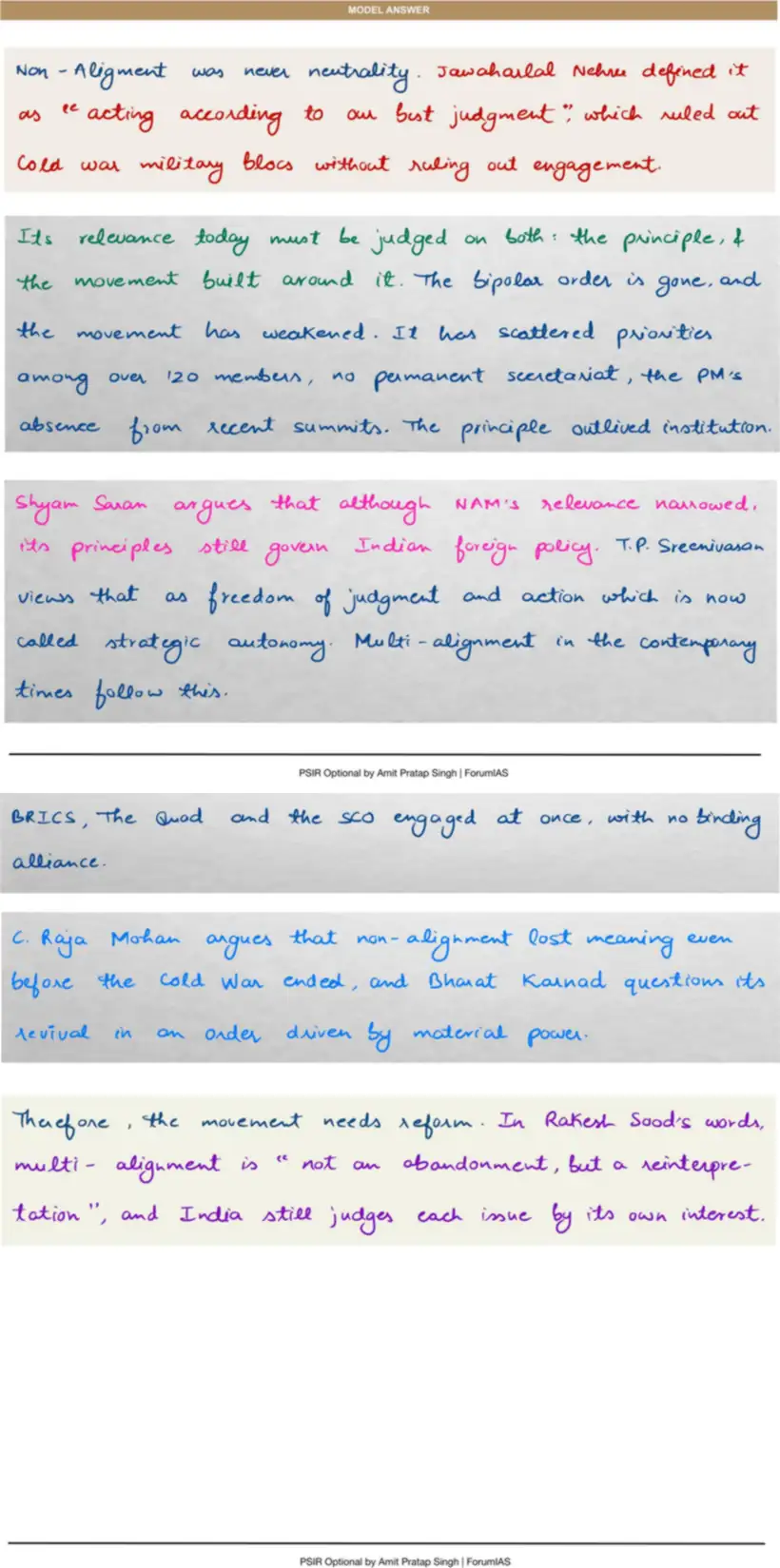
bipolar order gone + movement weakened (over 120 members, scattered priorities, no permanent secretariat, PM absent from summits) → principle outlives institution → Saran: principles still govern Indian foreign policy → Sreenivasan: core = freedom of judgment and action = strategic autonomy → multi-alignment in practice: Quad + BRICS + SCO, no binding alliance
sceptics go further → Raja Mohan: meaning lost even before the Cold War ended → Karnad: revival questionable in an order driven by material power
Route 1 movement needs reform, policy has already adapted → Sood: “not an abandonment, but a reinterpretation” → each issue judged on own interest
Route 2 relevance now sits in strategic autonomy plus a collective voice for the Global South → survives by redefinition and reform, not by attendance
Model answer
Handwritten, in the form it would be written in the examination hall.
Also asked on this head
India and the Non-Aligned Movement — 7 questions in the Vault.
- Non-Alignment 2.0 underscores India’s unique aspiration to emerge as a site for an alternative universality. Comment.
- Does the Non-Aligned Movement have any future in the wake of India’s growing indifference towards it?
- “India has of late, chosen to debunk non-alignment in its pursuit of multi-alignment.” Comment.
How this is taught
The same flow snapshot, built for every head of the syllabus, with the answer written in class.
The first session of Foundation 2027 is published in full.
Six programmes across three levels.