
Write a brief note on India’s interests in West Asia.
How the answer moves
The flow snapshot — the routes in, the body, the counter-view and the routes out.
Route 1 West Asia central to India’s foreign policy → interests material before ideological
Route 2 four interests (energy / people / trade / defence) → pursued via a de-hyphenated, multi-aligned strategy, no bloc
energy first (~88% crude, Gulf + Iran, Hormuz exposure — Pant/ORF) → diaspora + remittances (~9m in Gulf; safety → June-2025 evacuation) → trade & connectivity (Chabahar 2024 + INSTC → Central Asia; IMEC 2023 G20 → “Act West”/connectivity leadership; tied to a Saudi–Israel normalisation frozen by Gaza) → defence & three-pole logic (Taneja: Gulf economic / Israel technology / Iran neighbour) → all engaged without choosing = multi-alignment
strength = each pole accepts India’s ties with the others; strain = one regional war forces every interest onto the table at once (IMEC frozen by Gaza already shows the fragility)
Route 1 interests led by energy + diaspora, backed by trade, connectivity, defence, held together by multi-alignment
Route 2 “calibrated multi-alignment” (Pant): balance as the source of influence → real test = whether it holds as conflicts deepen
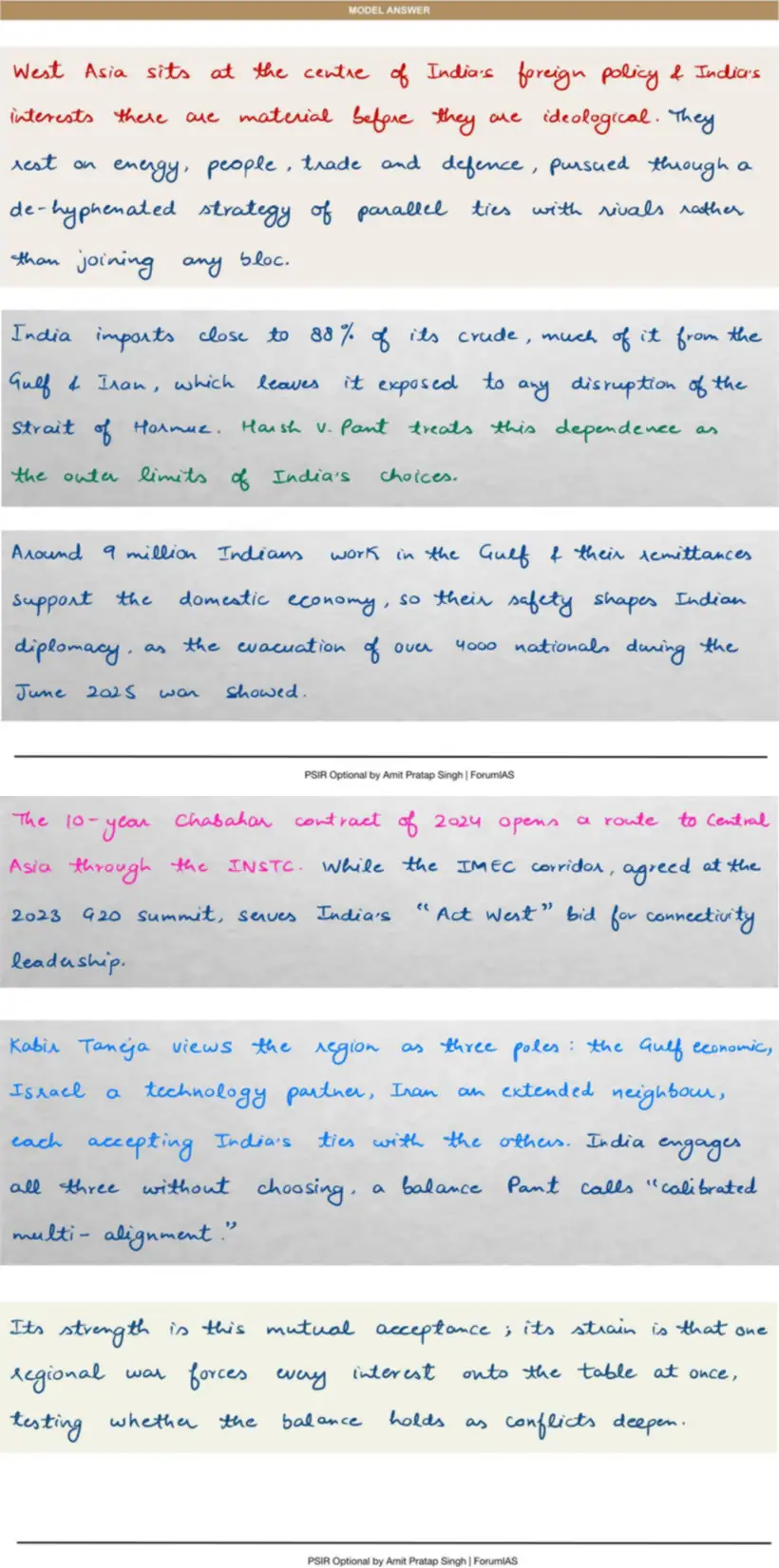
Model answer
Handwritten, in the form it would be written in the examination hall.
Also asked on this head
Recent Developments in Indian Foreign Policy — 23 questions in the Vault.
- India has recognised that West Asia is not a single contest, but a tangle of rivalries, bargains and anxieties. Comment.
- Discuss the three areas of security co-operation between India and Israel. (150 words)
- Critically examine India’s position on South China Sea Dispute.
How this is taught
The same flow snapshot, built for every head of the syllabus, with the answer written in class.
The first session of Foundation 2027 is published in full.
Six programmes across three levels.