
How the answer moves
The flow snapshot — the routes in, the body, the counter-view and the routes out.
Route 1 elected delegation replaces direct rule → practical form for large modern states
Route 2 second-best to direct democracy, yet most workable → rests on consent and trust
Locke: consent/trust → Mill: ideal modern form → defining feature = delegated decision-making by elected reps → checked by free elections + accountability → rule of law + rights (speech, assembly, religion) → Montesquieu: separation of powers/checks → Tocqueville: associations + pluralism keep participation alive → two models: trusteeship + Burke’s enlightened representation
same delegation → elite capture, weak accountability between elections, underrepresentation
Route 1 features make delegated rule both workable and accountable
Route 2 limits met through transparency, inclusivity, stronger accountability
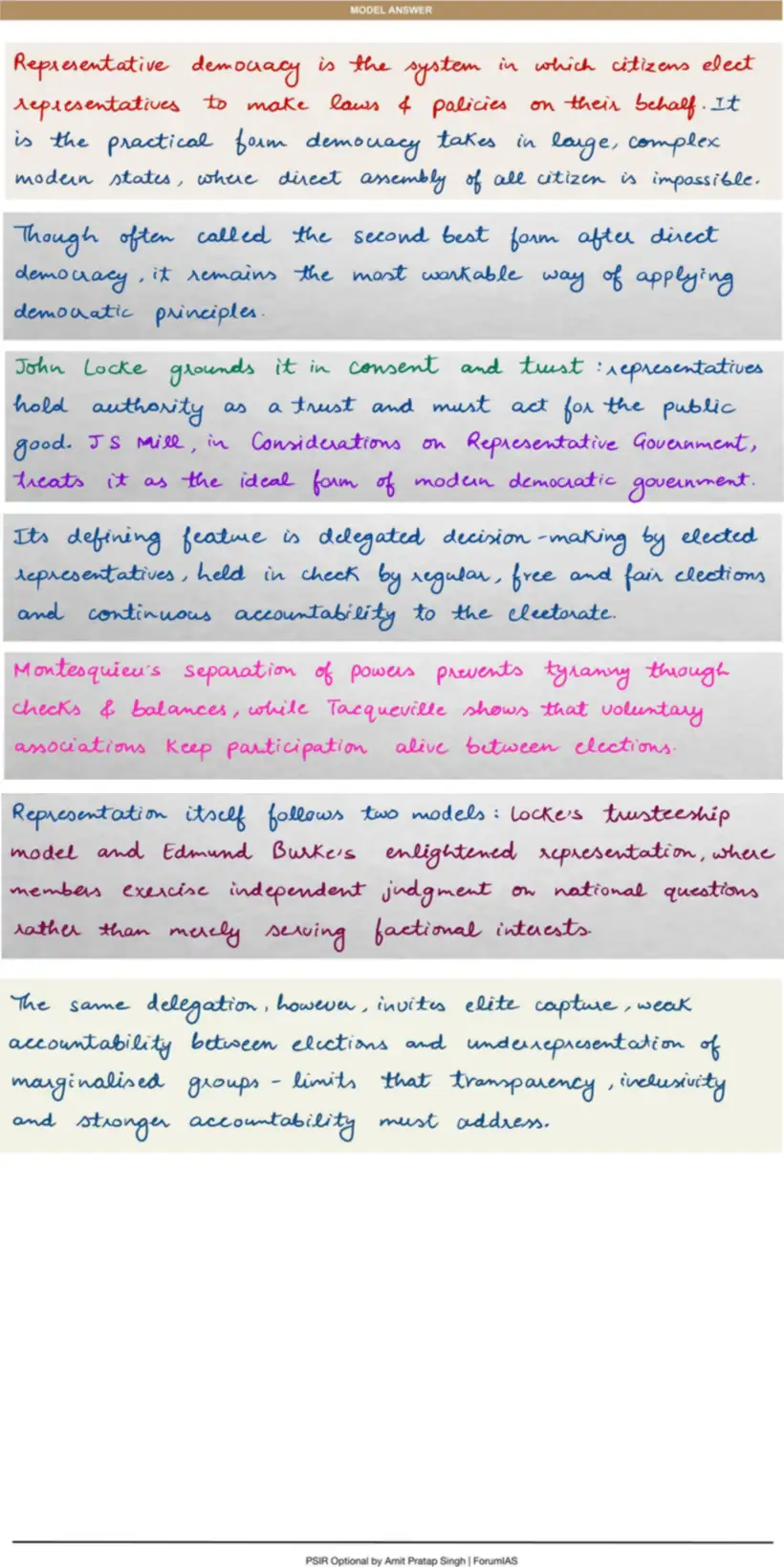
Model answer
Handwritten, in the form it would be written in the examination hall.
Also asked on this head
Democracy — 13 questions in the Vault.
- “Representative democracy is not an absolute principle, rather a question of time, place and circumstances.” Analyze the statement. Mention the major challenges to representative democracy.
- Substantive Democracy (150 words)
- The foundational base of western democracy has been
How this is taught
The same flow snapshot, built for every head of the syllabus, with the answer written in class.
The first session of Foundation 2027 is published in full.
Six programmes across three levels.