
How the answer moves
The flow snapshot — the routes in, the body, the counter-view and the routes out.
Route 1 not rival models → two halves of one legitimacy → participation = demos, deliberation = logos
Route 2 statement marks the exact failure point → each collapses without the other → breadth needs depth, depth needs breadth
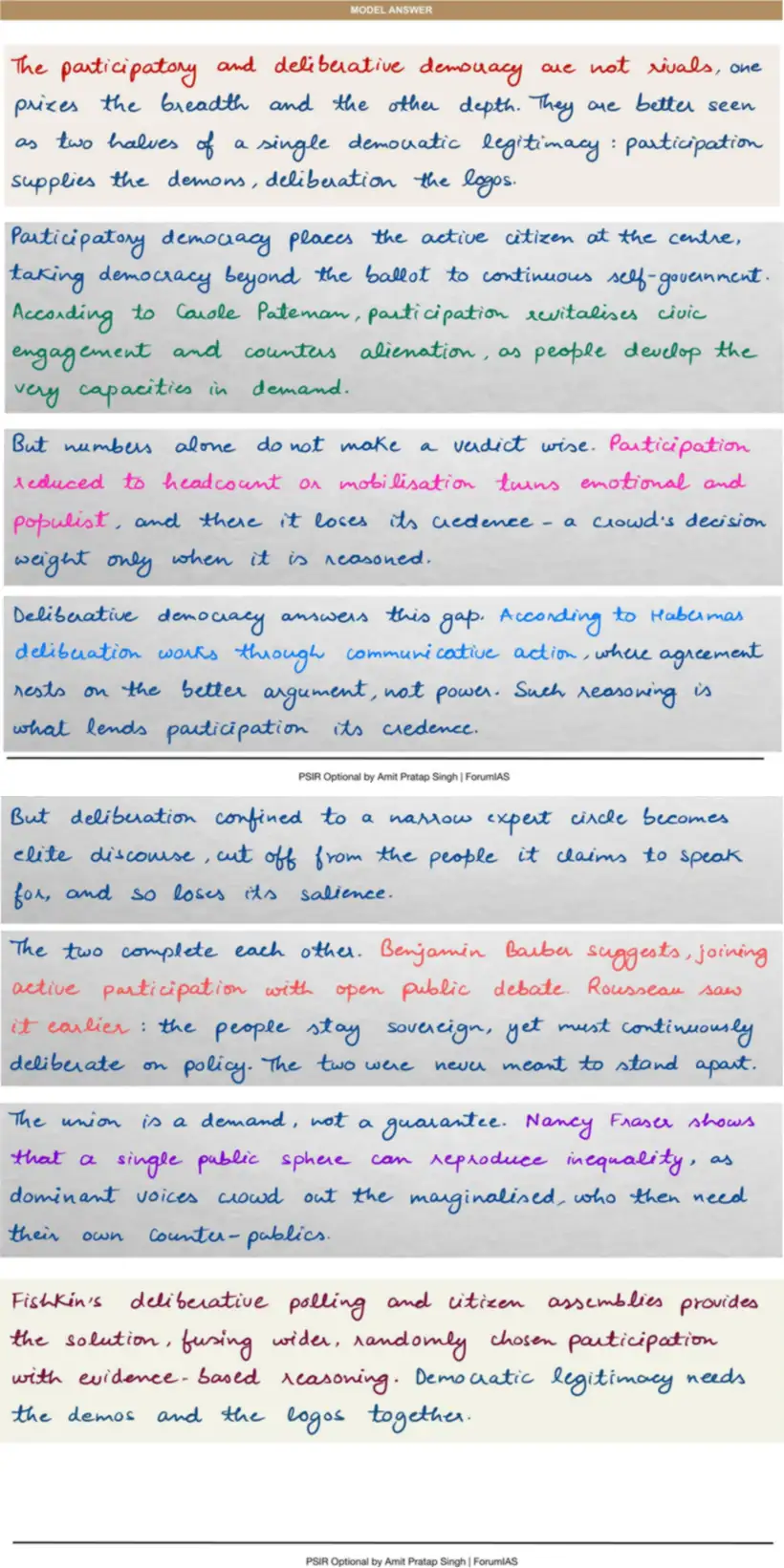
participatory democracy = active citizen beyond the ballot → Pateman: participation revives civic life, counters alienation → but headcount alone turns populist → loses credence → deliberative democracy fills the gap: quality of reasoning → Habermas: communicative action, better argument over power → reasoned debate gives participation its credence → but narrow expert deliberation = elite discourse → loses salience → each completes the other: inclusion makes deliberation authoritative, reason makes participation credible → Barber’s strong democracy = participation + debate → Rousseau: sovereign people who must continuously deliberate
fusion is a demand, not a guarantee → Fraser: single public sphere reproduces inequality, needs counter-publics → skilled speakers form an epistemic elite → mobilisation can still capture participation
Route 1 statement holds → deliberation alone = elite talk, no salience → participation alone = populist noise, no credence
Route 2 Fishkin’s deliberative polling / citizen assemblies fuse wide participation + evidence-based reason → legitimacy needs demos and logos together
Model answer
Handwritten, in the form it would be written in the examination hall.
Also asked on this head
Democracy — 13 questions in the Vault.
- “Representative democracy is not an absolute principle, rather a question of time, place and circumstances.” Analyze the statement. Mention the major challenges to representative democracy.
- Substantive Democracy (150 words)
- The foundational base of western democracy has been
How this is taught
The same flow snapshot, built for every head of the syllabus, with the answer written in class.
The first session of Foundation 2027 is published in full.
Six programmes across three levels.