
How the answer moves
The flow snapshot — the routes in, the body, the counter-view and the routes out.
Route 1 core claim: power always with an organised minority → so democracy = contest among elites, not rule of the people
Route 2 contrast: classical democracy promises government of the people → elite theory denies it → rule belongs to organised minorities
elite/mass division grounded in classical theory → Mosca (class that rules vs class that is ruled; minority always at the helm) → Pareto (circulation of elites; rule stays with the few) → Michels (Iron Law; “organisation = oligarchy”; even democratic parties oligarchise) → Schumpeter (democratic elitism; democracy = competitive method for votes; people only choose/replace rulers) → Lasswell (who governs; politics = who gets what; elites capture values — income, respect, safety)
denies democracy as rule of the people / citizens reduced to voters between elites → pluralist reply: many power centres fragment elites and keep them responsive
Route 1 elite theory remains a strong reminder: organised minorities shape every political order
Route 2 elite theory makes democracy procedural — selecting and replacing rulers, not self-government
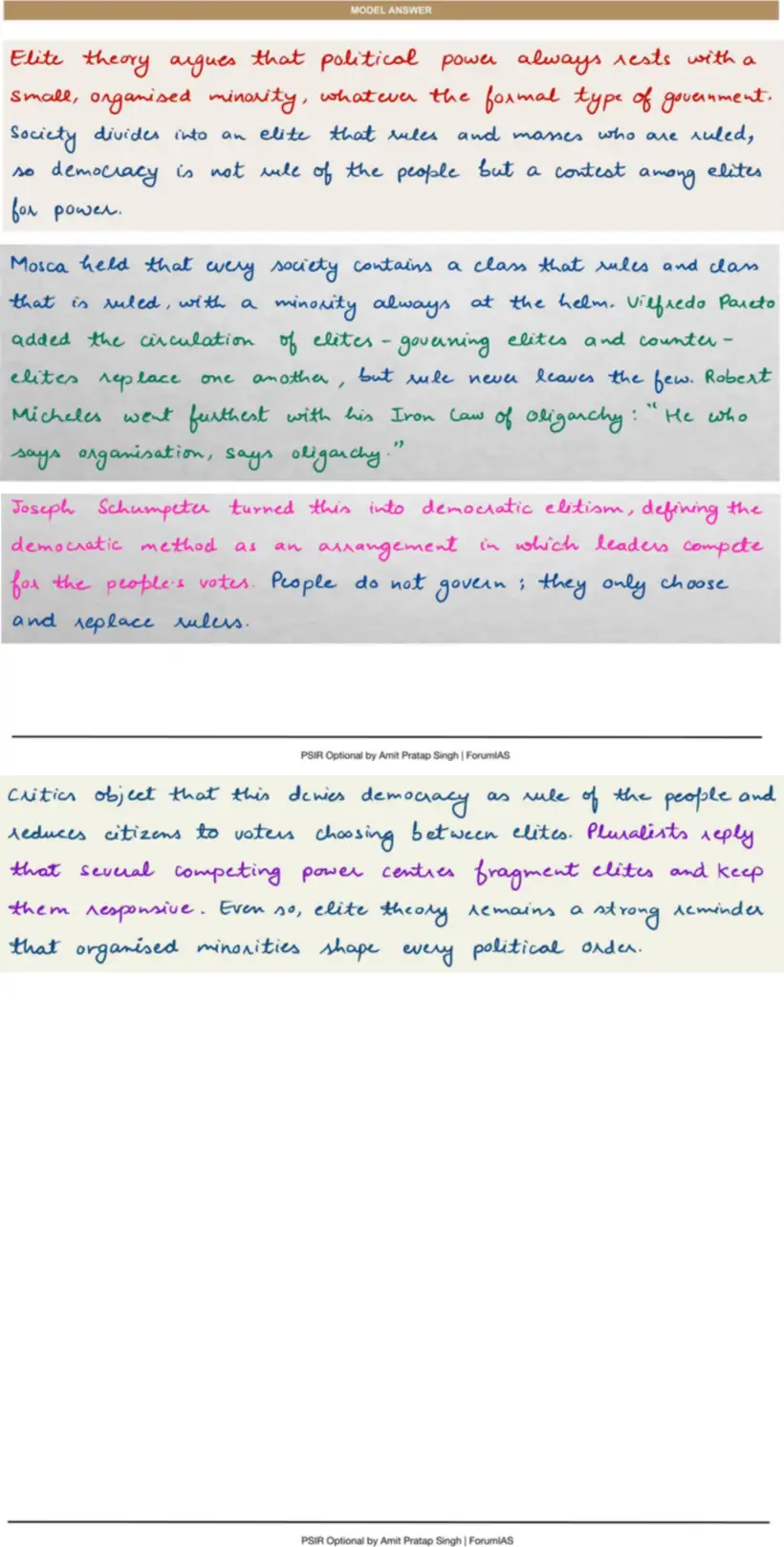
Model answer
Handwritten, in the form it would be written in the examination hall.
Also asked on this head
Democracy — 13 questions in the Vault.
- “Representative democracy is not an absolute principle, rather a question of time, place and circumstances.” Analyze the statement. Mention the major challenges to representative democracy.
- Substantive Democracy (150 words)
- The foundational base of western democracy has been
How this is taught
The same flow snapshot, built for every head of the syllabus, with the answer written in class.
The first session of Foundation 2027 is published in full.
Six programmes across three levels.