
How the answer moves
The flow snapshot — the routes in, the body, the counter-view and the routes out.
Route 1 democracy authorises power through consent → but contemporary success needs that power held within limits → Locke: government protects rights, bound by law, “where law ends, tyranny begins”
Route 2 restraint, not the mandate alone, is the real test → self-limitation = the harder half of democracy
authorise vs restrain (democracy authorises / constitutionalism restrains, both needed) → Zakaria: constitutionalism distinct, elections outrunning restraint → oppressive majority → Madison: oblige government to control itself → rule of law: government under law, minorities/dissenters protected → Diamond: “steel frame” against elected autocrats → separation of powers (Montesquieu): branches limit each other → pluralism (Dahl): power dispersed across press, opposition, civil society
self-limitation ≠ self-weakening → Bartels: backsliding is elite-driven loosening of self-limits → Holmes: restraining arbitrary power raises state capacity → Ambedkar: political democracy must rest on social & economic democracy → limit arbitrary power, not positive purpose
Route 1 state binds itself by law, divides authority, accepts plural checks → majorities rule without tyranny
Route 2 limited power and effective power are not opposites → the democracies that endure are those that restrain themselves
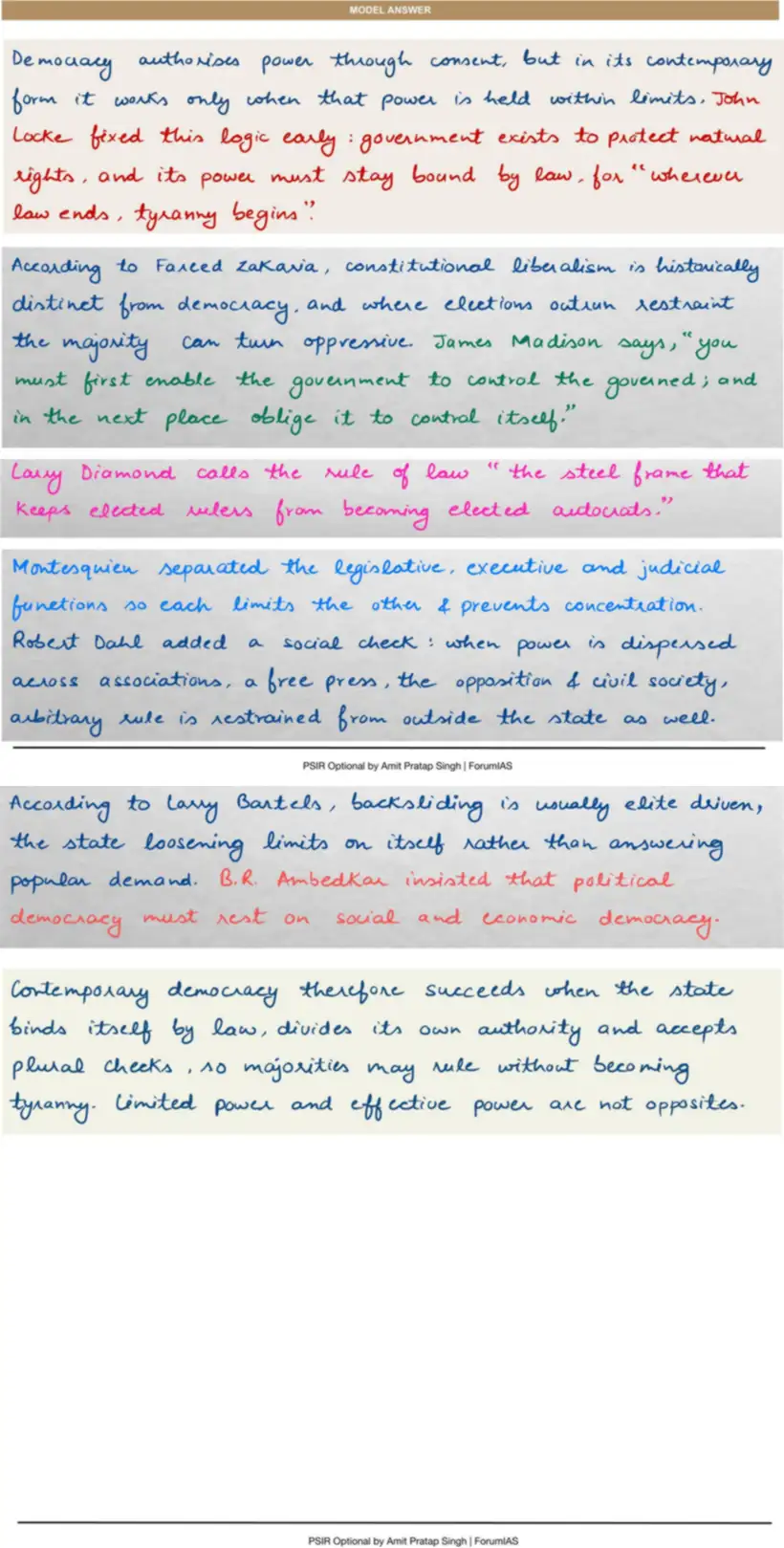
Model answer
Handwritten, in the form it would be written in the examination hall.
Also asked on this head
Democracy — 13 questions in the Vault.
- “Representative democracy is not an absolute principle, rather a question of time, place and circumstances.” Analyze the statement. Mention the major challenges to representative democracy.
- Substantive Democracy (150 words)
- The foundational base of western democracy has been
How this is taught
The same flow snapshot, built for every head of the syllabus, with the answer written in class.
The first session of Foundation 2027 is published in full.
Six programmes across three levels.