
How the answer moves
The flow snapshot — the routes in, the body, the counter-view and the routes out.
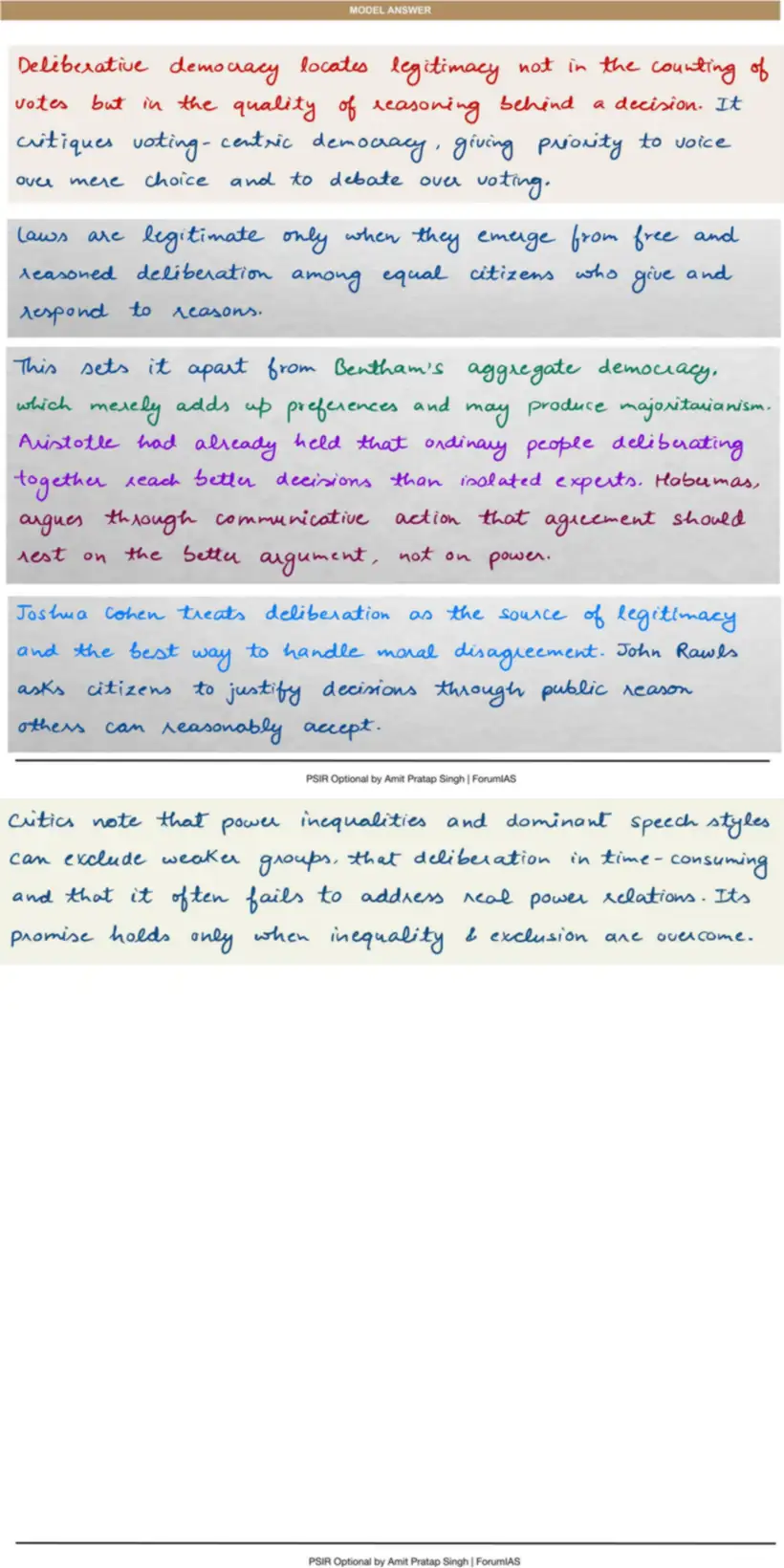
Route 1 legitimacy from quality of reasoning, not counting of votes → voice over choice, debate over voting
Route 2 democracy as reasoned judgement among free, equal citizens → laws valid only through free deliberation
reject Bentham’s aggregate democracy (sums preferences → majoritarianism) → Aristotle: collective deliberation beats isolated experts → Habermas: communicative action, better argument over power → Cohen: deliberation as legitimacy + handling moral disagreement → Rawls: public reason, reasons others can accept → qualitative participation → substantive democracy, informed citizens
power inequalities + dominant speech styles exclude weaker groups → time-consuming → fails to address real power relations
Route 1 reason, not numbers, makes democracy substantive
Route 2 promise holds only if inequality and exclusion are overcome
Model answer
Handwritten, in the form it would be written in the examination hall.
Also asked on this head
Democracy — 13 questions in the Vault.
- “Representative democracy is not an absolute principle, rather a question of time, place and circumstances.” Analyze the statement. Mention the major challenges to representative democracy.
- Substantive Democracy (150 words)
- The foundational base of western democracy has been
How this is taught
The same flow snapshot, built for every head of the syllabus, with the answer written in class.
The first session of Foundation 2027 is published in full.
Six programmes across three levels.