
How the answer moves
The flow snapshot — the routes in, the body, the counter-view and the routes out.
Route 1 legitimacy of public decisions rests on reasoned discussion, not vote-counting → Bessette’s term set against Bentham’s aggregate democracy → majoritarian drift
Route 2 question points to a manner of deciding → common concerns settled by citizens giving and weighing reasons
coercion-free dialogue as the core mechanism → Habermas: communicative action, better argument not power, ideal speech → Rawls: public reason, reasons others can accept → Cohen: reasons accessible to all → legitimacy + moral disagreement → quantity to quality → Gutmann & Thompson: mutually acceptable reasons → Sen: government by discussion checks unchecked power, curbs majoritarianism → deliberative devices (mini-publics, assemblies, polling) carry the ideal into practice
assumes reasonable, roughly equal citizens → power inequality distorts discussion → dominant speech styles → epistemic elite → Fraser: a single public sphere reproduces inequality → counter-publics for the marginalised
Route 1 deliberation makes democracy substantive → voice over choice, debate over voting
Route 2 promise to improve public decisions holds only where inclusion is real → exclusion actively addressed
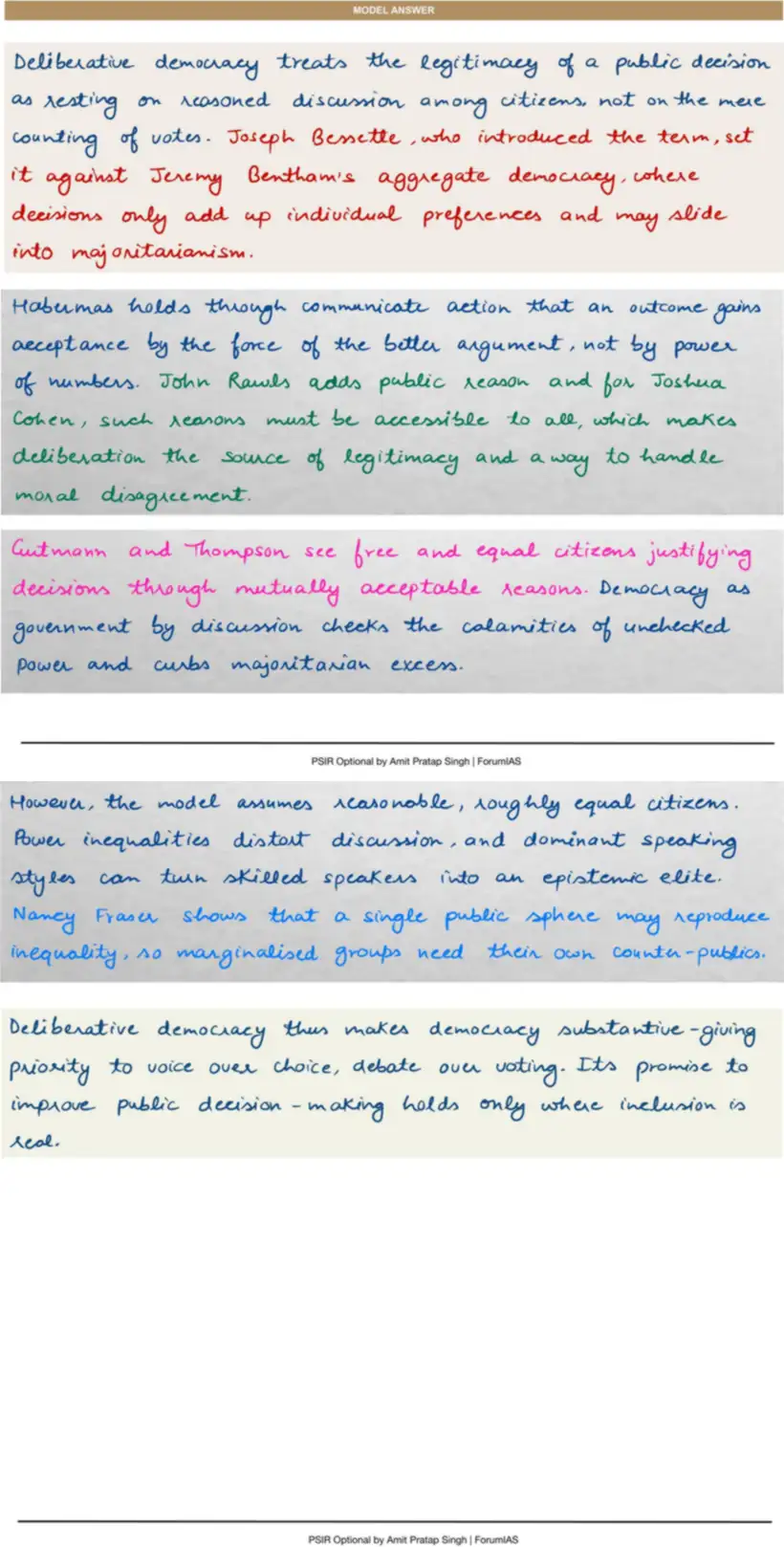
Model answer
Handwritten, in the form it would be written in the examination hall.
Also asked on this head
Democracy — 13 questions in the Vault.
- “Representative democracy is not an absolute principle, rather a question of time, place and circumstances.” Analyze the statement. Mention the major challenges to representative democracy.
- Substantive Democracy (150 words)
- The foundational base of western democracy has been
How this is taught
The same flow snapshot, built for every head of the syllabus, with the answer written in class.
The first session of Foundation 2027 is published in full.
Six programmes across three levels.