
How the answer moves
The flow snapshot — the routes in, the body, the counter-view and the routes out.
Route 1 Mill separates controlling the direction from running the government → representative democracy as the device for popular control of direction
Route 2 a whole people cannot govern directly → so they must command the direction → representation secures that command
Mill / Considerations → ideal form for a modern state → large society cannot decide directly → suffrage + elected representatives set broad direction, skilled hands execute → two tests of good government (virtue + intelligence; using people’s capacities) → control cannot stop at the ballot → local participation as “schools of political capacity” → expertise still needed → popular control of direction + expert conduct of detail → elections + accountability keep that control real
Schumpeter: only a contest for votes, no real control of policy → Rousseau: sovereignty cannot be represented, surrender forfeits command → Pateman & Barber: representation thins involvement, accountability fades between elections
Route 1 Mill’s line is a test, not just a description → representation is democratic only while the people steer the direction
Route 2 control captured by a powerful few → representation survives in form, lost in substance
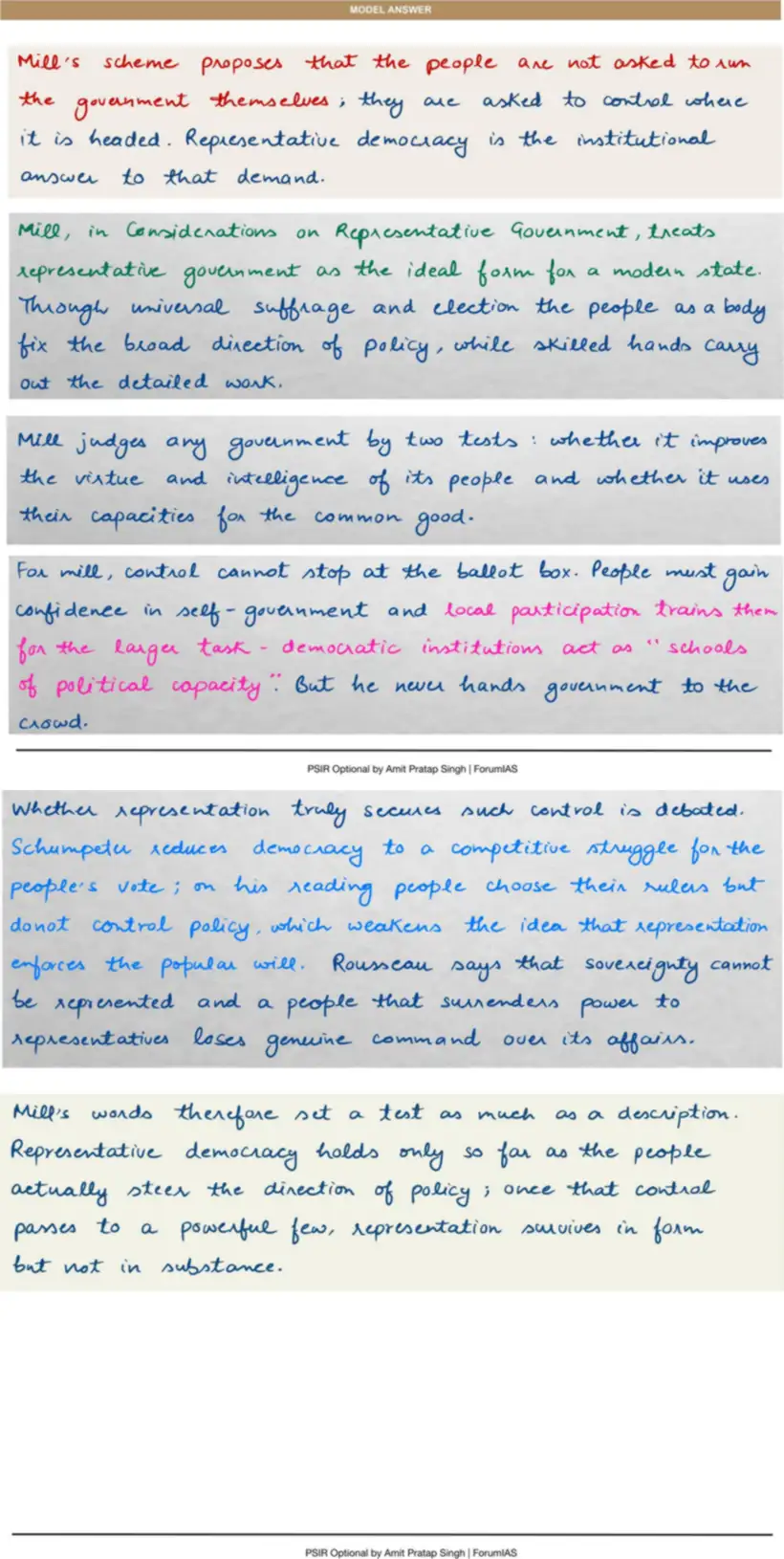
Model answer
Handwritten, in the form it would be written in the examination hall.
Also asked on this head
Democracy — 13 questions in the Vault.
- “Representative democracy is not an absolute principle, rather a question of time, place and circumstances.” Analyze the statement. Mention the major challenges to representative democracy.
- Substantive Democracy (150 words)
- The foundational base of western democracy has been
How this is taught
The same flow snapshot, built for every head of the syllabus, with the answer written in class.
The first session of Foundation 2027 is published in full.
Six programmes across three levels.