
Critically examine the Marxist aspect of political economy approach to the study of comparative politics.
How the answer moves
The flow snapshot — the routes in, the body, the counter-view and the routes out.
Route 1 locate Marxist strand inside political economy → politics read through economic structure + class → set against liberal market faith
Route 2 Marxist PE reads comparative development through mode of production, not markets → exploitation as the organising idea
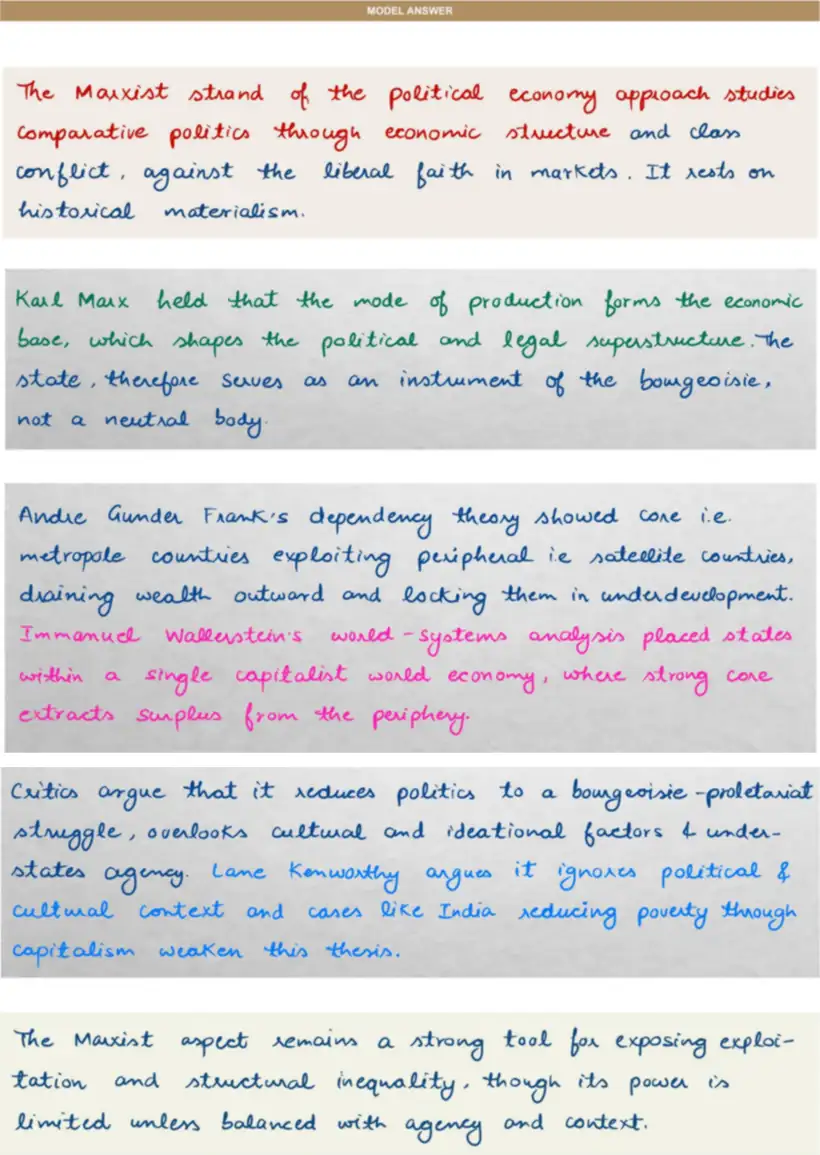
historical materialism → mode of production = economic base shapes political-legal superstructure → state as instrument of bourgeoisie (not neutral) → applied to uneven development across nations → Frank’s dependency (core/metropole drains periphery/satellite → underdevelopment) → Wallerstein’s world-systems (single capitalist world economy → core extracts surplus from periphery)
economic determinism → reduces politics to bourgeoisie–proletariat struggle → ignores culture/ideational factors + understates agency → Kenworthy: ignores political-cultural context + India’s poverty fall through capitalism weakens the thesis
Route 1 strong tool for exposing exploitation + structural inequality → but limited unless balanced with agency + context
Route 2 valuable diagnosis of global inequality → needs agency, culture, and empirical variation to complete it
Model answer
Handwritten, in the form it would be written in the examination hall.
Also asked on this head
Comparative Politics — 15 questions in the Vault.
- Extractive capitalism (150 words)
- Criticism of the institutional approach in comparative political analysis has come up in successive waves. Comment. (150 words)
- The modernization thesis asserts that affluence breeds stable democracy. How do you explain the success of India being the world’s largest democracy as an exceptional case?
How this is taught
The same flow snapshot, built for every head of the syllabus, with the answer written in class.
The first session of Foundation 2027 is published in full.
Six programmes across three levels.