
Explain the socio-economic impacts of arms race and identify the obstacles in the way of disarmament.
How the answer moves
The flow snapshot — the routes in, the body, the counter-view and the routes out.
Route 1 arms race = competitive acquisition + advancement of military capability → burden falls on economies and societies → yet weapons stay, because they are believed to buy security → disarmament stalls in that gap
Route 2 the Cold War priced the race: debt, welfare foregone, a collapsed USSR → yet no state surrendered the bomb → obstacle lies in what the bomb is thought to be worth, and in a regime the excluded call unequal
economic damage first → debt + dependency for arms importers → India–Pakistan missile competition → Reagan’s renewed nuclear race + SDI (1983), never realised → strain → collapse of the USSR → economy could not match capitalist living standards → social cost = what goes unspent → armaments money withheld from human welfare → world under a “balance of terror” → peak: Cuban Missile Crisis → hinge: Gavin — the race also built a deterrent that prevented direct superpower conflict; Waltz — nuclear weapons kept the Cold War “cold” → that belief is obstacle 1: no state gives up what it thinks keeps it safe → obstacle 2: the regime is itself unequal → Perkovich — India + Pakistan outside NPT, unrecognised as NWS → 1995 indefinite extension read as discriminatory → NWS resistance blocks CTBT + FMCT → 2017 ban treaty: no major nuclear power in it → verification hard → moral pressure fails on Iran / North Korea → China will not scrap its arsenal → Perkovich & Acton — weakened US umbrella → Japan + South Korea towards the bomb
Kissinger — deterrence assumes rational actors → the security defence relied on by every nuclear state is itself unsafe
Route 1 Simpson — universal + verifiable + non-discriminatory process → cost alone has never disarmed anyone → India’s No First Use shows restraint is possible → it spreads only when the excluded accept the order as equal
Route 2 the obstacle is political, not technical → verification can be engineered, equality cannot be faked → India’s No First Use as the model → Simpson’s three conditions as the way forward
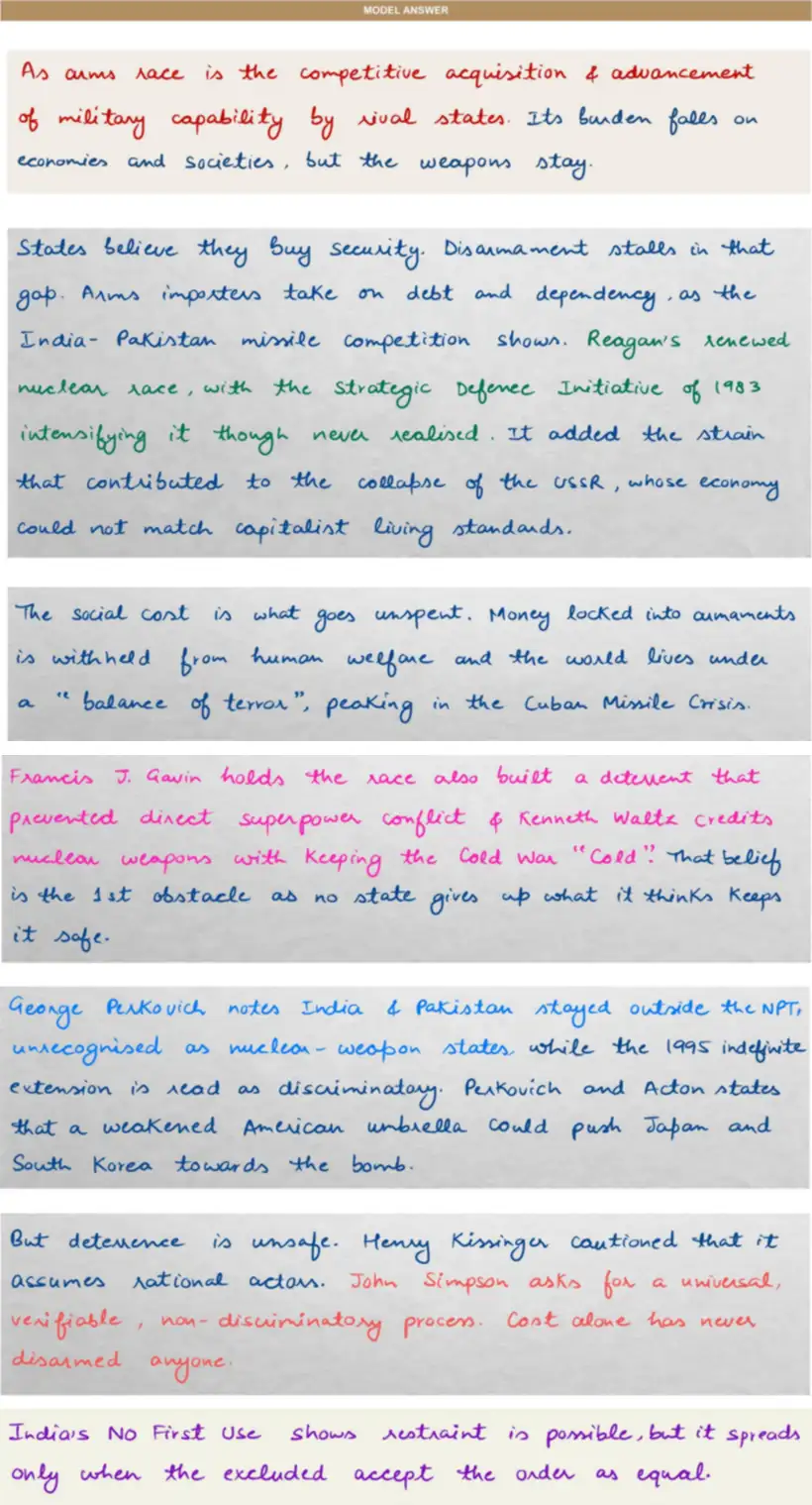
Model answer
Handwritten, in the form it would be written in the examination hall.
Also asked on this head
Changing International Political Order — 21 questions in the Vault.
- Does power transition theory reflect the dynamics of US-China relations?
- NATO, the oldest surviving collective security system, is facing challenge of transactional coercion from its own biggest member. What future does NATO have amidst such developments?
- The expansionist tendencies of the current Russian regime indicate its intentions for the realisation of a Greater Russia on the lines of the Soviet era. Comment....
How this is taught
The same flow snapshot, built for every head of the syllabus, with the answer written in class.
The first session of Foundation 2027 is published in full.
Six programmes across three levels.