
Discuss the various constraints on American hegemony today. Which of these are likely to become more prominent in the future?
How the answer moves
The flow snapshot — the routes in, the body, the counter-view and the routes out.
Route 1 hegemony ≠ military dominance alone → realist material base + Gramscian consent through ideas/institutions → both foundations under strain → spine: foundational constraints, not flashpoints, will grow
Route 2 start from the record: Iraq, Afghanistan 2021, Ukraine → force no longer enforces outcomes → so the real constraints sit in the material base and in consent → same spine
material constraint: China (technology, markets, value chains, since 2008) + Russia (Eastern Europe, Middle East) → limits of force (Iraq / Afghanistan / Ukraine) → economic constraint: Gilpin’s fragility (dollar, MNCs, nuclear weapons) → deficit spending + instability → de-dollarisation (China, Russia, India, Iran, Saudi Arabia) → institutional constraint: AIIB, NDB vs Bretton Woods → China’s weight in the UN system → ideational constraint: liberal order’s appeal weakened → Rapp-Hooper’s “alliance deficit”
not collapse → Ilhan: American pullback creates a “false perception” of multipolarity → neither Russia nor China is yet a peer competitor
Route 1 what grows is what touches the foundations: technology and supply chains, de-dollarisation, institutional competition → Taiwan and the Indian Ocean test the hegemon; a peer competitor can replace it
Route 2 constraints limit, they do not dismantle → adaptation, not collapse, settles the outcome (Zakaria)
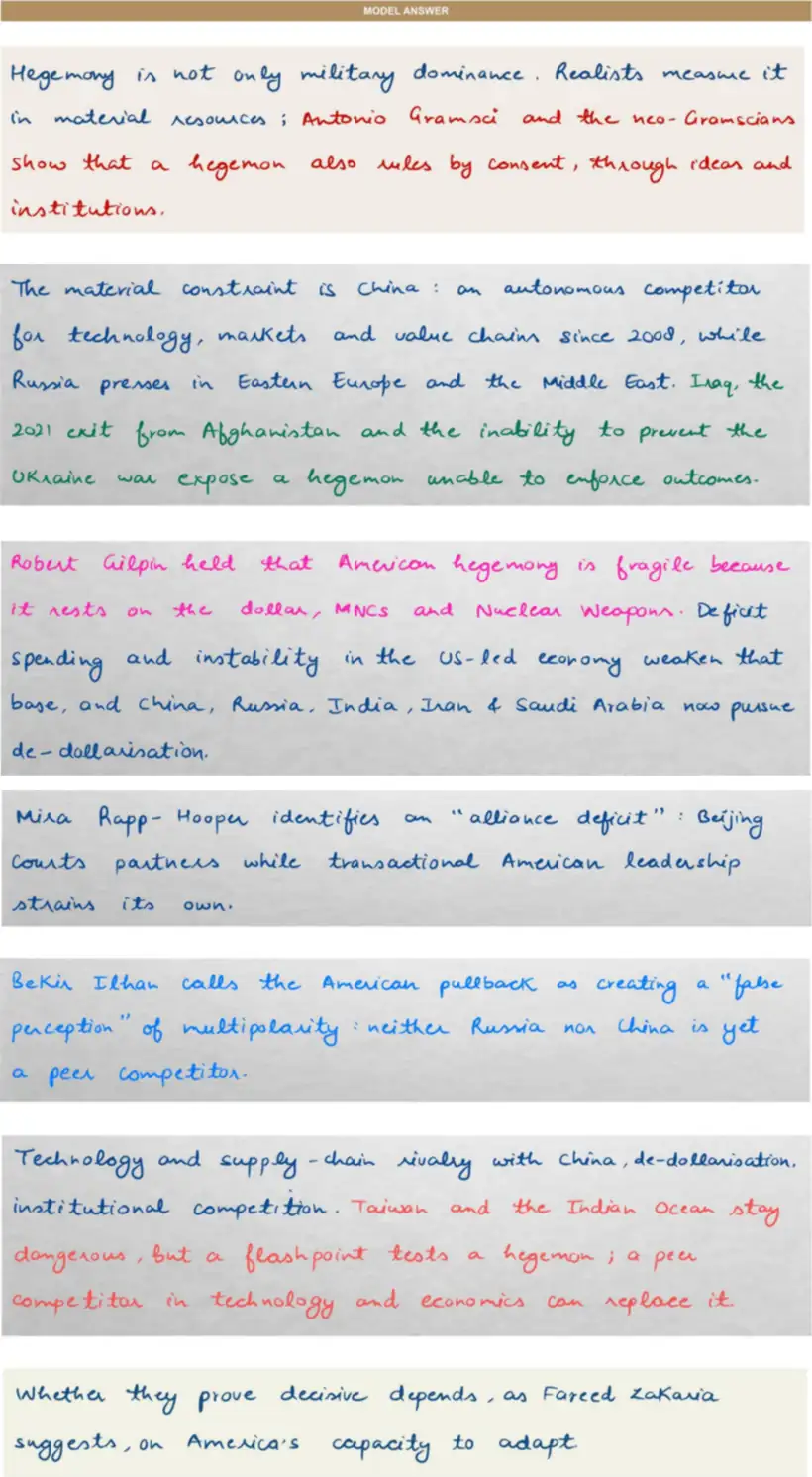
Model answer
Handwritten, in the form it would be written in the examination hall.
Also asked on this head
Changing International Political Order — 21 questions in the Vault.
- Does power transition theory reflect the dynamics of US-China relations?
- NATO, the oldest surviving collective security system, is facing challenge of transactional coercion from its own biggest member. What future does NATO have amidst such developments?
- The expansionist tendencies of the current Russian regime indicate its intentions for the realisation of a Greater Russia on the lines of the Soviet era. Comment....
How this is taught
The same flow snapshot, built for every head of the syllabus, with the answer written in class.
The first session of Foundation 2027 is published in full.
Six programmes across three levels.