
Discuss the consequences of Trump’s “America First” and Xi’s “Chinese Dream” on World Politics.
How the answer moves
The flow snapshot — the routes in, the body, the counter-view and the routes out.
Route 1 define both (America First, 2016: nationalist, unilateralist / Chinese Dream, 2013: national rejuvenation, return of the Middle Kingdom) → US steps back, China steps in → halves of one power transition
Route 2 the order’s architect retreats while its challenger advances → one process, not two → world politics reshaped but not settled
America First in practice (patriotism over globalism, UN 2018 → TPP abandoned → WTO dispute settlement blocked → JCPOA scrapped → allied burden-sharing) → Krauthammer / Wright: return of mercantilism → Chinese Dream in practice (China-centric globalisation: AIIB against Bretton Woods → BRI → A2/AD for regional hegemony) → East and South China Seas: territorial status quo and international law rejected → decline of Pax Americana → Allison: Thucydides Trap → balancing responses: Quad, Indo-Pacific, Cold War 2.0 → Chellaney: G-2 trap, forced choice for third states
China’s counter-claim: it is the status quo power, the US the real revisionist (decades of spreading liberalism and markets) → Ikenberry / Nye: this phase more complex than Cold War 1 — interdependence, not ideology
Route 1 Hass / Rapp-Hooper: no consensus on net impact → order reshaped, not settled
Route 2 the shape of the transition stays open → it turns on how the transition is managed
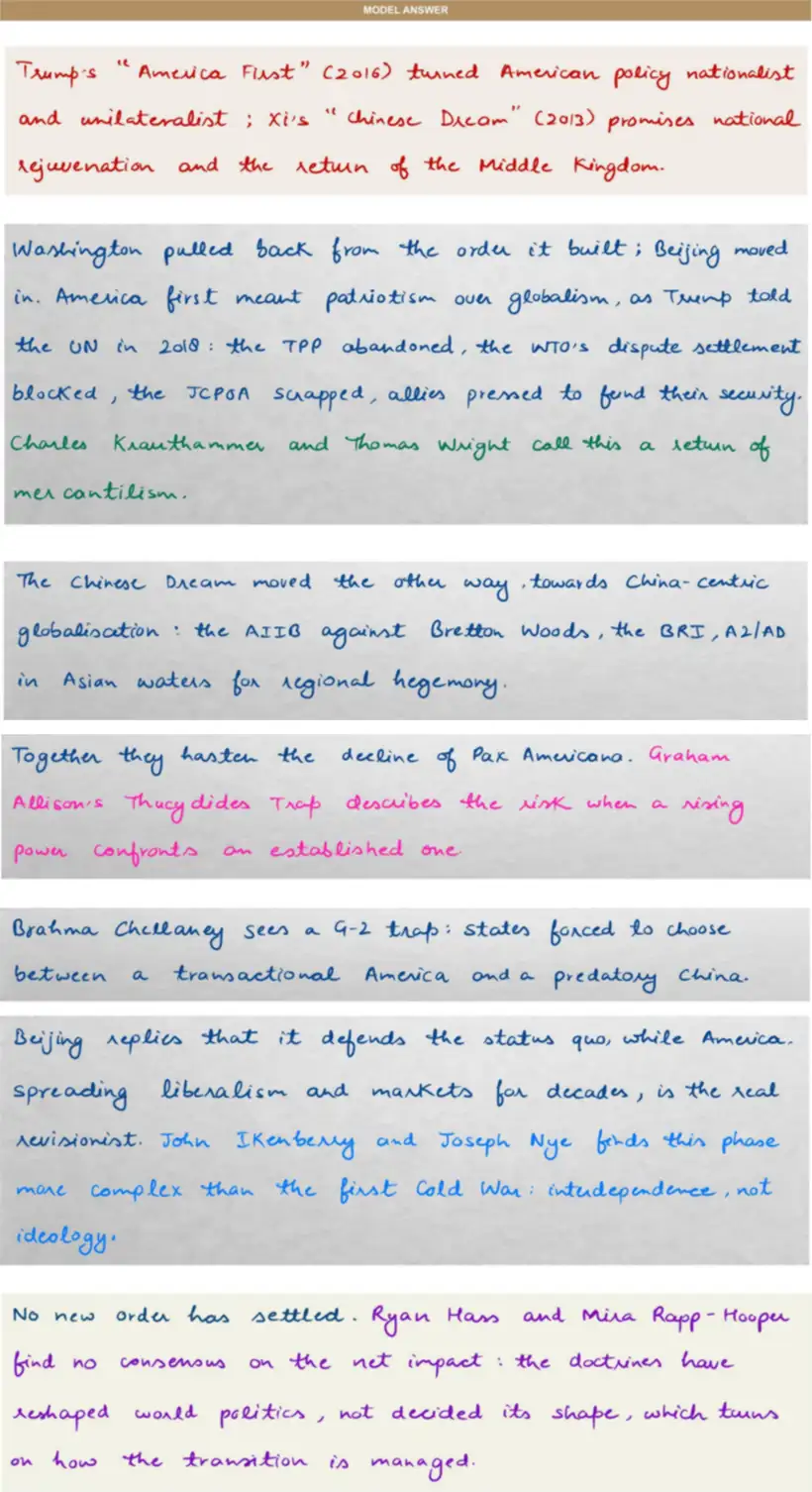
Model answer
Handwritten, in the form it would be written in the examination hall.
Also asked on this head
Changing International Political Order — 21 questions in the Vault.
- Does power transition theory reflect the dynamics of US-China relations?
- NATO, the oldest surviving collective security system, is facing challenge of transactional coercion from its own biggest member. What future does NATO have amidst such developments?
- The expansionist tendencies of the current Russian regime indicate its intentions for the realisation of a Greater Russia on the lines of the Soviet era. Comment....
How this is taught
The same flow snapshot, built for every head of the syllabus, with the answer written in class.
The first session of Foundation 2027 is published in full.
Six programmes across three levels.