
Do you endorse the view that the end of Bipolarity and the rise of multiple regional organisations has made
How the answer moves
The flow snapshot — the routes in, the body, the counter-view and the routes out.
Route 1 non-alignment ≠ neutrality (Schwarzenberger) → negative base: stay out of military alliances → positive base: independence of judgment (Belgrade, 1961) → the question’s two changes hit only the first base → endorse in part
Route 2 NAM born to escape two camps → camps gone, groupings multiplied → real question: was bloc-avoidance ever the whole of non-alignment? → endorse in part
the two bases → end of bipolarity empties the negative base → the positive base is untouched → Sreenivasan: freedom of judgment and action, valid whether one bloc or two → Paul: limited soft balancing, naming and shaming → partial credit for decolonisation, containing proliferation, easing bipolar tension → regional bodies work within regions; NAM’s field is the Global South, its work normative
Köchler: NAM fitted the bipolar era alone; objectives redundant; members lean on the US; no charter, statute or secretariat → G-7 / ASEAN / SCO / BRICS carry the economic agenda NAM never built → Raja Mohan: a movement in a “state of coma”
Route 1 structural charge sticks, irrelevance charge fails → Jaishankar: independence of action continues as strategic autonomy → less central, not irrelevant
Route 2 relevance has shifted, not ended → from bloc-avoidance to Global South voice and soft-balancing platform → “shifting and variable coalitions rather than settled alliances”
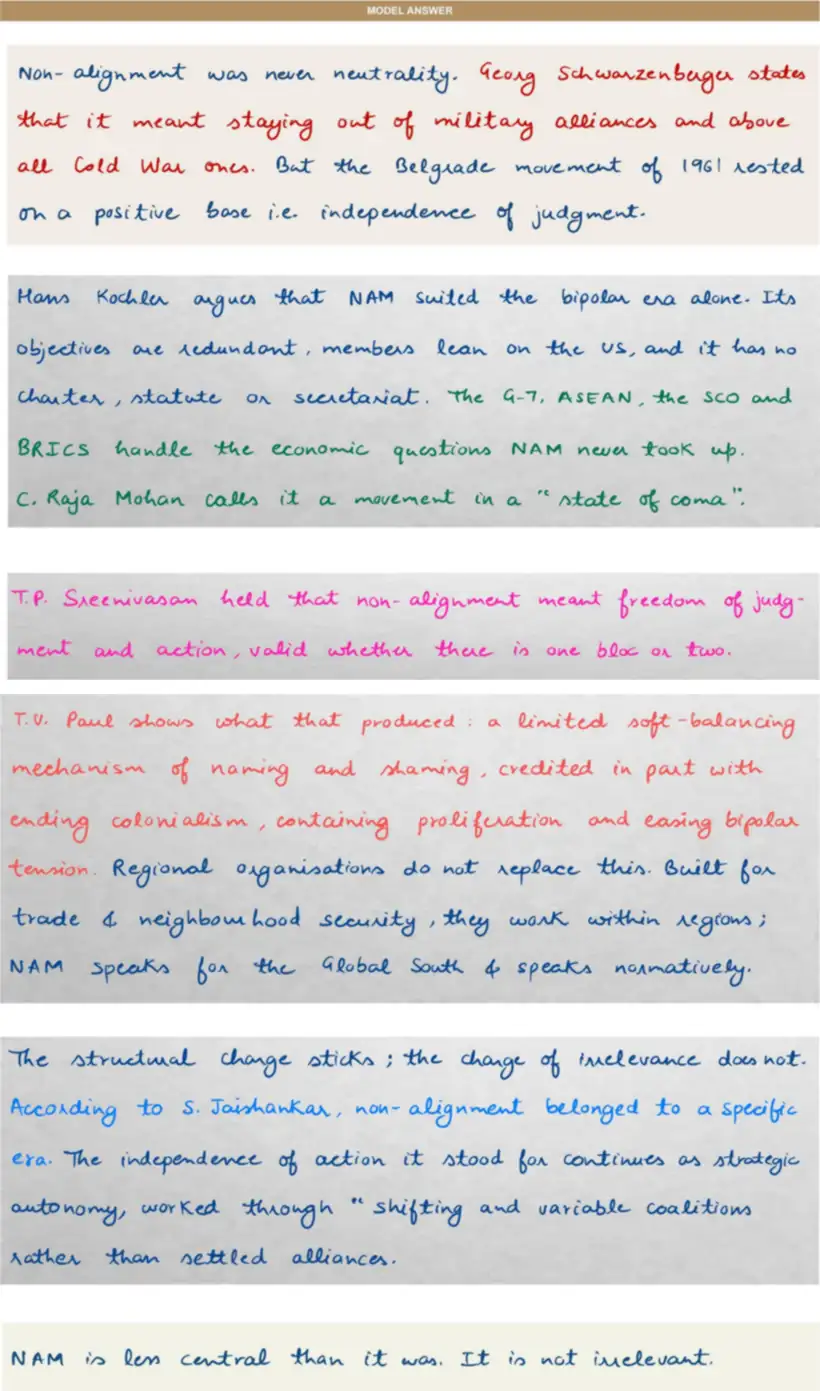
Model answer
Handwritten, in the form it would be written in the examination hall.
Also asked on this head
Changing International Political Order — 21 questions in the Vault.
- Does power transition theory reflect the dynamics of US-China relations?
- NATO, the oldest surviving collective security system, is facing challenge of transactional coercion from its own biggest member. What future does NATO have amidst such developments?
- The expansionist tendencies of the current Russian regime indicate its intentions for the realisation of a Greater Russia on the lines of the Soviet era. Comment....
How this is taught
The same flow snapshot, built for every head of the syllabus, with the answer written in class.
The first session of Foundation 2027 is published in full.
Six programmes across three levels.