
Critically examine the decline of the United States of America as a hegemon and its implications for the changing international political order.
How the answer moves
The flow snapshot — the routes in, the body, the counter-view and the routes out.
Route 1 hegemony = material dominance + consent → Gramsci: leadership by consent vs by force → verdict staked: decline real but partial → consent weakens faster than capability
Route 2 the peak was short (1989 → 2007-09 crash) → Gilpin’s fragile pillars → what cracked first is legitimacy, not capability
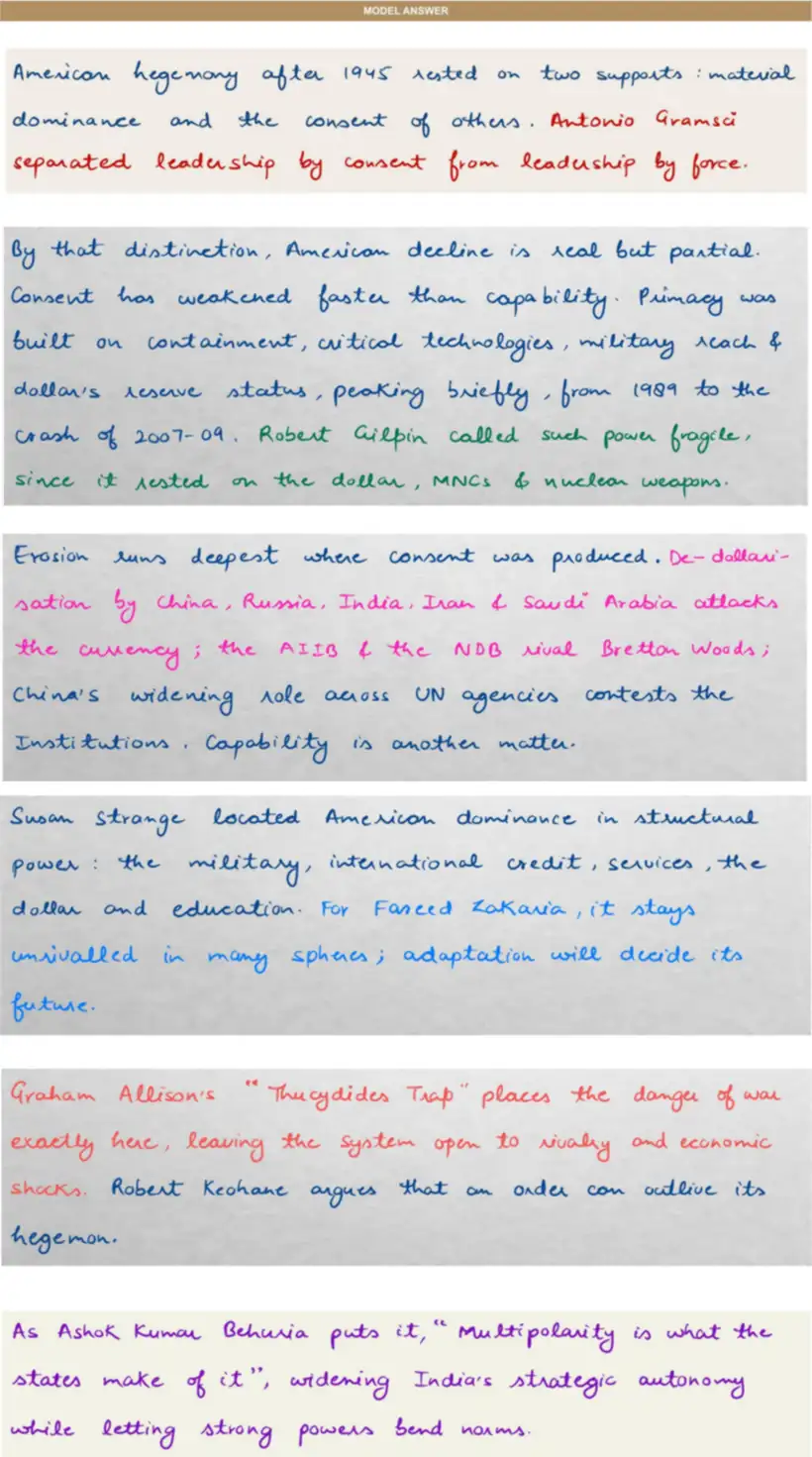
primacy built: containment / critical technologies / military reach / dollar’s reserve status → brief peak 1989–2007-09 → Gilpin: fragile pillars = dollar + MNCs + nuclear weapons → markers of decline: 9/11 → 2008 crisis (neoliberalism’s limits) → Afghanistan 2021 → Russia–Ukraine → erosion deepest at the consent pillar → de-dollarisation (China, Russia, India, Iran, Saudi Arabia) → AIIB / NDB rival Bretton Woods → China across UN agencies
capability is another matter → Strange: structural power (military, international credit, services, dollar, education) → Zakaria: still unrivalled in many spheres → adaptation, not collapse, decides the future
Route 1 no handover: West → Asia, unipolarity → multipolarity, no successor hegemon → Allison’s “Thucydides Trap” → order open to rivalry and economic shocks → Keohane: an order can outlive its hegemon
Route 2 Behuria: “Multipolarity is what the states make of it” → widened strategic autonomy for India → but room for strong powers to bend norms
Model answer
Handwritten, in the form it would be written in the examination hall.
Also asked on this head
Changing International Political Order — 21 questions in the Vault.
- Does power transition theory reflect the dynamics of US-China relations?
- NATO, the oldest surviving collective security system, is facing challenge of transactional coercion from its own biggest member. What future does NATO have amidst such developments?
- The expansionist tendencies of the current Russian regime indicate its intentions for the realisation of a Greater Russia on the lines of the Soviet era. Comment....
How this is taught
The same flow snapshot, built for every head of the syllabus, with the answer written in class.
The first session of Foundation 2027 is published in full.
Six programmes across three levels.