
Discuss the relevance of the normative ethos of the Non-Aligned Movement in magnifying India’s soft power in pursuit of her national interest.
How the answer moves
The flow snapshot — the routes in, the body, the counter-view and the routes out.
Route 1 Nye: soft power = attraction, not coercion → others follow because they admire the values → India’s attraction sourced in NAM’s normative ethos → ethos outlives the movement
Route 2 1947: no economic or military capability → values the only usable currency → non-alignment chosen as India’s instrument of influence
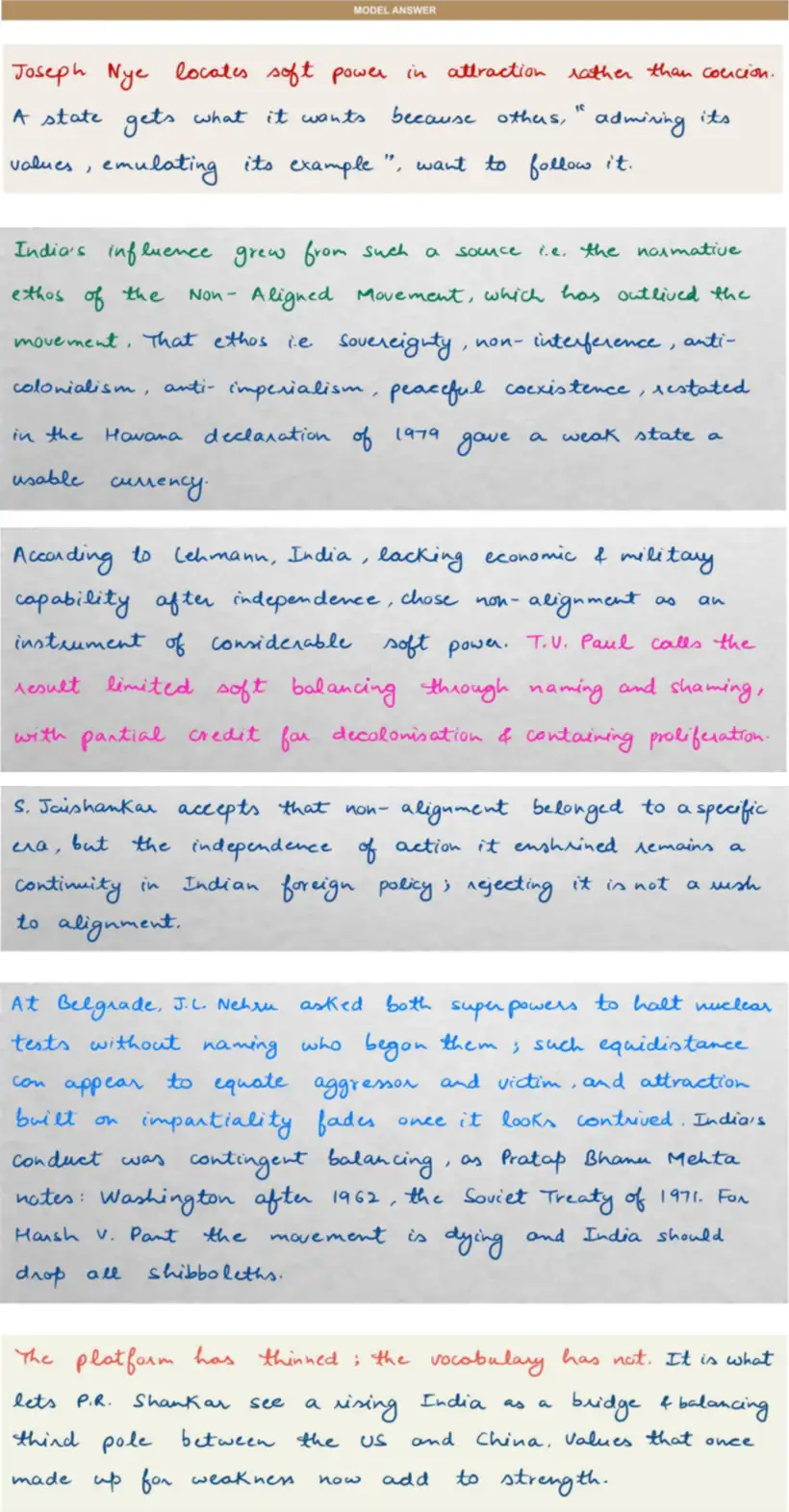
ethos named: sovereignty, non-interference, anti-colonialism, anti-imperialism, peaceful coexistence (Havana Declaration, 1979) → Lehmann: capability deficit → non-alignment as soft-power instrument → T. V. Paul: limited soft balancing, naming and shaming → partial credit: decolonisation, containing proliferation → ethos survives in new instruments → Jaishankar: era over, independence of action continues; rejection ≠ rush to alignment → reframed as strategic autonomy → legitimises balancing among major powers → South–South: ITEC, International Solar Alliance → anti-colonial memory becomes standing in the Global South
Nehru at Belgrade: tests condemned, initiator unnamed → equidistance can equate aggressor and victim → attraction fades once impartiality looks contrived → Mehta: contingent balancing — Washington after 1962, Soviet treaty of 1971 → Pant: movement dying, drop old shibboleths
Route 1 platform thinned, vocabulary intact → Shankar: bridge and balancing third pole between US and China → values that once made up for weakness now add to strength
Route 2 relevance shifts from organisation to ethos → strategic autonomy as non-alignment’s afterlife → soft power serves interest only while the values stay credible
Model answer
Handwritten, in the form it would be written in the examination hall.
Also asked on this head
Changing International Political Order — 21 questions in the Vault.
- Does power transition theory reflect the dynamics of US-China relations?
- NATO, the oldest surviving collective security system, is facing challenge of transactional coercion from its own biggest member. What future does NATO have amidst such developments?
- The expansionist tendencies of the current Russian regime indicate its intentions for the realisation of a Greater Russia on the lines of the Soviet era. Comment....
How this is taught
The same flow snapshot, built for every head of the syllabus, with the answer written in class.
The first session of Foundation 2027 is published in full.
Six programmes across three levels.