
Critically analyze the implications of Sino-American strategic rivalry for the south and south -east Asian region.
How the answer moves
The flow snapshot — the routes in, the body, the counter-view and the routes out.
Route 1 new bipolarity: economics + military weight, not ideology → main theatre = South & South-East Asia → real stake is autonomy, not war
Route 2 region sits between Chinese trade and American security → rivalry’s real question: can the choice be avoided → autonomy as the test
South China Sea as sharpest flashpoint (Vietnam, Philippines, Malaysia, Indonesia vs China; US freedom of navigation) → ASEAN refuses the choice (gains from both; ASEAN Way = consensus + non-interference → near neutrality) → Lee Hsien Loong: resident power vs reality on the doorstep → South Asia on the same logic (India–US + Quad vs BRI/CPEC) → India’s double bind (Raja Mohan: opportunity + challenge; land frontier after Galwan + Indian Ocean) → smaller states pay first (Chellaney: debt-trap diplomacy — Sri Lanka, Pakistan, Myanmar)
competition also brings courtship → US partnerships (Vietnam, Indonesia) give weight they otherwise lack → interdependence (Nye, Ikenberry) → rigid blocs unlikely → sharper danger is Chellaney’s G-2 trap: forced choice between a transactional America and a predatory China
Route 1 two futures: driver of peace and prosperity vs epicentre of turbulence
Route 2 outcome rests on middle powers holding strategic autonomy, not on Washington and Beijing alone
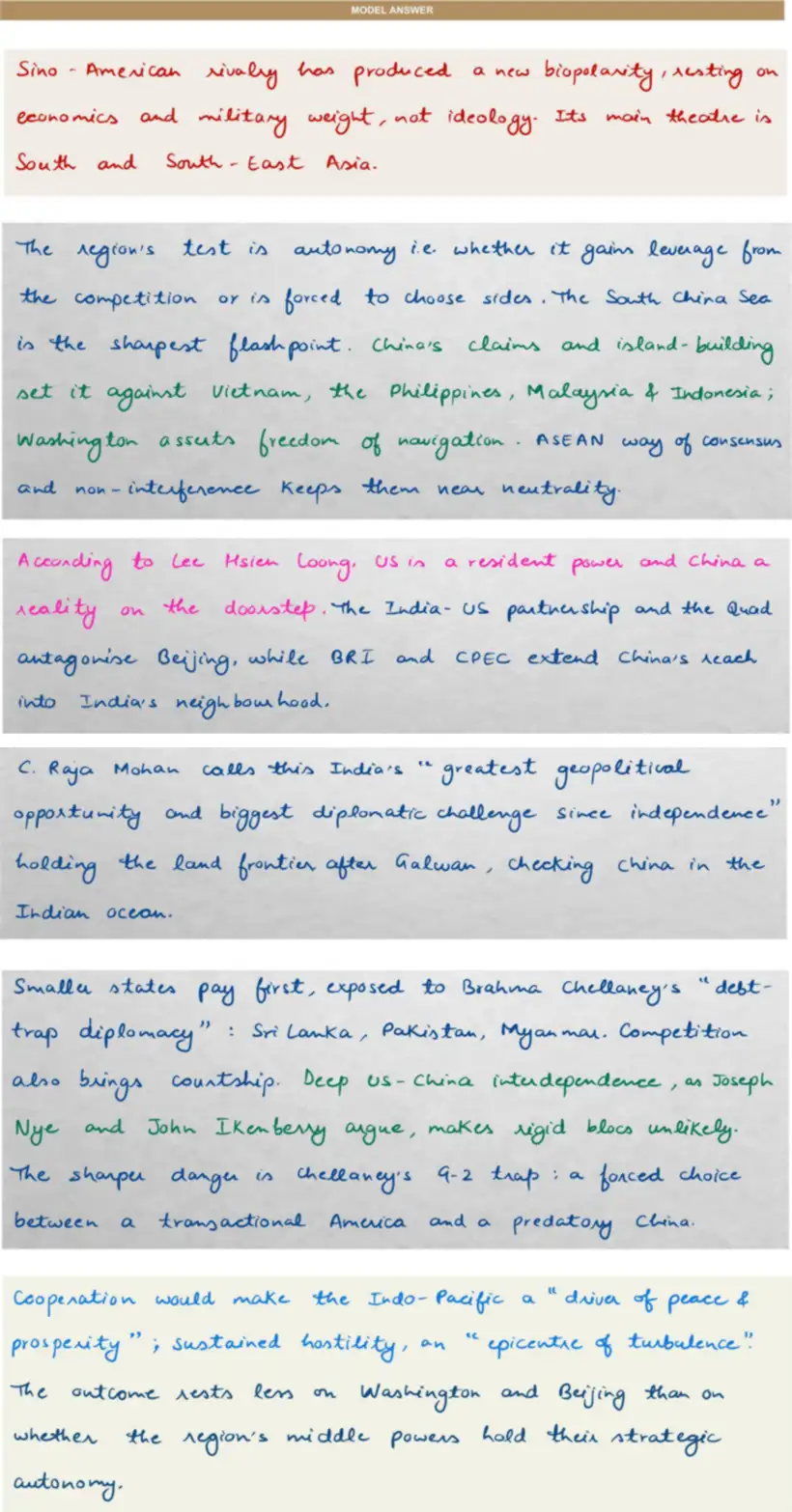
Model answer
Handwritten, in the form it would be written in the examination hall.
Also asked on this head
Changing International Political Order — 21 questions in the Vault.
- Does power transition theory reflect the dynamics of US-China relations?
- NATO, the oldest surviving collective security system, is facing challenge of transactional coercion from its own biggest member. What future does NATO have amidst such developments?
- The expansionist tendencies of the current Russian regime indicate its intentions for the realisation of a Greater Russia on the lines of the Soviet era. Comment....
How this is taught
The same flow snapshot, built for every head of the syllabus, with the answer written in class.
The first session of Foundation 2027 is published in full.
Six programmes across three levels.