
Discuss the ways to strengthen the Non-Aligned Movement (NAM) to enable it to address the challenges faced by the developing countries.
How the answer moves
The flow snapshot — the routes in, the body, the counter-view and the routes out.
Route 1 Cold War rationale gone → developing-world vulnerabilities remain (unequal trade, coercion, UN system they cannot shape) → machinery weak, founding idea intact → rebuild the surviving framework
Route 2 strengthening presupposes worth → critics (“coma”, “dying organisation”) vs defenders (soft balancing) → framework still functions → reshape and re-energise, not reinvent
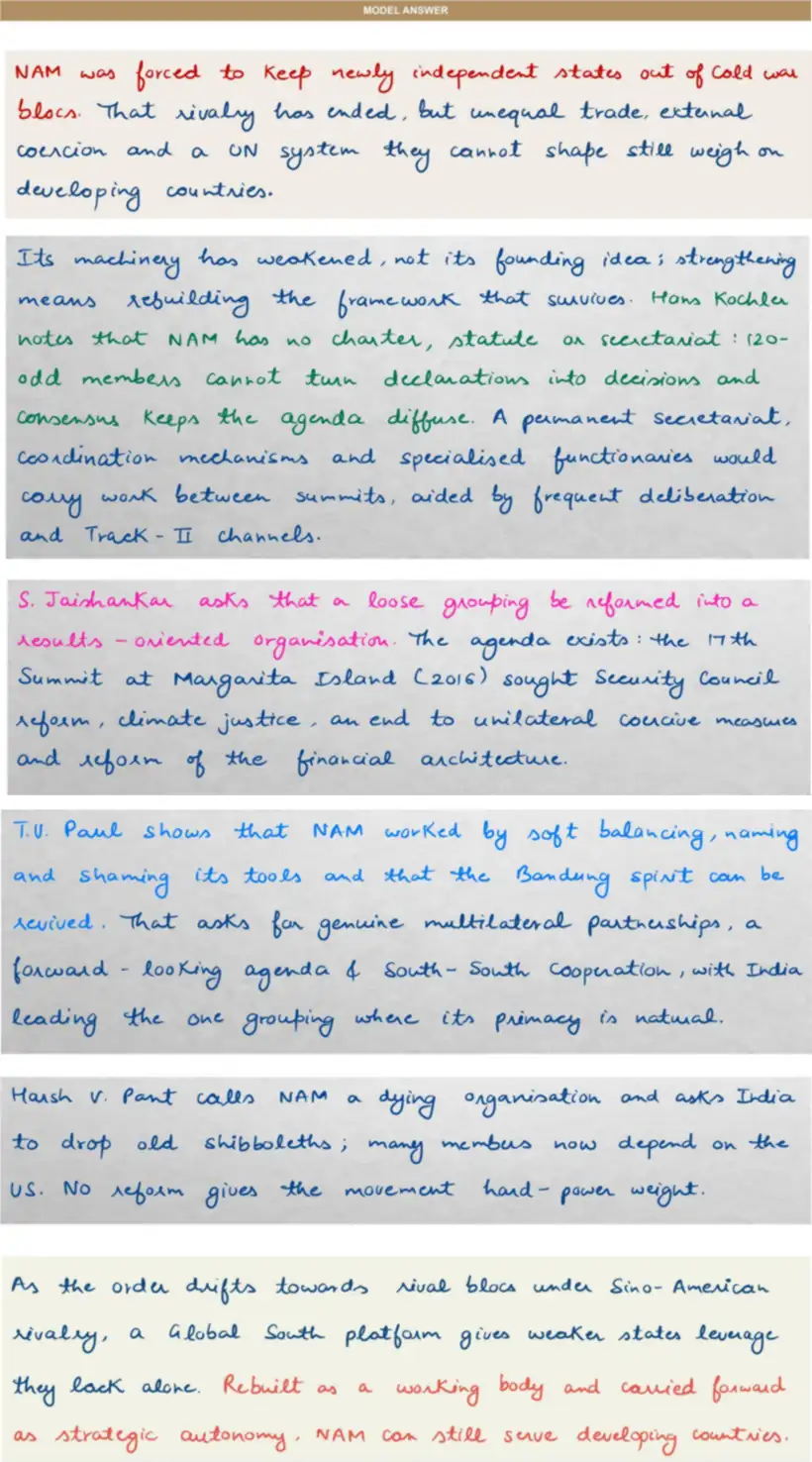
Repair 1, structural: Köchler — no charter / statute / secretariat → 120-odd members, declarations never become decisions → consensus → diffuse agenda → fix: permanent secretariat + coordination mechanisms + specialised functionaries + frequent deliberation / Track-II → Repair 2, method: Jaishankar — loose grouping → results-oriented organisation → agenda already exists (17th Summit, Margarita Island 2016: UNSC reform, climate justice, unilateral coercive measures, financial architecture) → delivery is the gap → Khanna — economic turn, North–South bridge, inequality binds members → Repair 3, political: Paul — soft balancing, naming and shaming, Bandung spirit revivable → multilateral partnerships + forward-looking agenda + South–South cooperation + India’s natural leadership
Pant — dying organisation, drop old shibboleths → members now depend on the US → no reform buys hard power
Route 1 order drifting towards rival blocs (Sino-American rivalry) → Global South platform = leverage weaker states lack alone → rebuilt body + strategic autonomy → serves developing countries
Route 2 never a third pole of power → but a repaired platform: structure, delivery, South–South economics → autonomy preserved in a bloc-forming order
Model answer
Handwritten, in the form it would be written in the examination hall.
Also asked on this head
Changing International Political Order — 21 questions in the Vault.
- Does power transition theory reflect the dynamics of US-China relations?
- NATO, the oldest surviving collective security system, is facing challenge of transactional coercion from its own biggest member. What future does NATO have amidst such developments?
- The expansionist tendencies of the current Russian regime indicate its intentions for the realisation of a Greater Russia on the lines of the Soviet era. Comment....
How this is taught
The same flow snapshot, built for every head of the syllabus, with the answer written in class.
The first session of Foundation 2027 is published in full.
Six programmes across three levels.