
Bipolar structure of the world is more stable than the multipolar one. Comment.
How the answer moves
The flow snapshot — the routes in, the body, the counter-view and the routes out.
Route 1 polarity = distribution of power → statement is neorealist → Cold War appears to prove it → set the test: the structure, or the weapons the poles carried?
Route 2 1945–91: no great-power war → 1914 and 1939: multipolar systems collapsed into war → record looks decisive → but ask what actually held the peace
Waltz (1979): bipolarity most stable — national interests align with bloc interests, two powers leave little room for miscalculation → Mearsheimer puts it in reverse: “back to the future” after 1991, both World Wars grew from multipolar systems, fluid balances let ambitious powers expand → Gaddis: the result was the “Long Peace”
classical realists read the same record differently → Morgenthau + Carr: multipolarity more stable — alliances balance, limited wars threaten no one directly → two rigid blocs make every dispute zero-sum → Berlin, Cuba: that calm could turn nuclear
Route 1 Waltz himself credits nuclear weapons with keeping the war cold → discipline came from deterrence and crisis management → no structure supplies that alone → bipolarity narrows conflict; peace still has to be managed
Route 2 true as description (fewer war-triggers), weak as a law of peace → today’s US–China “new bipolarity” carries deep interdependence and behaves nothing like the first → stability follows statecraft, not the count of poles
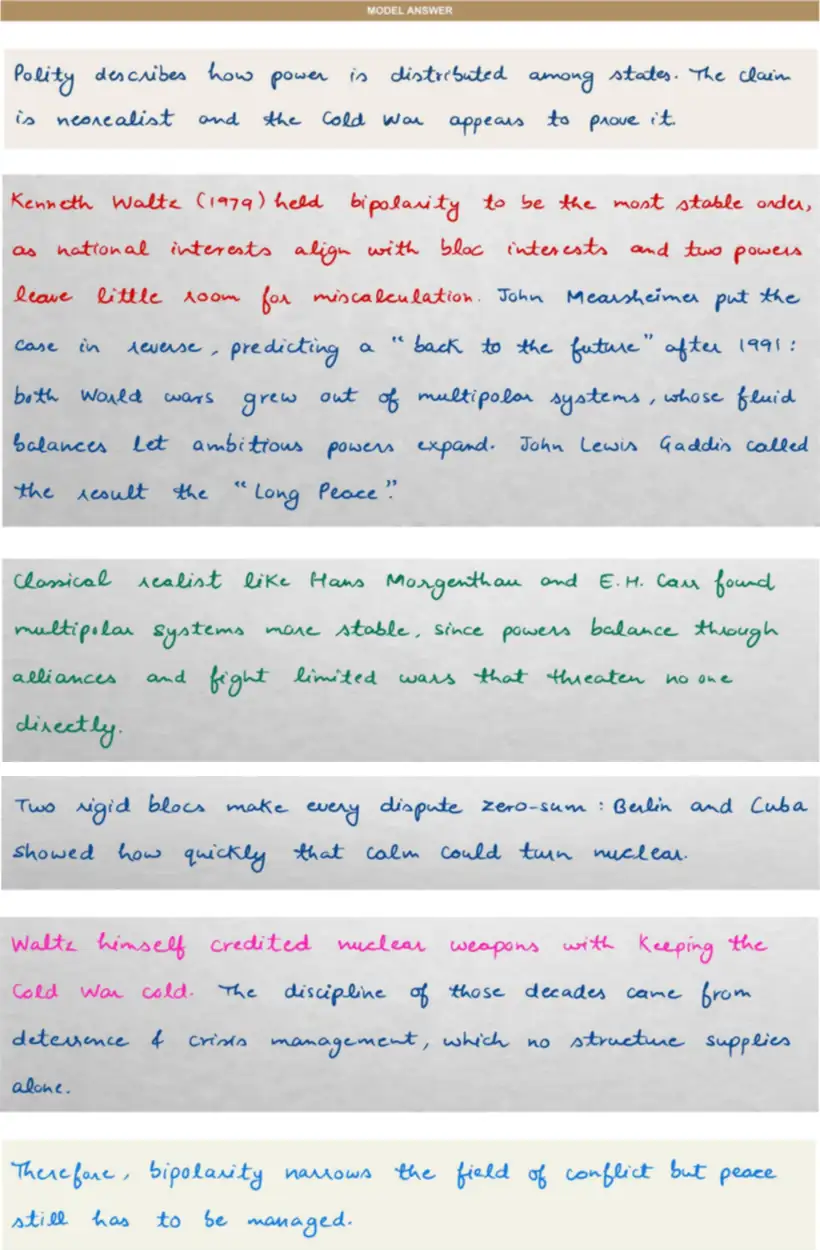
Model answer
Handwritten, in the form it would be written in the examination hall.
Also asked on this head
Changing International Political Order — 21 questions in the Vault.
- Does power transition theory reflect the dynamics of US-China relations?
- NATO, the oldest surviving collective security system, is facing challenge of transactional coercion from its own biggest member. What future does NATO have amidst such developments?
- The expansionist tendencies of the current Russian regime indicate its intentions for the realisation of a Greater Russia on the lines of the Soviet era. Comment....
How this is taught
The same flow snapshot, built for every head of the syllabus, with the answer written in class.
The first session of Foundation 2027 is published in full.
Six programmes across three levels.