
Russian-Ukraine crisis has cast a dark shadow on the energy needs of the member states of the European Union (EU). Comment.
How the answer moves
The flow snapshot — the routes in, the body, the counter-view and the routes out.
Route 1 EU born from energy → Treaty of Paris 1951, coal + steel, war “materially impossible” → Mitrany’s functional interdependence → 2022 flips that founding strength into weakness /
Route 2 pre-war energy map: ~40% of imported gas, about a third of total energy from Russia → an asymmetric dependence sitting at the centre of EU energy needs → the crisis exposed it
founding bond (energy = peace) → dependence (40% gas / one-third energy) → coercion (exports curtailed, Nord Stream 1 offline) → price surge + supply insecurity → why Russia moved: Mearsheimer (NATO expansion) vs Sakwa (great-power reassertion), same energy bill for Europe → IEA: “first truly global energy crisis” → uneven exposure (Germany, Finland, Latvia, smaller states) → cohesion tested, not only economies → common answer: ~15% gas demand cut → diversification (US LNG scaled up; spare cargoes freed by China’s lower LNG imports) → acceleration (renewables, heat pumps, demand reduction)
the shadow is not total → coercion pushed the EU faster than the Green Deal alone had managed → but the cure carries its own cost → return to coal and nuclear against the net-zero 2050 promise
Route 1 interdependence inside the union = peace; asymmetric dependence outside it = leverage → IEA: damage lasting years → shadow real and long → diverse energy mix + strategic energy security /
Route 2 the shock did what the Green Deal alone could not → the crisis ends a dependence the union should never have carried → energy security, not cheaper gas, is the lasting lesson
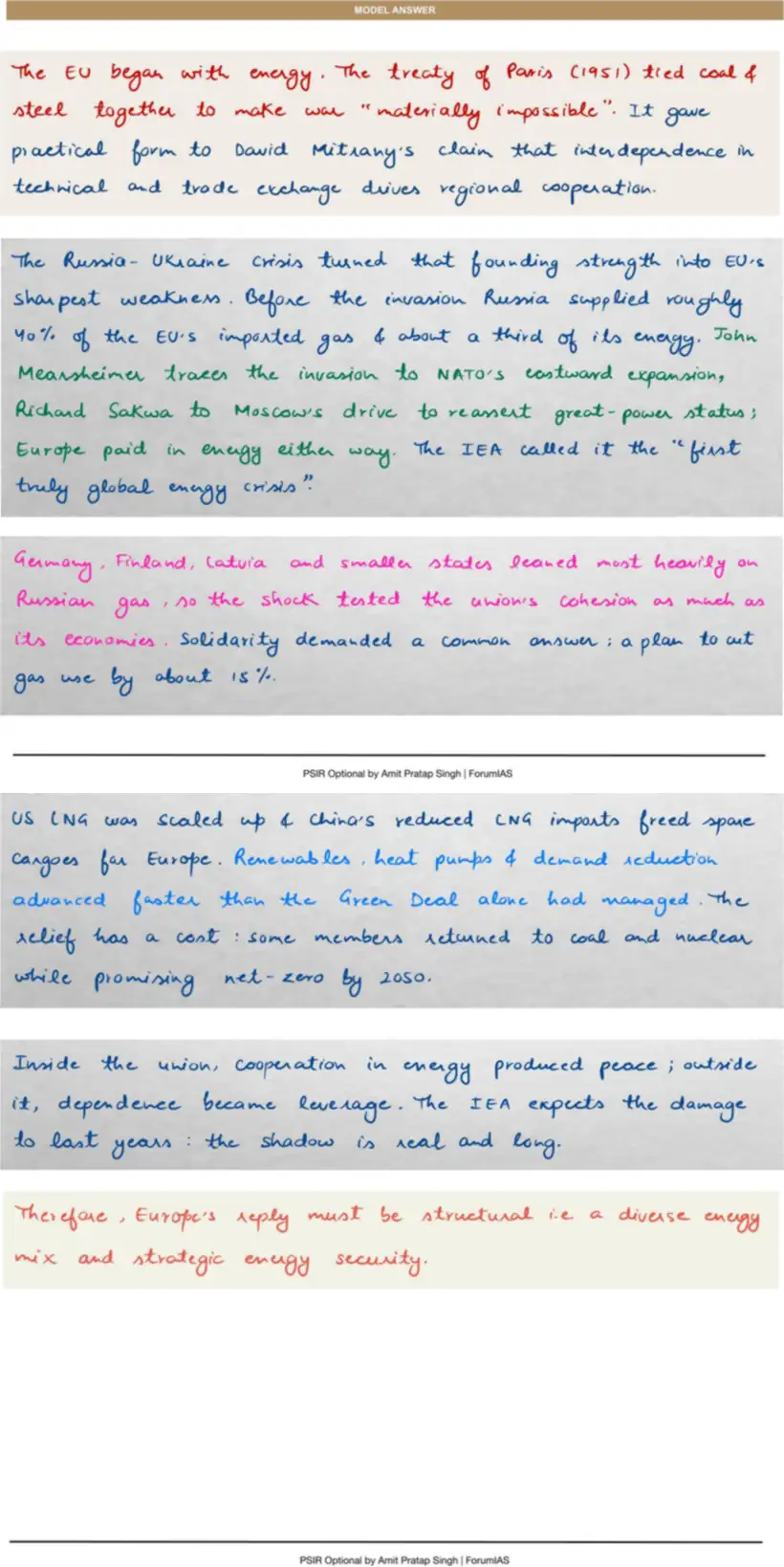
Model answer
Handwritten, in the form it would be written in the examination hall.
Also asked on this head
Regionalisation of World Politics — 14 questions in the Vault.
- QUAD requires more robust architecture than the summit driven mode to tide over the current challenges. Elaborate.
- Explain the success of ASEAN as a regional organisation.
- American President Donald Trump’s proposal to withdraw from the ‘NAFTA’ would bring unforeseen consequences to the regionalisation of world politics. Elaborate. (150 words)
How this is taught
The same flow snapshot, built for every head of the syllabus, with the answer written in class.
The first session of Foundation 2027 is published in full.
Six programmes across three levels.