
Critically analyse the role of ASEAN in the promotion of regional peace and security through economic cooperation and trade.
How the answer moves
The flow snapshot — the routes in, the body, the counter-view and the routes out.
Route 1 Mitrany’s “philosophy of peace” = the premise the question tests → ASEAN reverses it → politics settled before economics /
Route 2 Bangkok Declaration 1967 = Cold War security front, not a trade bloc → trade widened a peace norms had already created → could not secure it alone
ASEAN Way (consensus, non-interference, sovereignty) → ZOPFAN 1971 + TAC 1976 → no inter-member war → Fisher: “Balkans of Asia” → zone of peace → Acharya: norm localisation + norm subsidiarity → AFTA 1992 → AEC single market & production base → Keohane: interdependence raises cost of conflict → big economies outside → trade turned outward: ARF, ASEAN Plus Three, EAS, RCEP → APSC Blueprint 2015
no Haas spillover → ASEAN stays intergovernmental → non-tariff barriers, low intra-ASEAN trade → consensus stalls on South China Sea and Myanmar after the 2021 coup → wider engagement pulls US–China rivalry in
Route 1 Mahbubani & Sng, The ASEAN Miracle: A Catalyst for Peace → potential holds even under power politics → too early to write off the record /
Route 2 trade widened the zone of peace, consultation keeps it → economics is the instrument of ASEAN’s security order, norms are its foundation
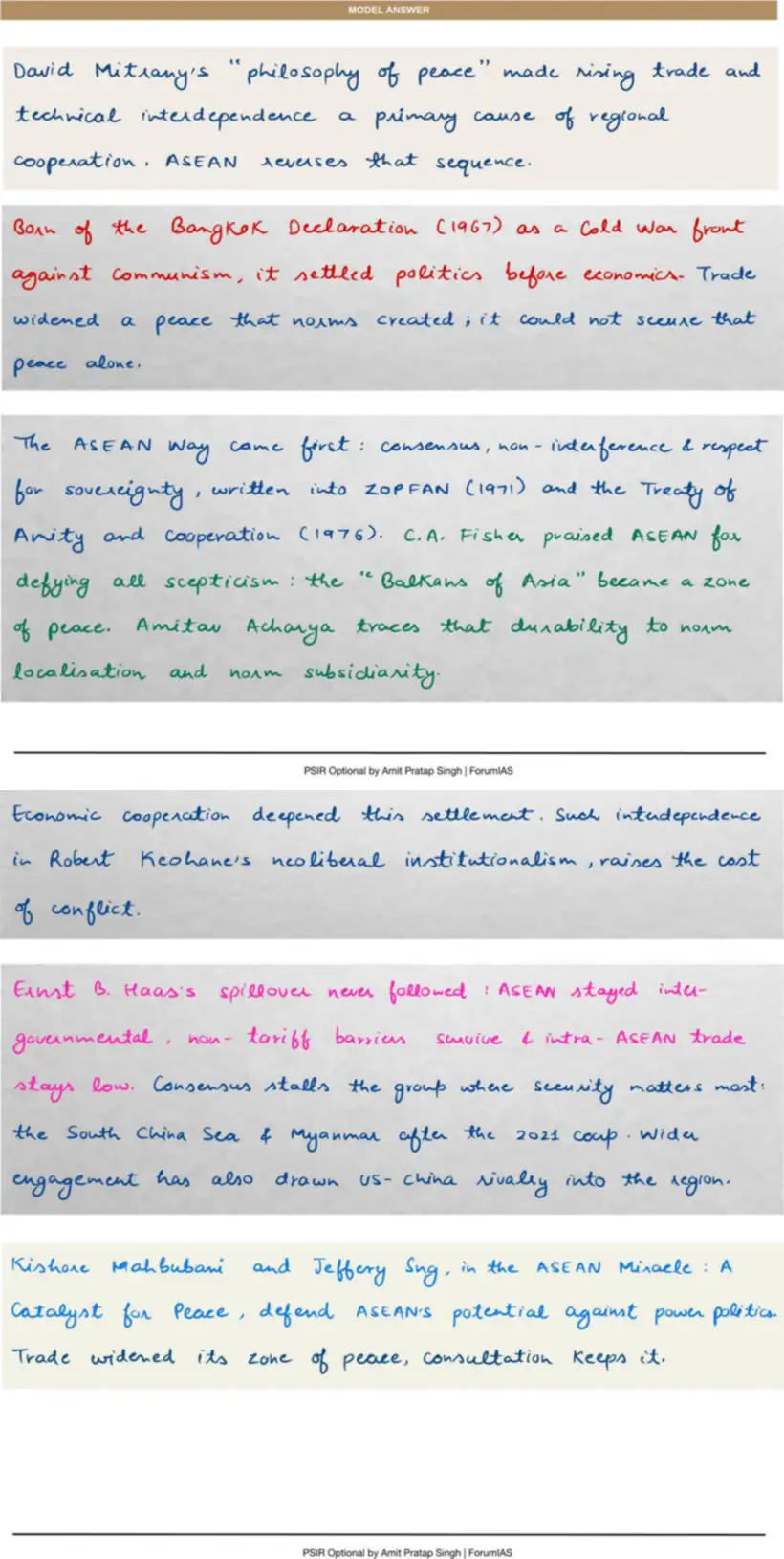
Model answer
Handwritten, in the form it would be written in the examination hall.
Also asked on this head
Regionalisation of World Politics — 14 questions in the Vault.
- QUAD requires more robust architecture than the summit driven mode to tide over the current challenges. Elaborate.
- Explain the success of ASEAN as a regional organisation.
- American President Donald Trump’s proposal to withdraw from the ‘NAFTA’ would bring unforeseen consequences to the regionalisation of world politics. Elaborate. (150 words)
How this is taught
The same flow snapshot, built for every head of the syllabus, with the answer written in class.
The first session of Foundation 2027 is published in full.
Six programmes across three levels.