
How has ‘BREXIT’ affected the regionalisation process initiated by European Union and what could be its likely impacts in the regionalisation process of world politics?
How the answer moves
The flow snapshot — the routes in, the body, the counter-view and the routes out.
Route 1 EU as deepest integration → Haas’s spillover expectation → Britain’s 2016 vote moves the other way → cost without refutation; terms of regionalism change /
Route 2 Brexit as the first live test of pooled sovereignty → scale and confidence lost inside Europe → example carried outward
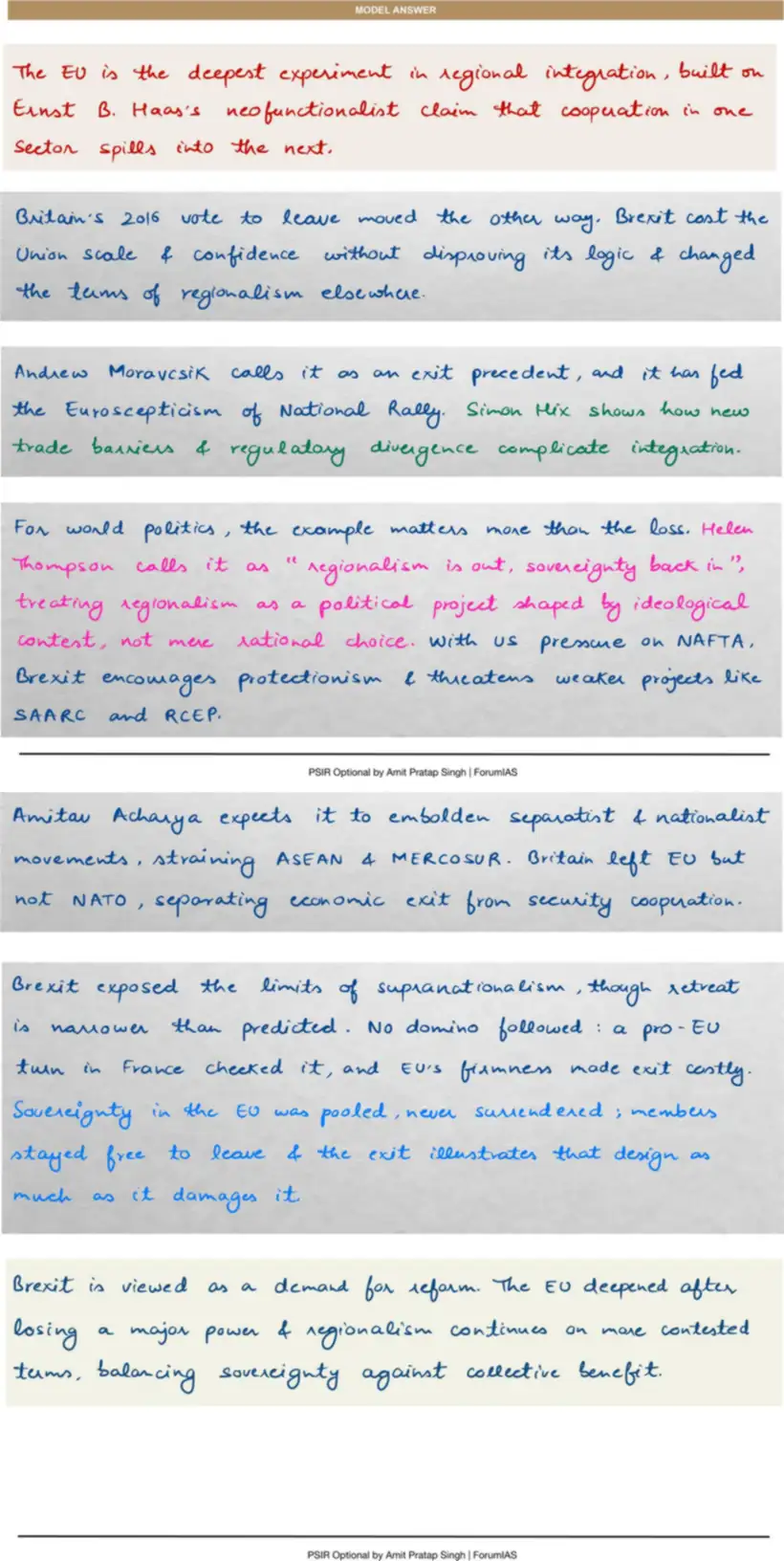
loss of a major economy and political player → collective strength weakened → Moravcsik: exit precedent → Euroscepticism (National Rally, AfD) → Hix: new trade barriers + regulatory divergence complicate integration → turn outward: example matters more than the loss → Thompson: “regionalism is out, sovereignty back in”; regionalism as ideological contest, not rational choice → with US pressure on NAFTA → protectionism encouraged → weaker projects exposed (SAARC, RCEP) → Acharya: separatist / nationalist movements emboldened → ASEAN, MERCOSUR strained → out of the EU but not NATO → economic regionalism separable from security
limits of supranationalism real, but retreat narrower than predicted → no domino; pro-EU turn in France → EU firmness makes exit costly → sovereignty pooled, never surrendered; members always free to leave → exit illustrates the design as much as it damages it
Route 1 Brexit as a demand for reform → EU deepened after losing a major power /
Route 2 regionalism continues, on more contested terms → sovereignty balanced against collective benefit
Model answer
Handwritten, in the form it would be written in the examination hall.
Also asked on this head
Regionalisation of World Politics — 14 questions in the Vault.
- QUAD requires more robust architecture than the summit driven mode to tide over the current challenges. Elaborate.
- Explain the success of ASEAN as a regional organisation.
- American President Donald Trump’s proposal to withdraw from the ‘NAFTA’ would bring unforeseen consequences to the regionalisation of world politics. Elaborate. (150 words)
How this is taught
The same flow snapshot, built for every head of the syllabus, with the answer written in class.
The first session of Foundation 2027 is published in full.
Six programmes across three levels.