
What were the limitations of NAFTA? How did its replacement by the United States-Mexico-Canada Agreement counter them? Explain.
How the answer moves
The flow snapshot — the routes in, the body, the counter-view and the routes out.
Route 1 NAFTA 1994, first pact of two developed states with an emerging-market economy → as trade policy it worked ($290 bn 1993 → $1.1 tn 2016) → limits lay in what it left unregulated → USMCA = rules written into the same market /
Route 2 NAFTA’s record was two-sided → trade surged, jobs and wages did not (Scott) → the gap was regulatory, not commercial → USMCA rewrote the terms to close it
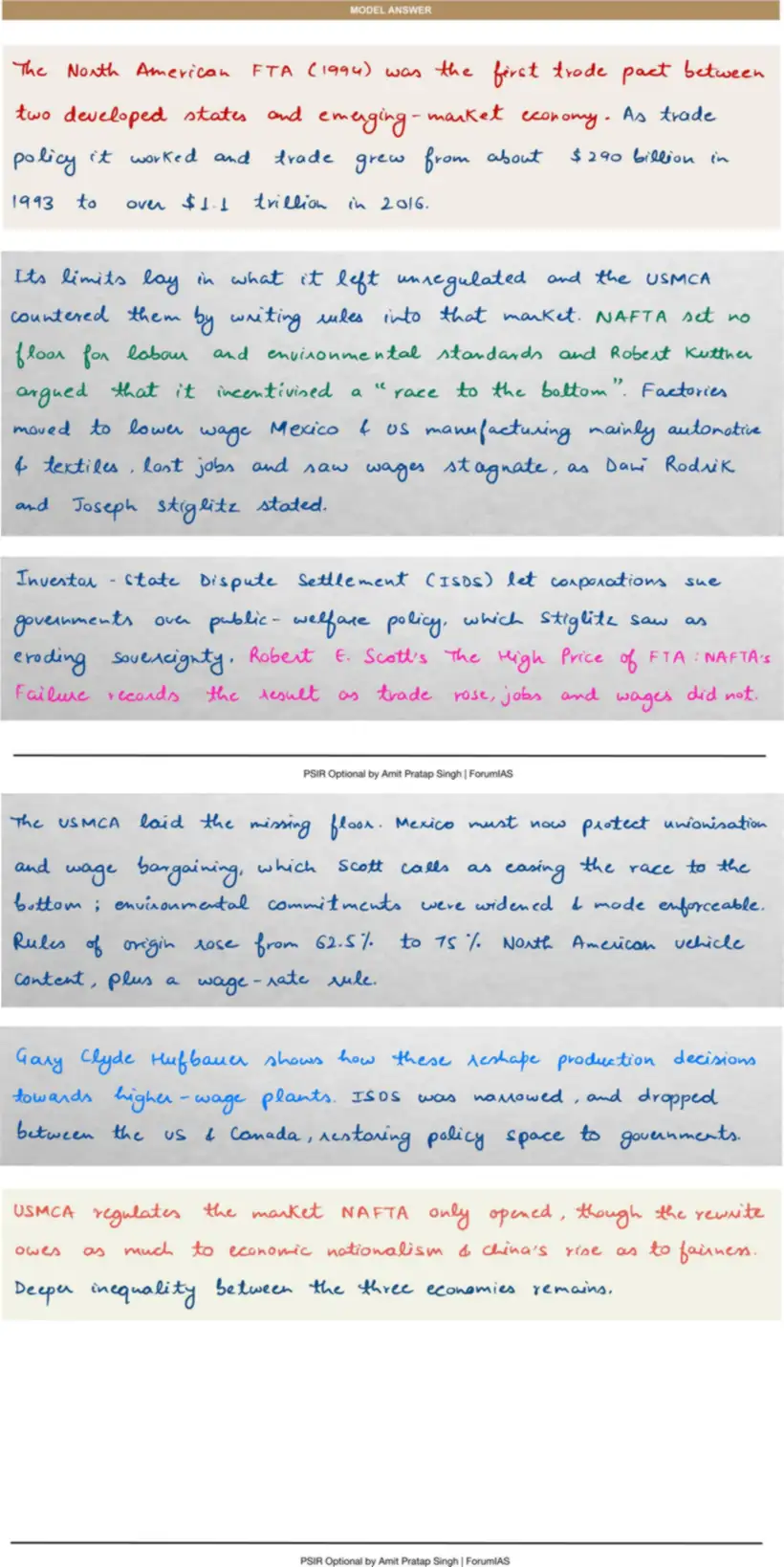
no floor for labour/environment → Kuttner, “race to the bottom” → production follows the incentive → factories to lower-wage Mexico → US job losses + wage stagnation (Rodrik, Stiglitz) → ISDS lets firms sue governments over public-welfare policy → sovereignty eroded (Stiglitz) → Scott, The High Price of Free Trade → verdict: trade rose, jobs/wages did not → USMCA lays the missing floor (Mexican unionisation + wage bargaining; Scott: eases the race to the bottom) → environment widened + enforceable → rules of origin 62.5% → 75% + wage-rate rule → production steered to higher-wage plants (Hufbauer) → ISDS narrowed, dropped US–Canada → policy space restored
correction real but partial → rewrite driven as much by economic nationalism and China’s rise as by fairness → inequality between the three economies untouched
Route 1 USMCA regulates the market NAFTA only opened → deeper regional inequality stays /
Route 2 a regulatory defect needed a regulatory cure → floor + content rules + investor limits deliver it → equity between the three economies still unfinished
Model answer
Handwritten, in the form it would be written in the examination hall.
Also asked on this head
Regionalisation of World Politics — 14 questions in the Vault.
- QUAD requires more robust architecture than the summit driven mode to tide over the current challenges. Elaborate.
- Explain the success of ASEAN as a regional organisation.
- American President Donald Trump’s proposal to withdraw from the ‘NAFTA’ would bring unforeseen consequences to the regionalisation of world politics. Elaborate. (150 words)
How this is taught
The same flow snapshot, built for every head of the syllabus, with the answer written in class.
The first session of Foundation 2027 is published in full.
Six programmes across three levels.