
Account for the rise of European Union as a highly influential regional organisation.
How the answer moves
The flow snapshot — the routes in, the body, the counter-view and the routes out.
Route 1 EU as “gold standard” → post-war pact grows into supranational entity → rise followed a method /
Route 2 problem of war answered with economic cooperation → each success carries the union into a new field
post-war reconstruction forces cooperation → Mitrany’s functionalism (technical cooperation → habits of collaboration → spill into other domains) → Schuman & Monnet apply it → ECSC 1951, war “materially impossible” → community method over balance of power → Haas’s spillover → EEC 1957 → success attracts more members → single market, euro, Schengen → Maastricht 1992 (foreign policy, security, justice) → enlargement consolidates post-communist democracy → Erasmus + rights → Fligstein’s “European society” → third-largest GDP, climate, CETA, JCPOA → global influence
the state never disappeared → Moravcsik: national preferences + interstate bargaining set the pace → solidarity (Greece, transfers) keeps members willing → Brexit → exit stayed open
Route 1 pooled sovereignty without dissolving the state → cooperation binding, membership voluntary /
Route 2 that balance is the achievement → benchmark others adapt but rarely copy
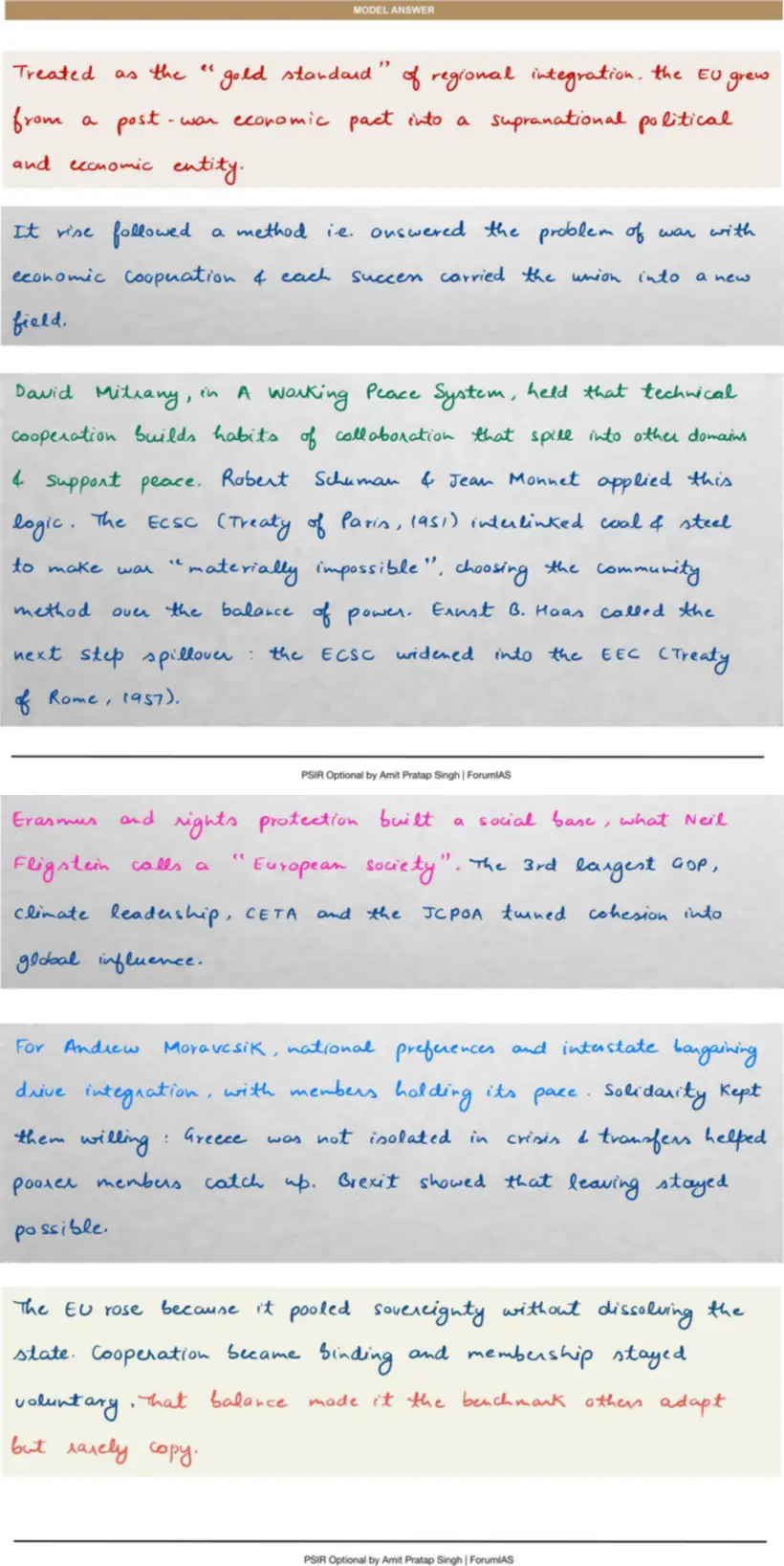
Model answer
Handwritten, in the form it would be written in the examination hall.
Also asked on this head
Regionalisation of World Politics — 14 questions in the Vault.
- QUAD requires more robust architecture than the summit driven mode to tide over the current challenges. Elaborate.
- Explain the success of ASEAN as a regional organisation.
- American President Donald Trump’s proposal to withdraw from the ‘NAFTA’ would bring unforeseen consequences to the regionalisation of world politics. Elaborate. (150 words)
How this is taught
The same flow snapshot, built for every head of the syllabus, with the answer written in class.
The first session of Foundation 2027 is published in full.
Six programmes across three levels.