
“Trump’s return to the White House is a jolt to push the European Union to invest in its own defence and economic and technological revival.” Comment.
How the answer moves
The flow snapshot — the routes in, the body, the counter-view and the routes out.
Route 1 regionalism = condition + process → common sense of threat = the condition; political will = the process → Trump’s return supplies the condition, cohesion decides the rest /
Route 2 ‘America First’ shakes the transatlantic bedrock → European defence has run through NATO since the Cold War → the autonomy question is forced open; the answer lies in Europe, not Washington
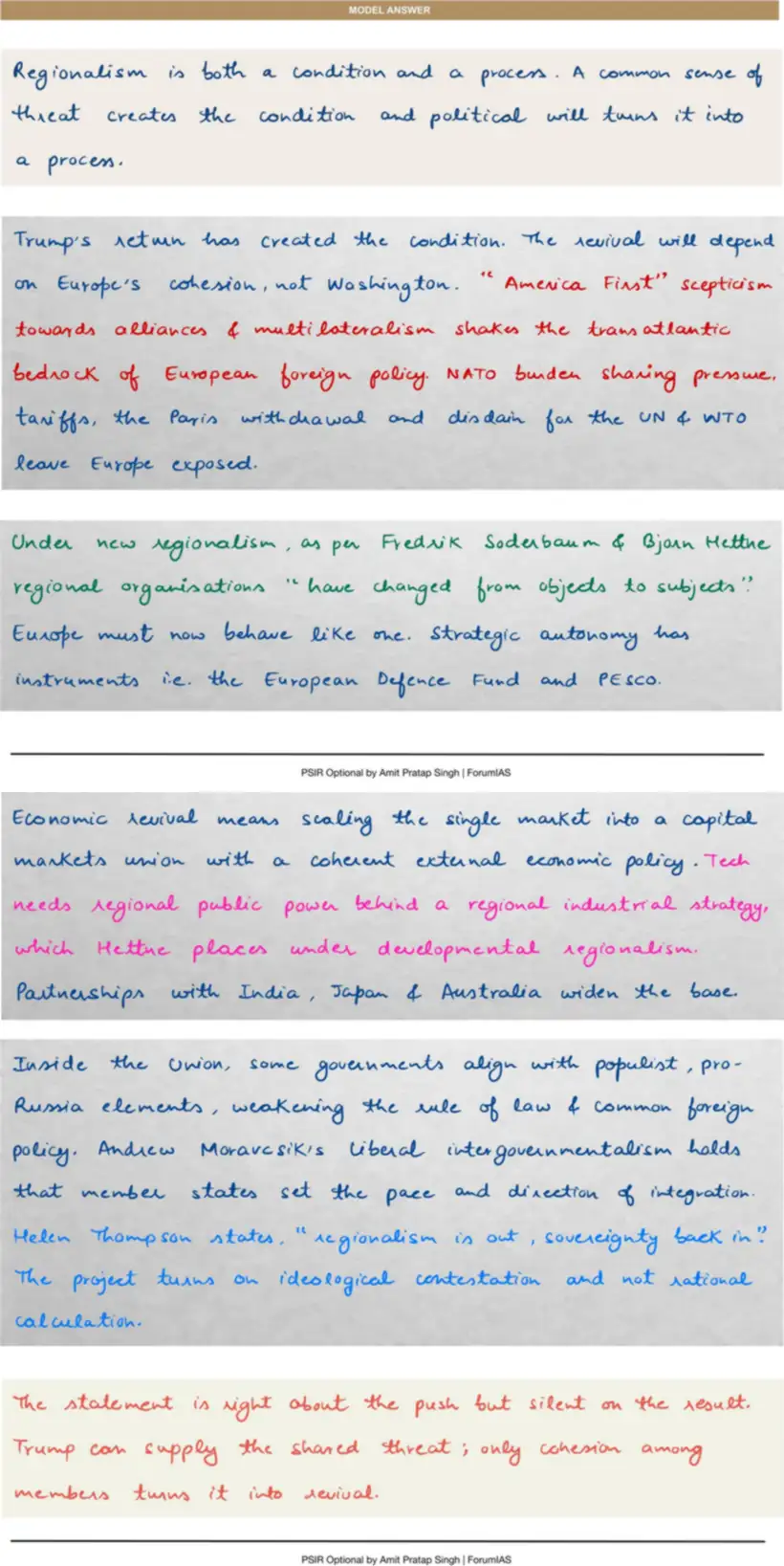
America First scepticism towards alliances/multilateralism → NATO burden-sharing pressure + tariffs + Paris withdrawal + disdain for UN/WTO → Europe exposed, resurgent Russia in Ukraine → new regionalism: organisations “from objects to subjects” (Söderbaum–Hettne) → Europe must act as a subject → defence: strategic autonomy, European Defence Fund, PESCO → economy: single market → capital markets union + coherent external economic policy → technology: regional public power → regional industrial strategy (Hettne, developmental regionalism) → partners: India, Japan, Australia
the jolt does not decide the result → some member governments align with populist, pro-Russia elements → rule of law + common foreign policy weakened → liberal intergovernmentalism (Moravcsik): members still set the pace and direction → Thompson: “regionalism is out, sovereignty back in” → the project turns on ideological contestation, not rational calculation
Route 1 right about the push, silent on the result → Trump supplies the shared threat; only cohesion supplies the revival /
Route 2 condition given, process still to be built → autonomy is a political choice inside Europe, not an American gift
Model answer
Handwritten, in the form it would be written in the examination hall.
Also asked on this head
Regionalisation of World Politics — 14 questions in the Vault.
- QUAD requires more robust architecture than the summit driven mode to tide over the current challenges. Elaborate.
- Explain the success of ASEAN as a regional organisation.
- American President Donald Trump’s proposal to withdraw from the ‘NAFTA’ would bring unforeseen consequences to the regionalisation of world politics. Elaborate. (150 words)
How this is taught
The same flow snapshot, built for every head of the syllabus, with the answer written in class.
The first session of Foundation 2027 is published in full.
Six programmes across three levels.