
Evaluate the role of BIMSTEC in multi-sectoral technical and economic cooperation.
How the answer moves
The flow snapshot — the routes in, the body, the counter-view and the routes out.
Route 1 mandate written into the name → Bangkok Declaration 1997, South + Southeast Asia → verdict staked: works as a technical body, disappoints as an economic one /
Route 2 BIMSTEC as a functional experiment → sector-by-sector design, each member leading one → judge it against its own promise
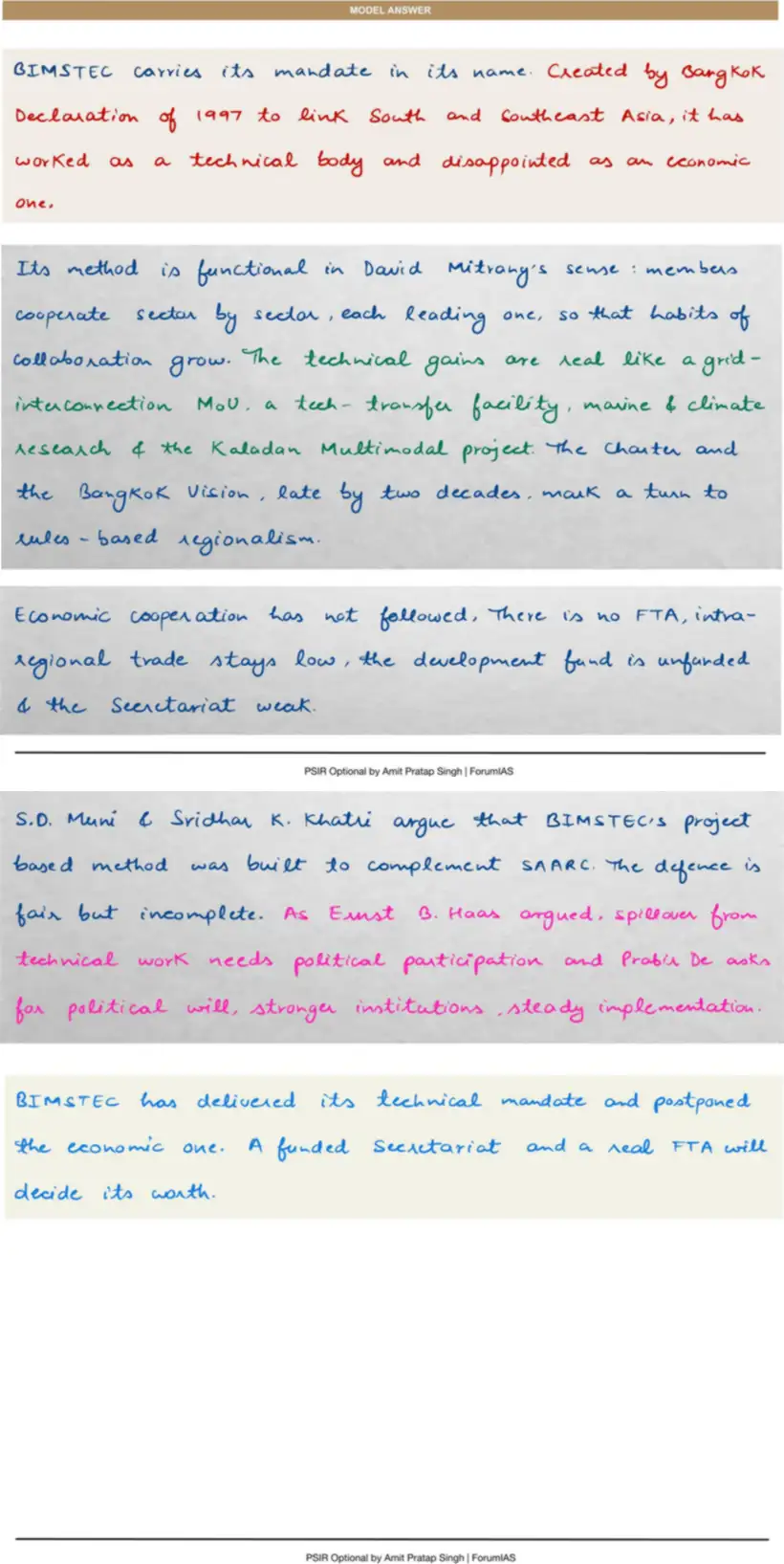
Mitrany’s functional method → technical cooperation breeds habits of collaboration → the gains are real: grid-interconnection MoU → technology-transfer facility → marine and climate research → Kaladan Multimodal → Charter + Bangkok Vision, late by two decades → turn to rules-based regionalism → but the economic half is missing: no FTA → low intra-regional trade → unfunded Development Fund → weak Secretariat
Muni & Khatri: the project-based method was built to complement SAARC → defence fair but incomplete → Haas: spillover needs political participation → De: political will, stronger institutions, steady implementation
Route 1 technical mandate delivered, economic one postponed → a funded Secretariat and a real FTA will decide its worth /
Route 2 design sound, politics missing → BIMSTEC works as a functional platform, not yet as an economic community
Model answer
Handwritten, in the form it would be written in the examination hall.
Also asked on this head
Regionalisation of World Politics — 14 questions in the Vault.
- QUAD requires more robust architecture than the summit driven mode to tide over the current challenges. Elaborate.
- Explain the success of ASEAN as a regional organisation.
- American President Donald Trump’s proposal to withdraw from the ‘NAFTA’ would bring unforeseen consequences to the regionalisation of world politics. Elaborate. (150 words)
How this is taught
The same flow snapshot, built for every head of the syllabus, with the answer written in class.
The first session of Foundation 2027 is published in full.
Six programmes across three levels.