
How successful has the ‘ASEAN Plus Three’ been in addressing regional problems? Support your answer with Specific examples.
How the answer moves
The flow snapshot — the routes in, the body, the counter-view and the routes out.
Route 1 APT = ASEAN 10 + China, Japan, South Korea → born of the 1997–98 Asian financial crisis → record has followed that origin → economic/technical problems addressed, political/strategic ones not /
Route 2 success must be graded by the type of regional problem → APT was designed as a crisis-response body → strong where the problem is technical, weak where it is strategic
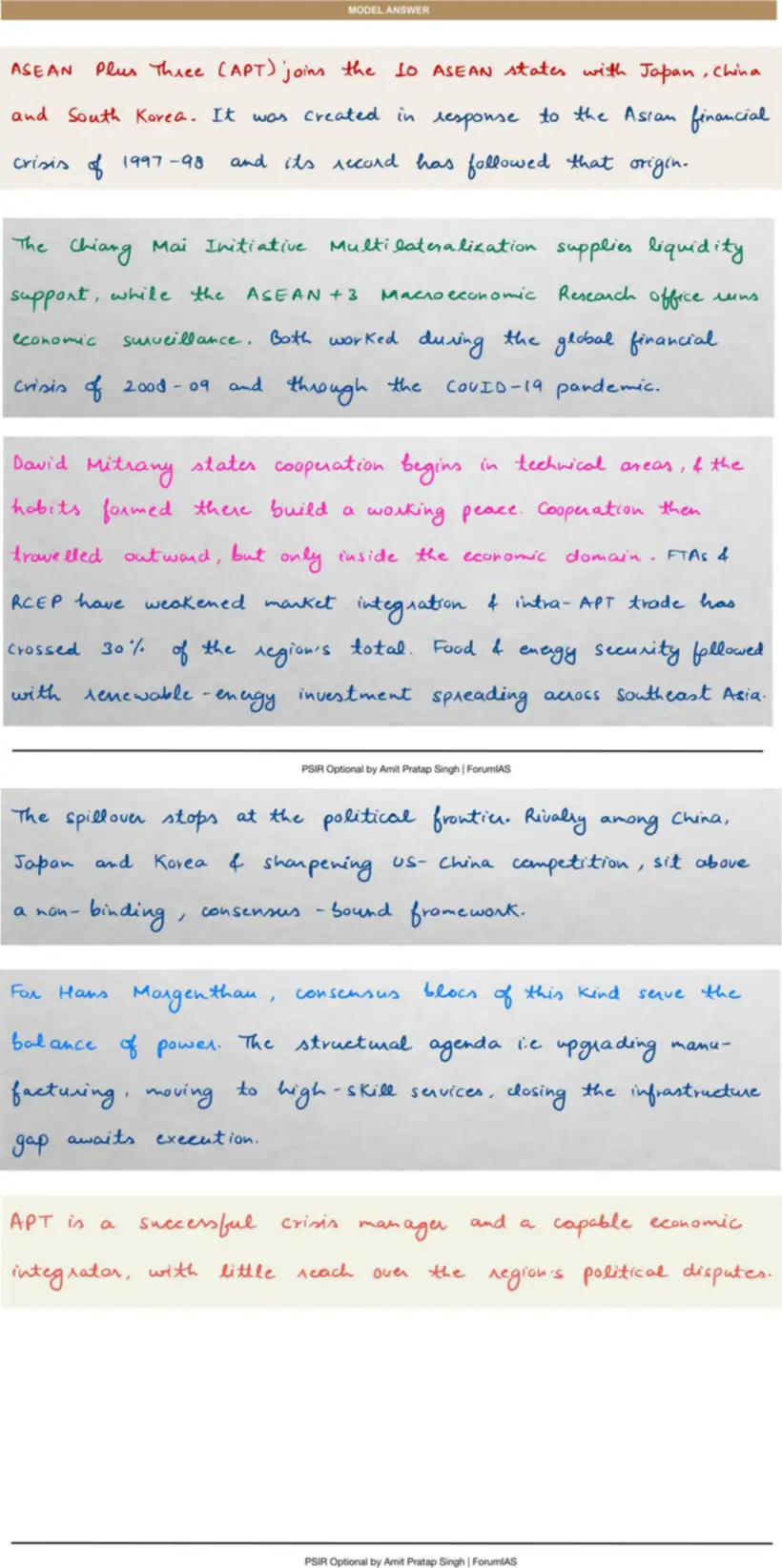
financial safety net: CMIM (liquidity) + AMRO (surveillance) → tested and held in the 2008–09 global financial crisis and COVID-19 → Mitrany: cooperation begins in technical areas, habits build a working peace → Haas’s spillover, but confined to the economic domain → FTAs and RCEP; intra-APT trade above 30% of regional total → food and energy security; renewable-energy investment across Southeast Asia
spillover halts at the political frontier → China–Japan–Korea rivalry + sharpening US–China competition → non-binding, consensus-bound design; liberal intergovernmentalism — members keep pace and direction → Morgenthau: such consensus blocs serve the balance of power → structural agenda (manufacturing upgrade, high-skill services, infrastructure gap) still awaits execution
Route 1 successful crisis manager and capable economic integrator → little reach over political disputes → judged by the problem it was built for, it has worked /
Route 2 success is bounded by design → what consensus can settle, APT has settled; what needs binding commitment lies beyond it
Model answer
Handwritten, in the form it would be written in the examination hall.
Also asked on this head
Regionalisation of World Politics — 14 questions in the Vault.
- QUAD requires more robust architecture than the summit driven mode to tide over the current challenges. Elaborate.
- Explain the success of ASEAN as a regional organisation.
- American President Donald Trump’s proposal to withdraw from the ‘NAFTA’ would bring unforeseen consequences to the regionalisation of world politics. Elaborate. (150 words)
How this is taught
The same flow snapshot, built for every head of the syllabus, with the answer written in class.
The first session of Foundation 2027 is published in full.
Six programmes across three levels.