
Discuss India’s vision of a New World order in the 21st century.
How the answer moves
The flow snapshot — the routes in, the body, the counter-view and the routes out.
Route 1 “Asian Century” / Indo-Pacific pivot → multipolar order, no fresh hegemon or bipolar bloc → pluralist heritage vs China’s “Middle Kingdom”
Route 2 thesis-first: multipolar + reformist → built on strategic autonomy and multi-alignment → then locate in the “Asian Century”
autonomy + multi-alignment → Jaishankar (inaction → action; engage US/Russia/EU/ASEAN by interest) → Raja Mohan (non-alignment → multi-alignment; power diffuses) → balancer → leading state → UNSC reform / IMEC / I2U2 / Global South / G20 (Vasudhaiva Kutumbakam) → Bajpaee (bridge West–Global South; reformist, not revisionist)
is it truly multipolar? → Rajagopalan (bipolar US–China; costly illusion) → Acharya (post-Western, multiplex; no single dominant power) → India’s multipolarity = goal as much as description
Route 1 reformist agency → multi-alignment steers a diffusing order toward inclusion → convert flexible autonomy into consistent leadership
Route 2 multipolarity still aspiration as much as fact → India’s task is to realise it → change through inclusion, not disruption
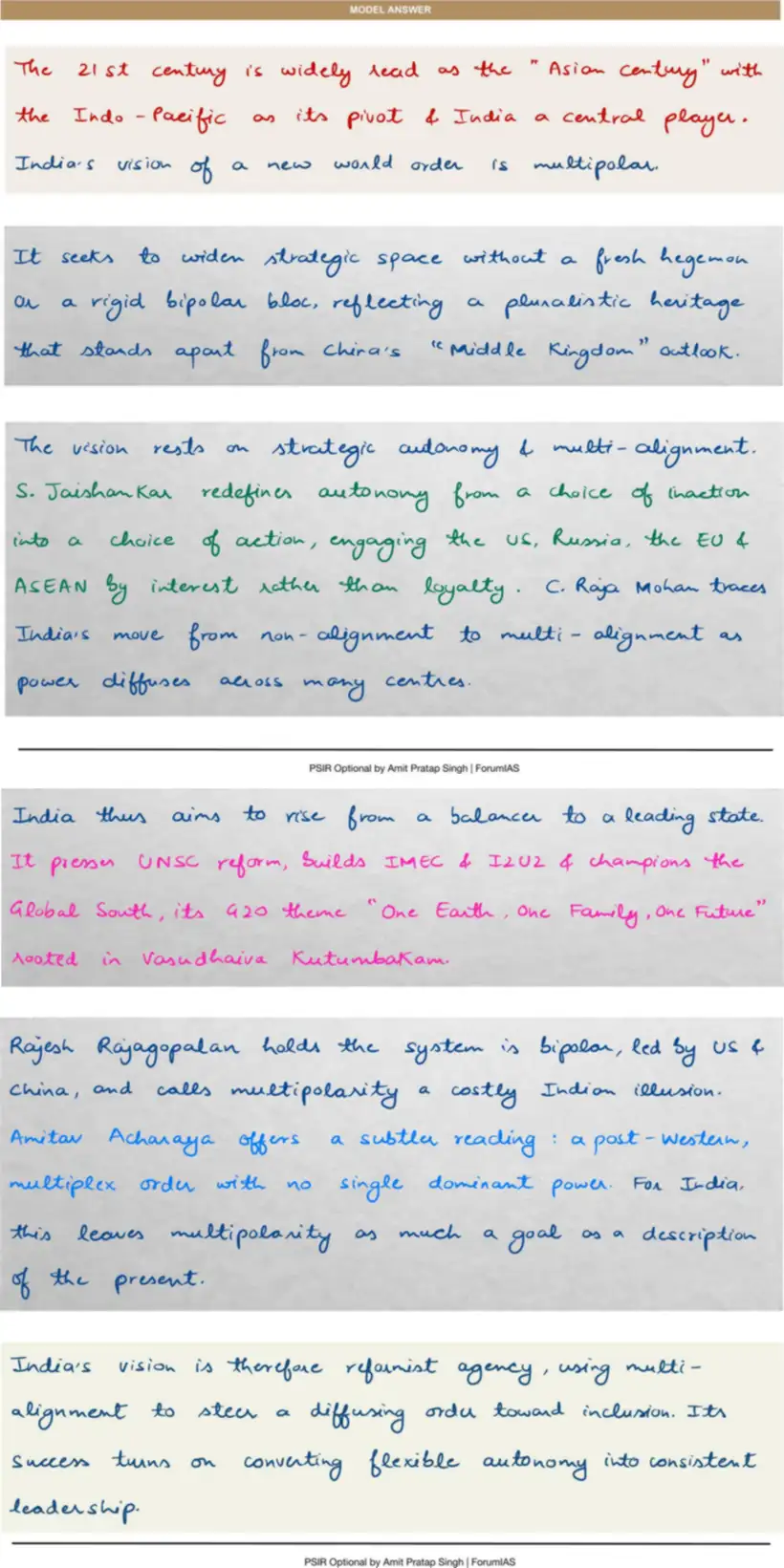
Model answer
Handwritten, in the form it would be written in the examination hall.
Also asked on this head
Recent Developments in Indian Foreign Policy — 23 questions in the Vault.
- India has recognised that West Asia is not a single contest, but a tangle of rivalries, bargains and anxieties. Comment.
- Discuss the three areas of security co-operation between India and Israel. (150 words)
- Critically examine India’s position on South China Sea Dispute.
How this is taught
The same flow snapshot, built for every head of the syllabus, with the answer written in class.
The first session of Foundation 2027 is published in full.
Six programmes across three levels.