
Critically examine the role of India in shaping the emerging world order.
How the answer moves
The flow snapshot — the routes in, the body, the counter-view and the routes out.
Route 1 unipolar moment over → not multipolar but multiplex (Acharya) → judge India against this → reformist bridge, agenda-setter not rule-maker
Route 2 emerging order = many consequential actors + issue-specific leadership + rising Global South → read India through this lens → bridge, not rule-writer
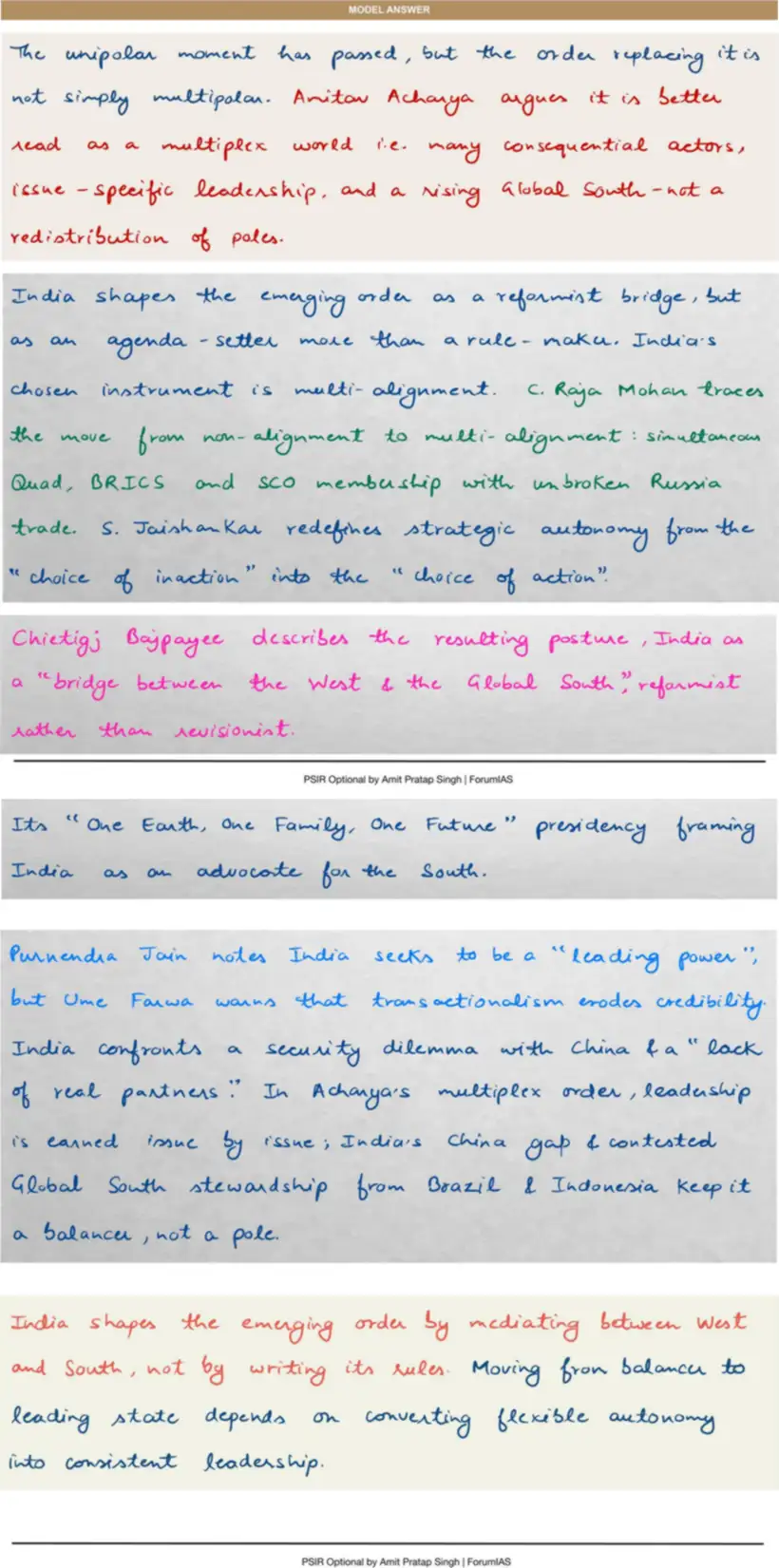
multi-alignment as instrument → Raja Mohan (non-alignment → multi-alignment: Quad + BRICS + SCO + Russia) → Jaishankar (autonomy: inaction → action) → Bajpaee (bridge West–Global South, reformist not revisionist) → concretes: UNSC reform, I2U2, IMEC, AU into G20, “One Earth, One Family, One Future”
aspiration outruns capacity → Jain (“leading power” claim) vs Farwa (transactionalism → China security dilemma → “lack of real partners”) → in a multiplex order leadership earned issue-by-issue → China gap + contested Global-South stewardship (Brazil, Indonesia) → balancer, not pole
Route 1 India shapes by mediating West–South, not by writing rules
Route 2 balancer → leading state only if flexible autonomy matures into consistent leadership
Model answer
Handwritten, in the form it would be written in the examination hall.
Also asked on this head
Recent Developments in Indian Foreign Policy — 23 questions in the Vault.
- India has recognised that West Asia is not a single contest, but a tangle of rivalries, bargains and anxieties. Comment.
- Discuss the three areas of security co-operation between India and Israel. (150 words)
- Critically examine India’s position on South China Sea Dispute.
How this is taught
The same flow snapshot, built for every head of the syllabus, with the answer written in class.
The first session of Foundation 2027 is published in full.
Six programmes across three levels.