
For India, a multipolar world order would also mean a multipolar Asia. Comment.
How the answer moves
The flow snapshot — the routes in, the body, the counter-view and the routes out.
Route 1 Cold War binaries dissolved → power diffused across many actors → India answers by multi-alignment (US, Russia, Europe, ASEAN — interest, not loyalty) → stake: world & Asia are one proposition
Route 2 Jaishankar → multipolar world “feasible only by a multipolar Asia” → global multipolarity empty if one power masters the region → stake the link
world & Asia one proposition for India → China’s rise unbalances the region, narrows India’s choices (AIIB / expanded SCO / NDB) → India presses a multipolar Asia to secure interests vs China → design = equal distribution of power & responsibility → three elements: Asian security ↔ global security + India’s UNSC claim / shared decision-making (major & minor powers) / inclusivity not exclusivity (room for US) → shared leadership among India, China, Japan
is a multipolar Asia feasible? → Rajagopalan: China outweighs India or any Asian combination → Asia tilts to US-China bipolarity, India leans on the US → Raja Mohan: “myth of multipolarity” as a bipolar order forms
Route 1 link holds as India’s purpose, not a guarantee → multipolar Asia a project, not an automatic yield of global multipolarity
Route 2 build it via India’s own rise + countervailing coalitions → India seeks a larger role in the diffusion of power while checking Chinese dominance
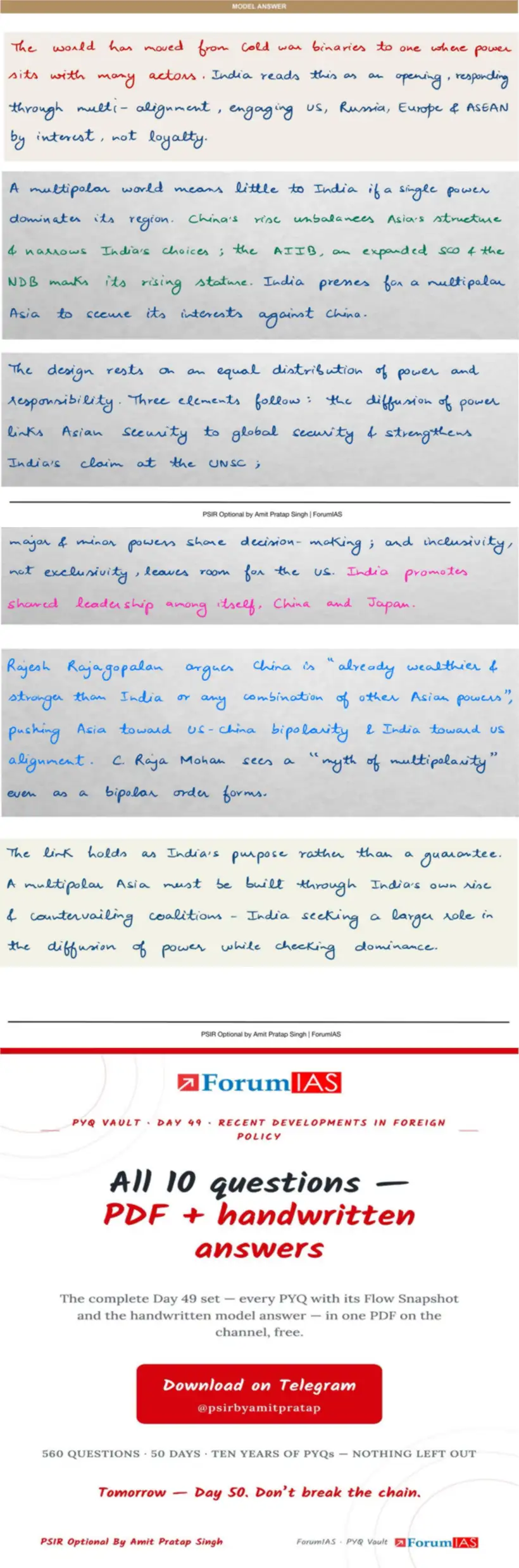
Model answer
Handwritten, in the form it would be written in the examination hall.
Also asked on this head
Recent Developments in Indian Foreign Policy — 23 questions in the Vault.
- India has recognised that West Asia is not a single contest, but a tangle of rivalries, bargains and anxieties. Comment.
- Discuss the three areas of security co-operation between India and Israel. (150 words)
- Critically examine India’s position on South China Sea Dispute.
How this is taught
The same flow snapshot, built for every head of the syllabus, with the answer written in class.
The first session of Foundation 2027 is published in full.
Six programmes across three levels.