
India maintains strong ties with countries that will assure a free and open Indo-Pacific and guarantee sreater connectivity with rest of the world. Analyze.
How the answer moves
The flow snapshot — the routes in, the body, the counter-view and the routes out.
Route 1 Indo-Pacific = pivot of world politics → India answers through partnerships, not alliances → frame = strategic autonomy
Route 2 India’s own maritime vision: SAGAR → MAHASAGAR (2025) → sets the free-and-open frame
maritime leg: Quad (US–Japan–Australia), Malabar + maritime domain awareness → France, Vietnam, ASEAN centrality (Act East) → open sea-lanes without treaty → connectivity leg: IMEC vs Belt and Road → Chabahar bypasses Pakistan → MAHASAGAR “trade for development”, inclusive alternative to BRI → links to Europe, Gulf, Global South
does partnership-without-alliance actually deliver? → Tarapore’s zone balancing (capacity-building short of alliance) vs Rajagopalan’s evasive balancing (satisfies neither China nor partners) → Bajpaee: risk of a “second-tier” role as AUKUS hardens
Route 1 balancing without alliance → secures sea-lanes + connectivity while refusing entanglement → autonomy in practice
Route 2 the free-and-open order depends on converting flexible autonomy into consistent delivery
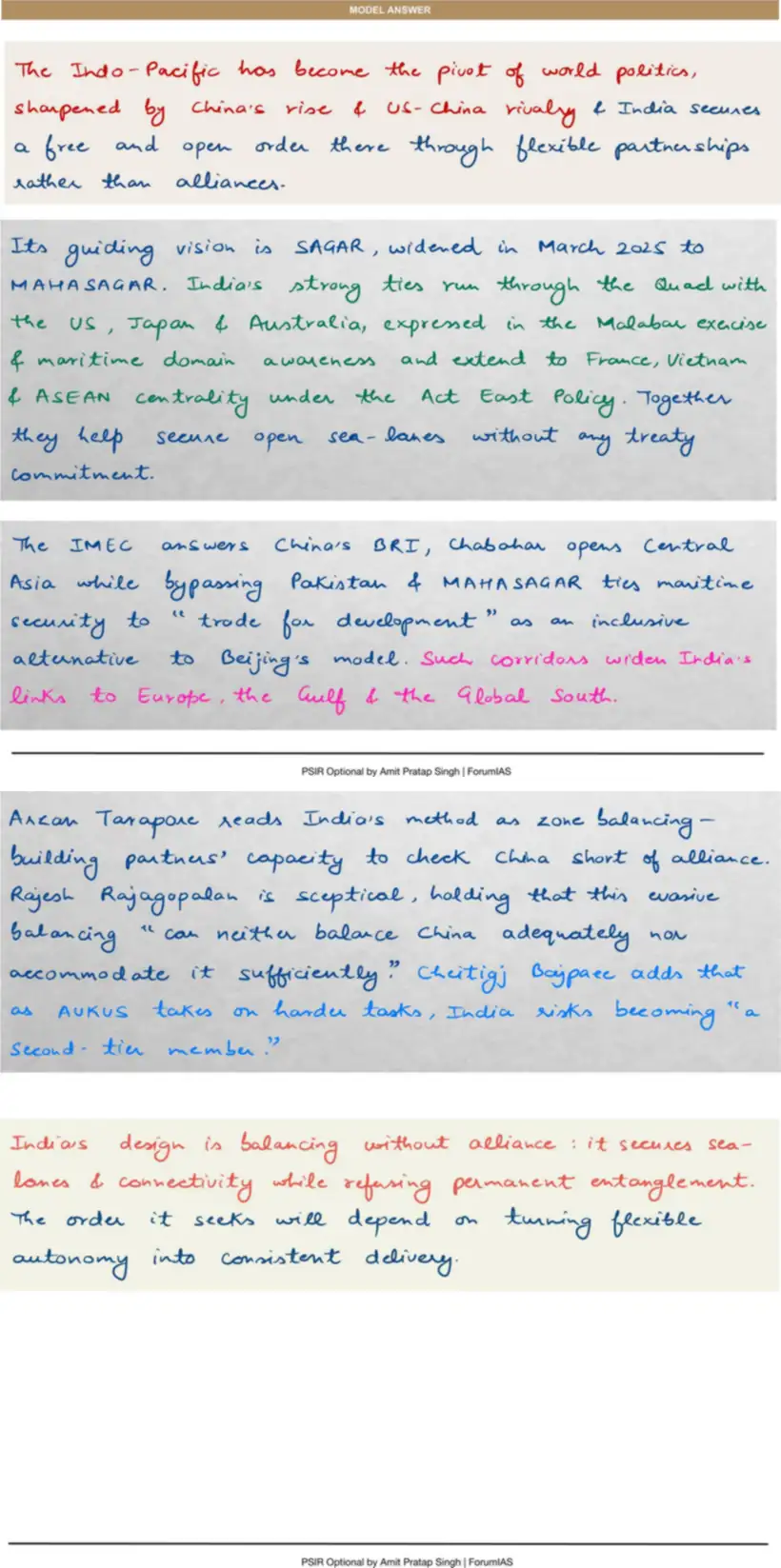
Model answer
Handwritten, in the form it would be written in the examination hall.
Also asked on this head
Recent Developments in Indian Foreign Policy — 23 questions in the Vault.
- India has recognised that West Asia is not a single contest, but a tangle of rivalries, bargains and anxieties. Comment.
- Discuss the three areas of security co-operation between India and Israel. (150 words)
- Critically examine India’s position on South China Sea Dispute.
How this is taught
The same flow snapshot, built for every head of the syllabus, with the answer written in class.
The first session of Foundation 2027 is published in full.
Six programmes across three levels.