
Evaluate India’s vision of a new world order.
How the answer moves
The flow snapshot — the routes in, the body, the counter-view and the routes out.
Route 1 “new world order” from Bush 1991 (rule-based) → unipolarity fading into an Asian Century → India’s answer: multipolar, shared power/responsibility, not a hegemon-swap
Route 2 reformist vision rooted in pluralist heritage → set against China’s “Middle Kingdom” → rebalance the order, not replace it
strategic autonomy recast, inaction → action (Jaishankar) → non-alignment → multi-alignment, interest not loyalty (Raja Mohan) → democratise world politics (Avinash Kumar) → G20 2023 (“One Earth, One Family, One Future,” AU entry, Global Biofuels Alliance, IMEC vs BRI) → Voice of the Global South → bridge West–South (Bajpaee) → balancer → leading power
premise contested: bipolar US–China, multipolarity a “costly illusion” (Rajagopalan) → post-hegemonic / multiplex order (Acharya) → so multipolarity is description + goal → yet character reformist not revisionist: BRICS anti-hegemonic without a clean break (Papa & Han) → limits: China security dilemma + few real partners (Farwa), Global-South claim contested (Brazil, Indonesia)
Route 1 coherent + distinctive vision → change through inclusion, not disruption
Route 2 verdict hinges on two tests → multipolarity proving more than aspiration + flexible autonomy maturing into consistent leadership at home
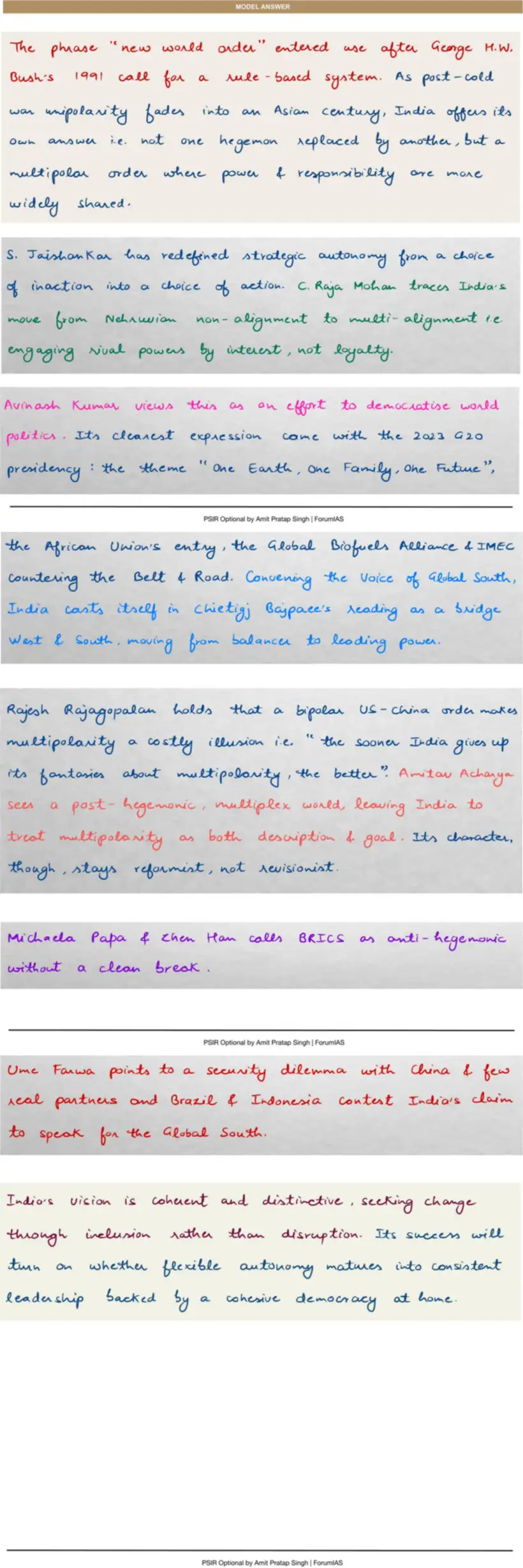
Model answer
Handwritten, in the form it would be written in the examination hall.
Also asked on this head
Recent Developments in Indian Foreign Policy — 23 questions in the Vault.
- India has recognised that West Asia is not a single contest, but a tangle of rivalries, bargains and anxieties. Comment.
- Discuss the three areas of security co-operation between India and Israel. (150 words)
- Critically examine India’s position on South China Sea Dispute.
How this is taught
The same flow snapshot, built for every head of the syllabus, with the answer written in class.
The first session of Foundation 2027 is published in full.
Six programmes across three levels.