
How does the recent takeover of Afghanistan by Taliban impact India’s strategic interests?
How the answer moves
The flow snapshot — the routes in, the body, the counter-view and the routes out.
Route 1 Aug 2021 takeover undid two decades of Indian statecraft in one stroke → Menon’s “test case” for India’s leading-power claim
Route 2 one reversal struck security, connectivity and regional balance together → costly on every front
~US$3bn + goodwill exposed → security first: ISI proxies (LeT/JeM), ISIS-K, narcotics → Happymon Jacob: soft power insufficient, no Plan B → Chabahar / Delaram–Zaranj strained → China + Pakistan gain room for hostile Kabul axis → Taliban–Pakistan friction reopens space → Saraswat: Taliban transaction-minded, Islamabad rift = India’s opening → Muttaqi’s Oct 2025 Delhi visit + “no Afghan soil against India” + Kabul embassy upgrade
Katju: engagement buys leverage but risks legitimising the regime
Route 1 serious near-term reversal, yet core security and connectivity interests protected
Route 2 calibrated engagement without recognition → impact contained, not permanent
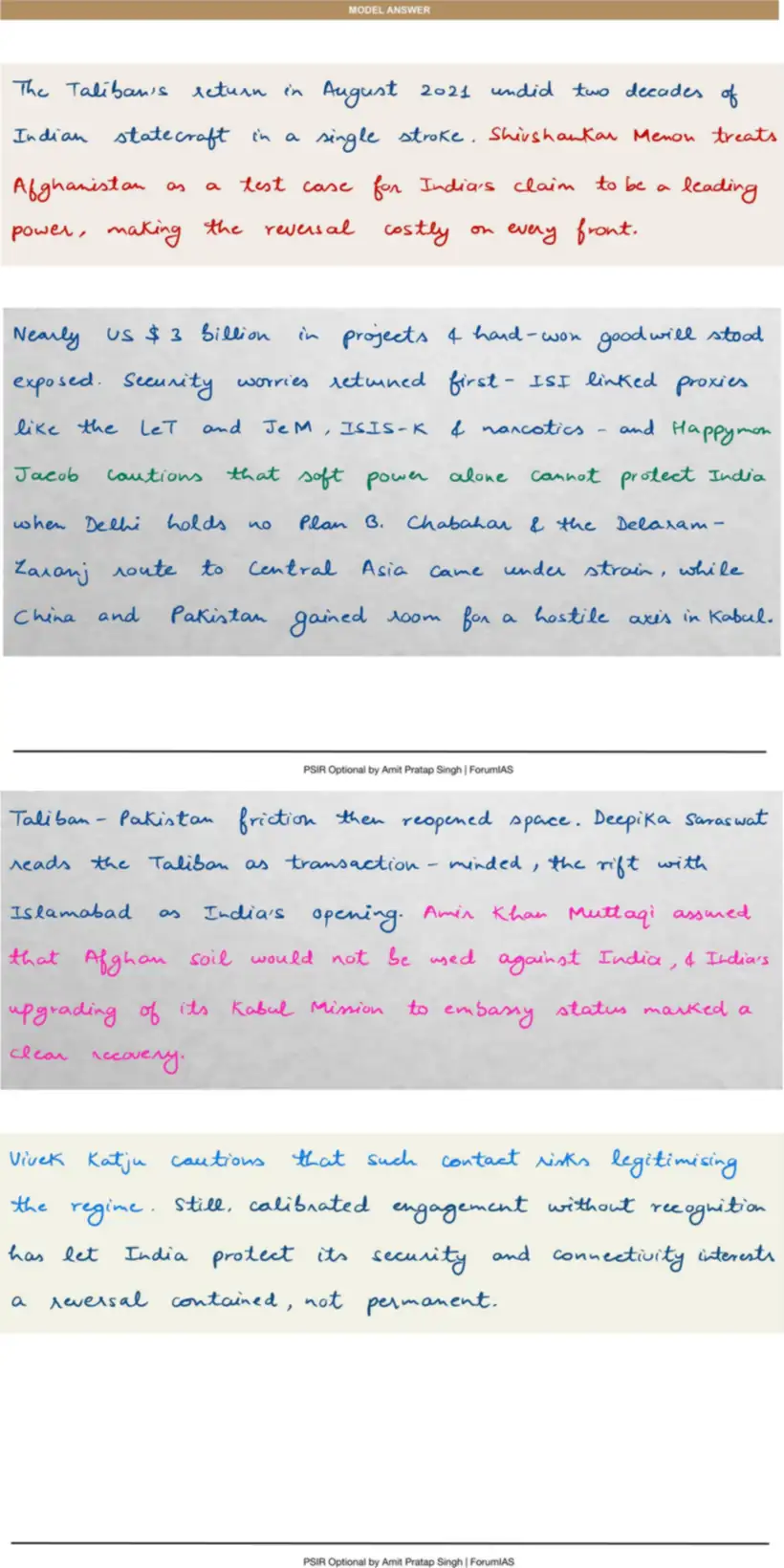
Model answer
Handwritten, in the form it would be written in the examination hall.
Also asked on this head
Recent Developments in Indian Foreign Policy — 23 questions in the Vault.
- India has recognised that West Asia is not a single contest, but a tangle of rivalries, bargains and anxieties. Comment.
- Discuss the three areas of security co-operation between India and Israel. (150 words)
- Critically examine India’s position on South China Sea Dispute.
How this is taught
The same flow snapshot, built for every head of the syllabus, with the answer written in class.
The first session of Foundation 2027 is published in full.
Six programmes across three levels.