
“The war in Afghanistan is crucial from the point of view of India’s national security. If the Americans withdraw and jihadis emerge with a sense of triumphalism, India will face increasing onslaught of terrorism”. Comment
How the answer moves
The flow snapshot — the routes in, the body, the counter-view and the routes out.
Route 1 fear is well-founded → Afghanistan on NW approaches + 1990s Kabul as terror nursery → but must the prediction follow?
Route 2 Afghanistan = India’s security buffer → US exit + triumphant Taliban did happen → so test the determinism, not the concern
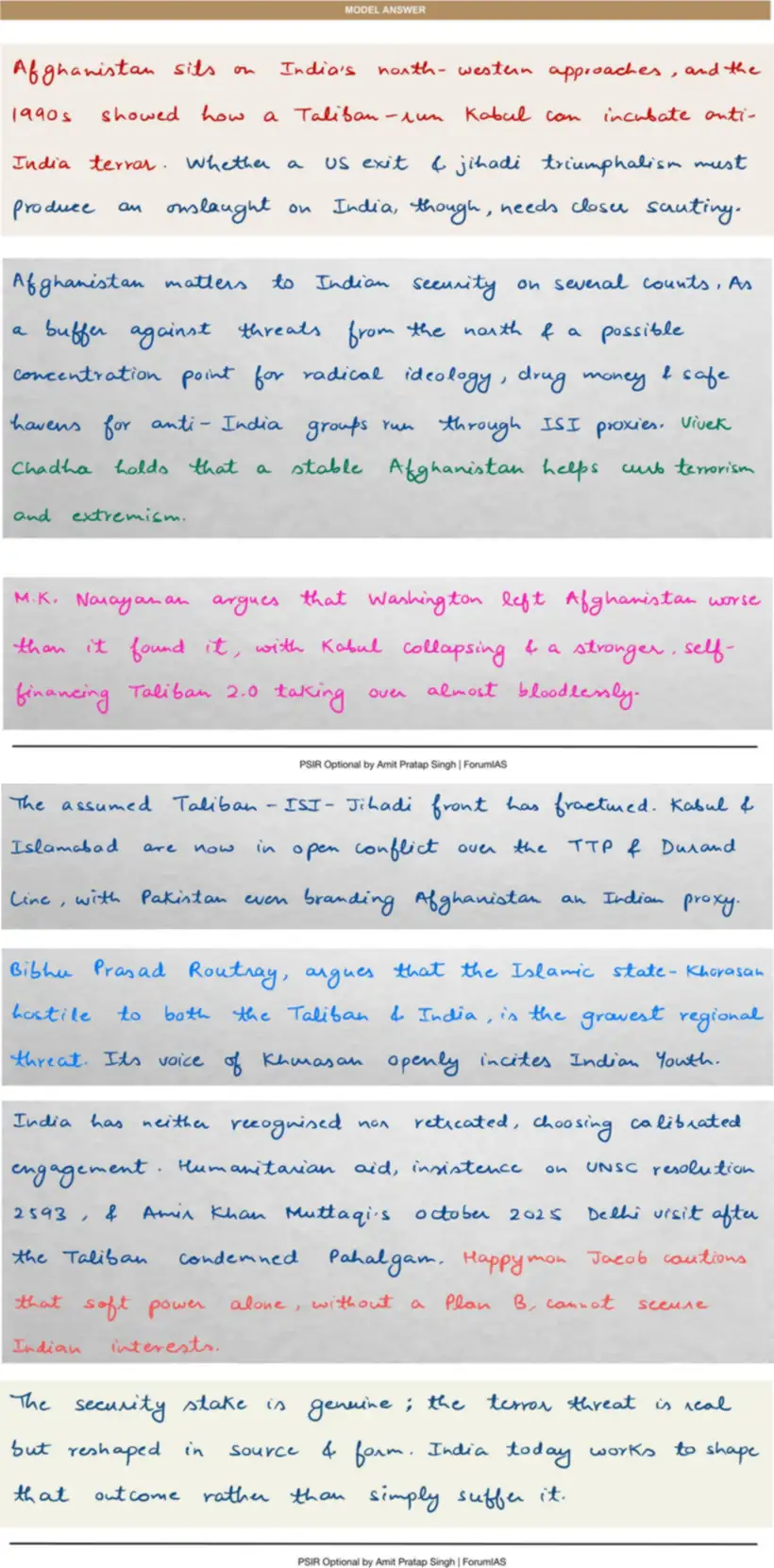
why Afghanistan matters (buffer, radical ideology, drugs, ISI proxies / Chadha: stable Afghanistan curbs terror) → trigger arrived (Aug 2021 pullout; Narayanan: US left it worse; stronger, self-financing Taliban 2.0) → the straight line bends: Taliban–ISI–jihadi front fractures → Kabul–Islamabad open war over TTP & Durand Line (“Indian proxy” jibe) → threat changes actor: ISKP (Routray), anti-Taliban + anti-India, Voice of Khurasan incites Indian youth → India’s reply: no recognition, no retreat → aid + UNSC 2593 + Muttaqi’s Oct 2025 Delhi visit post-Pahalgam
danger is still real: ISI proxies (LeT/JeM) persist, Taliban 2.0 stronger, ISKP active → Happymon Jacob: soft power alone, no Plan B → Taliban–Pakistan friction offers only limited relief
Route 1 security stake genuine; threat real but reshaped in source & form → India now shapes the outcome, not merely suffers it
Route 2 concern valid, prediction not deterministic → risk managed by calibrated engagement — neither recognition nor retreat
Model answer
Handwritten, in the form it would be written in the examination hall.
Also asked on this head
Recent Developments in Indian Foreign Policy — 23 questions in the Vault.
- India has recognised that West Asia is not a single contest, but a tangle of rivalries, bargains and anxieties. Comment.
- Discuss the three areas of security co-operation between India and Israel. (150 words)
- Critically examine India’s position on South China Sea Dispute.
How this is taught
The same flow snapshot, built for every head of the syllabus, with the answer written in class.
The first session of Foundation 2027 is published in full.
Six programmes across three levels.