
Would you agree with the contention that India’s inclination to lean on a ‘more aggressive hyper-realist posture’ has gained a new momentum in the aftermath of the Pahalgam terrorist strike? Comment.
How the answer moves
The flow snapshot — the routes in, the body, the counter-view and the routes out.
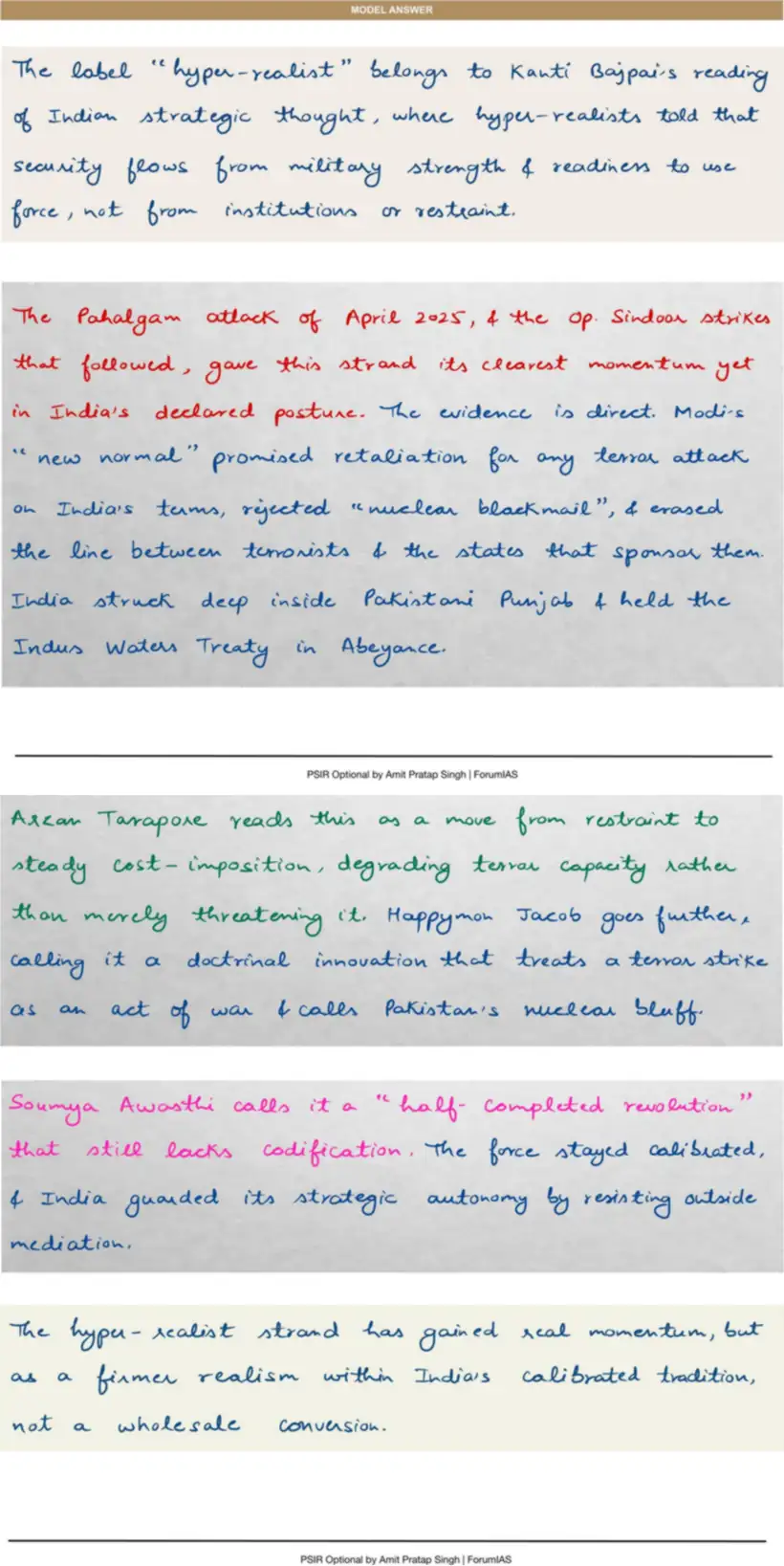
Route 1 “hyper-realist” = Bajpai’s strand → security from military strength / use of force, not institutions → Pahalgam + Sindoor gave it clearest momentum in declared posture
Route 2 Pahalgam strike → Sindoor + “new normal” → force-first signalling → does the hyper-realist strand now have fresh momentum?
Modi’s “new normal” (retaliate on own terms / no nuclear blackmail / no terrorist–sponsor distinction) → strikes deep in Punjab + IWT in abeyance → Tarapore: restraint → cost-imposition (degrade, not just threaten) → Jacob: doctrinal innovation, terror strike = act of war, calls nuclear bluff
momentum in posture, not settled doctrine → Awasthi: “half-completed revolution,” no codification → force stayed calibrated → strategic autonomy held (resisted mediation)
Route 1 real momentum, but firmer realism within calibrated tradition → not wholesale conversion
Route 2 hyperrealism ascendant in rhetoric + cost-imposition → yet bounded by calibration + autonomy → deepening, not displacement
Model answer
Handwritten, in the form it would be written in the examination hall.
Also asked on this head
Recent Developments in Indian Foreign Policy — 23 questions in the Vault.
- India has recognised that West Asia is not a single contest, but a tangle of rivalries, bargains and anxieties. Comment.
- Discuss the three areas of security co-operation between India and Israel. (150 words)
- Critically examine India’s position on South China Sea Dispute.
How this is taught
The same flow snapshot, built for every head of the syllabus, with the answer written in class.
The first session of Foundation 2027 is published in full.
Six programmes across three levels.