
The tariff threats have pushed India and the European Union closer. Evaluate the India-EU partnership.
How the answer moves
The flow snapshot — the routes in, the body, the counter-view and the routes out.
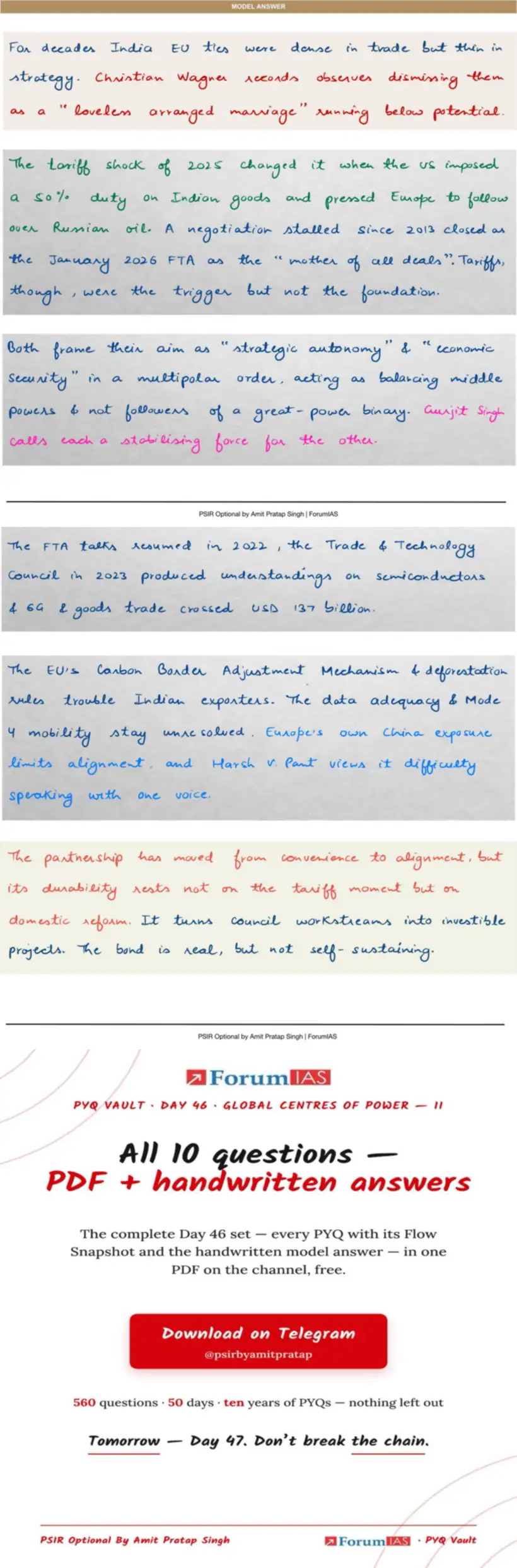
Route 1 India-EU long “below potential,” trade-dense / strategy-thin (Wagner) → 2025 tariff shock changed tempo → stalled talks close as Jan 2026 FTA
Route 2 US 50% duty + Russia-oil pressure → “mother of all deals” concluded → but tariffs = trigger, not foundation
real driver is convergence, not tariffs → “strategic autonomy” + “economic security,” balancing middle powers in a multipolar order (Gurjit Singh: each a stabilising force) → base already there: FTA 2022, TTC 2023 (semiconductors / 6G), goods trade > USD 137bn → accord read as de-risking vs unpredictable Washington + over-reliance on China → IMEC could cut freight time 40%
frictions persist → CBAM + deforestation rules; data adequacy; Mode 4 mobility; EU’s own China exposure; Pant — EU can’t speak with one voice
Route 1 convenience → alignment; durability rests on domestic reform + investible TTC projects, not the tariff moment
Route 2 bond now real, not yet self-sustaining → tariff was catalyst; strategic depth must be earned
Model answer
Handwritten, in the form it would be written in the examination hall.
Also asked on this head
India and the Global Centres of Power — 27 questions in the Vault.
- Critically evaluate India-Russia relations in the 21st century. How have both the countries responded to America meddling in their relations in the recent times.
- “The mother of all deals” is a transformative milestone in Indo-EU trade relations. Elaborate on the new Security and Defence partnership.
- Does the idea of the 21st century as ‘Asian century’ continue to remain feasible given the growing friction between India and China?
How this is taught
The same flow snapshot, built for every head of the syllabus, with the answer written in class.
The first session of Foundation 2027 is published in full.
Six programmes across three levels.