
Illustrate with examples how political parties in India have played a crucial role in drawing the historically disadvantaged groups into the mainstream political system.
How the answer moves
The flow snapshot — the routes in, the body, the counter-view and the routes out.
Route 1 parties as central institution → aggregate demands → convert into representation/office → Jaffrelot “silent revolution”
Route 2 excluded groups + adult franchise → parties turn numbers into power → lower-caste entry frames the answer
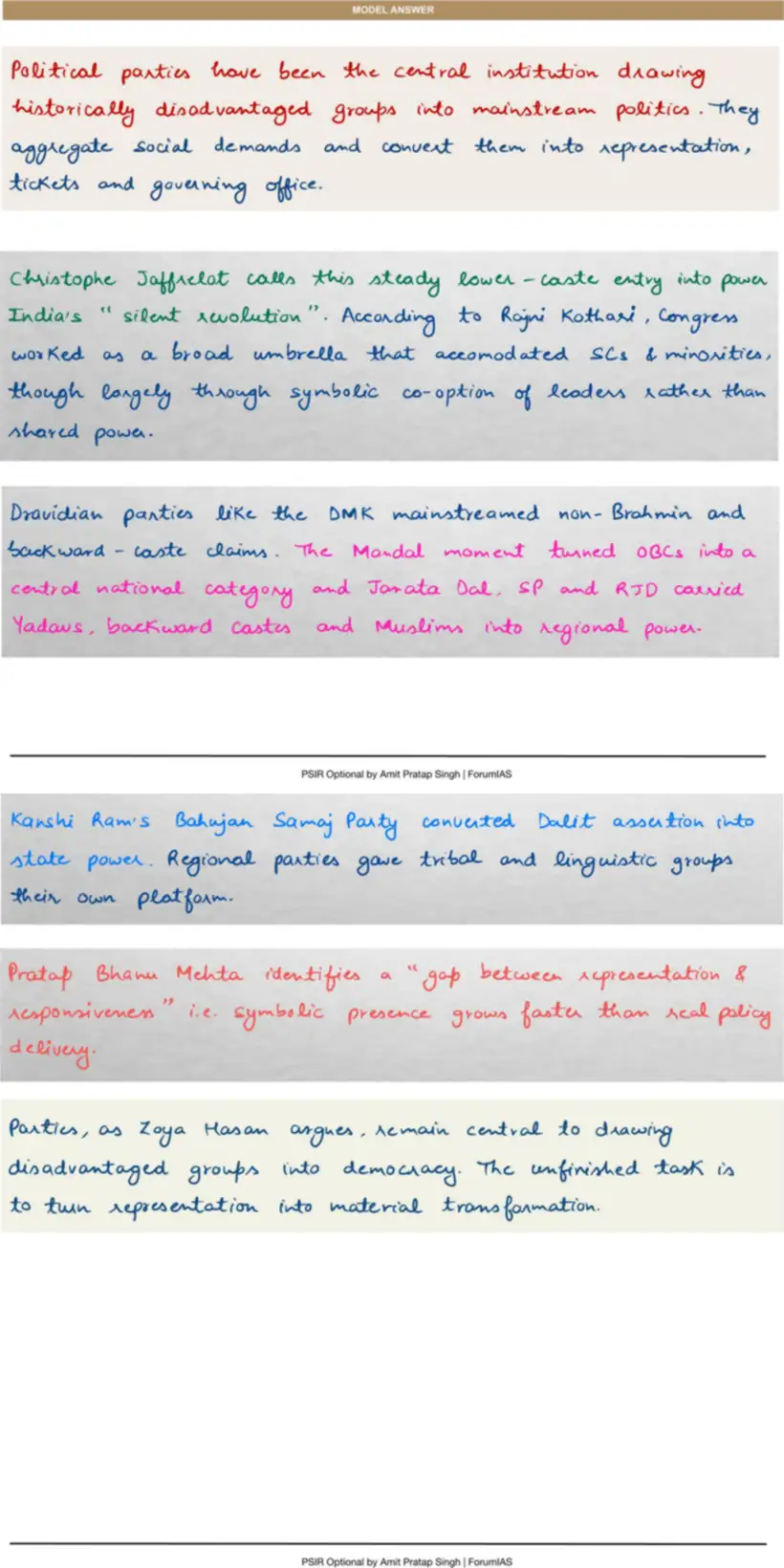
Congress umbrella (Kothari) → accommodates SC/minorities via symbolic co-option → autonomous assertion widens base → Dravidian/DMK mainstream non-Brahmin + backward claims → Mandal makes OBCs a national category → Janata Dal / SP / RJD carry Yadavs, OBCs, Muslims into regional power → Kanshi Ram’s BSP → Dalit assertion into state power (Mayawati, UP CM) → regional parties platform tribal + linguistic groups
inclusion real but incomplete → Mehta “gap between representation and responsiveness” → symbolic presence outruns policy delivery
Route 1 parties central to democratic inclusion (Zoya Hasan) → unfinished task: representation → material transformation
Route 2 drawing-in genuine but partial → next step is responsiveness, not more caste arithmetic
Model answer
Handwritten, in the form it would be written in the examination hall.
Also asked on this head
Party System — 18 questions in the Vault.
- Elucidate the prominent trends in voting behaviour in contemporary India, and discuss how astroturfing affects the scenario.
- When there are multiple stakeholders of power, conversation and consensus become the natural ingredients of governance. Analyze with respect to coalition politics.
- Critically assess the role of pressure groups in the decision-making process of the government.
How this is taught
The same flow snapshot, built for every head of the syllabus, with the answer written in class.
The first session of Foundation 2027 is published in full.
Six programmes across three levels.