
Discuss the future of SAARC in the light of India’s increased focus on other regional groupings like ASEAN and BIMSTEC.
How the answer moves
The flow snapshot — the routes in, the body, the counter-view and the routes out.
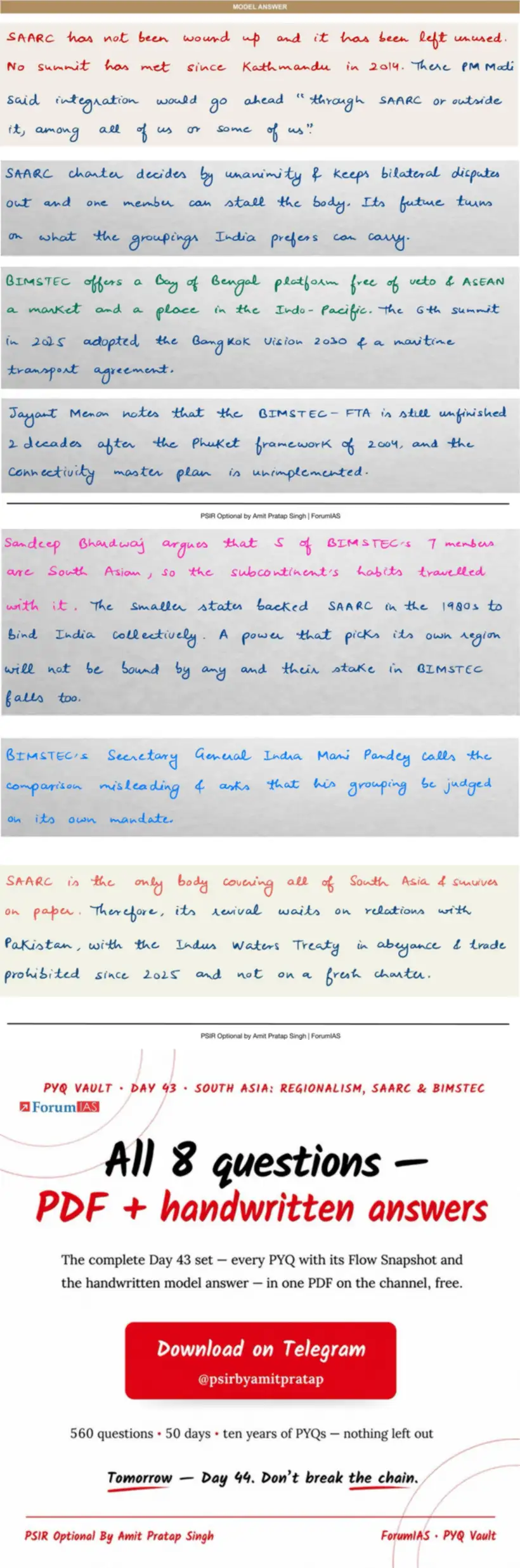
Route 1 not wound up, left unused → no summit since Kathmandu 2014 → Modi: through SAARC or outside it → India has followed that line
Route 2 charter works by unanimity, bilateral disputes excluded → one member can stall the body → future turns on what the substitutes can carry
BIMSTEC = Bay of Bengal platform free of that veto / ASEAN = market + Indo-Pacific place → Bangkok Vision 2030 + maritime transport agreement, April 2025 → India’s position: paused, not closed → Menon: BIMSTEC FTA unfinished since Phuket 2004, connectivity plan unimplemented → Bhardwaj: five of seven members South Asian, habits travelled across → smaller states built SAARC to bind India collectively → a power that picks its region binds itself to none → their stake in BIMSTEC falls too → Dhaka asks in Delhi, July 2026, that the two work together
Pandey: comparison misleading, judge BIMSTEC on its own mandate → it was never meant to include Pakistan or Afghanistan
Route 1 survives on paper → the only body covering all of South Asia
Route 2 revival waits on Pakistan — Indus Waters in abeyance, trade prohibited — not on a fresh charter
Model answer
Handwritten, in the form it would be written in the examination hall.
Also asked on this head
India and South Asia — 32 questions in the Vault.
- The island of Kachchatheevu remains an intractable issue in India-Srilanka relations. Comment.
- How does illegal cross border migration pose challenges to India’s security? Discuss the steps taken by the government in this direction and their effectiveness.
- Critically evaluate the important factors of India-Maldives relations on the eve of sixty years of diplomatic ties between the two countries.
How this is taught
The same flow snapshot, built for every head of the syllabus, with the answer written in class.
The first session of Foundation 2027 is published in full.
Six programmes across three levels.