
Discuss the ways and means to realise greater economic co-operation among the Member States of South Asia.
How the answer moves
The flow snapshot — the routes in, the body, the counter-view and the routes out.
Route 1 5% against ASEAN’s 25% → gap is one of delivery, not agreements → spine: cut the cost of crossing borders
Route 2 tariffs already cut, trade did not follow → wrong instrument → shift the target from tariffs to trade costs
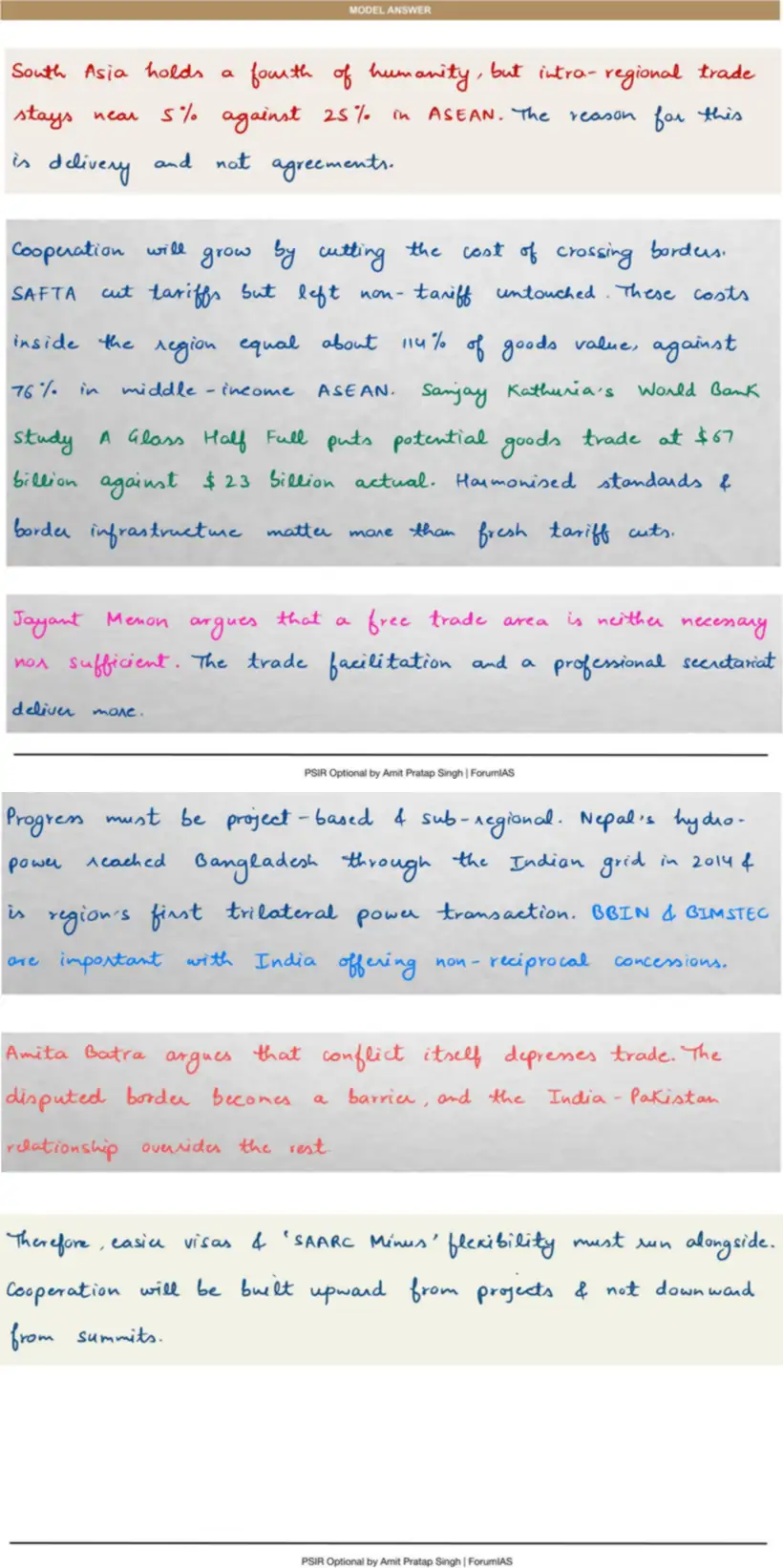
SAFTA’s tariff-only design, NTBs untouched → non-tariff costs ~114% vs ASEAN’s 76% → Kathuria: $23bn actual / $67bn potential → standards + border infrastructure over tariff cuts → Menon: FTA neither necessary nor sufficient → facilitation + professional secretariat → therefore project-based, sub-regional → energy as proof: Nepal → Bangladesh via Indian grid, 2024, first trilateral transaction → BBIN / BIMSTEC as carriers → India’s non-reciprocal concessions
Batra: conflict itself depresses trade → disputed border becomes a barrier → India–Pakistan overrides the rest → economics alone cannot deliver
Route 1 visas + ‘SAARC Minus’ flexibility alongside → built upward from projects, not downward from summits
Route 2 the cheapest route runs through border costs, not summit declarations → deliver where politics already allows
Model answer
Handwritten, in the form it would be written in the examination hall.
Also asked on this head
India and South Asia — 32 questions in the Vault.
- The island of Kachchatheevu remains an intractable issue in India-Srilanka relations. Comment.
- How does illegal cross border migration pose challenges to India’s security? Discuss the steps taken by the government in this direction and their effectiveness.
- Critically evaluate the important factors of India-Maldives relations on the eve of sixty years of diplomatic ties between the two countries.
How this is taught
The same flow snapshot, built for every head of the syllabus, with the answer written in class.
The first session of Foundation 2027 is published in full.
Six programmes across three levels.