
What are the reasons for lack of ‘regionness’ in South Asia?
How the answer moves
The flow snapshot — the routes in, the body, the counter-view and the routes out.
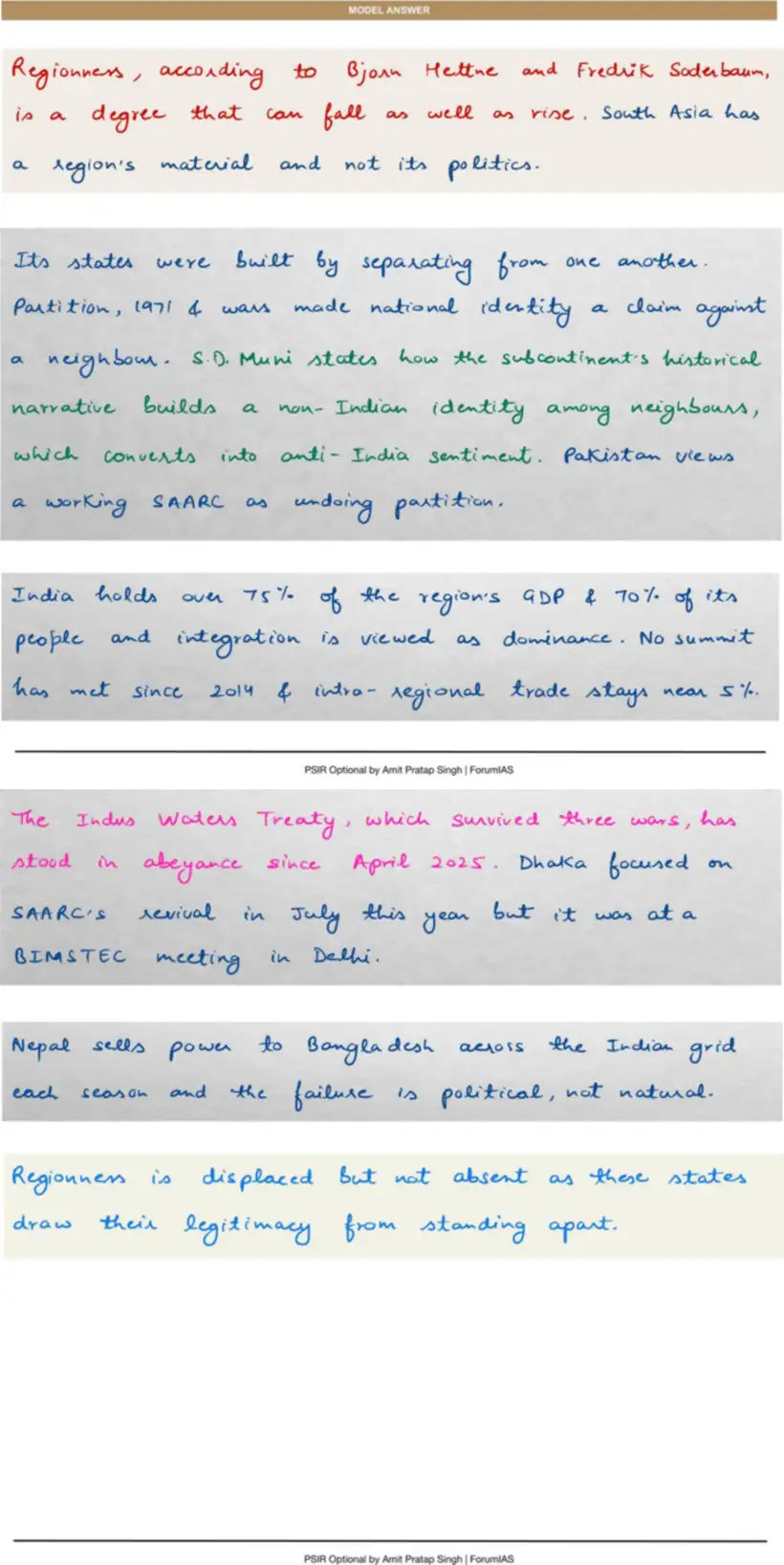
Route 1 regionness is a degree, not a fact of geography (Hettne–Söderbaum) → the level can fall as well as rise → South Asia: a region’s material, not its politics
Route 2 the material is shared, the politics is not → because the founding act of these states was separation
separation as the founding act (Partition, 1971, their wars) → national identity becomes a claim against a neighbour → Muni: non-Indian identity converting into anti-India sentiment → Pakistan: a working SAARC undoes partition → asymmetry (75% GDP, 70% people) → integration reads as dominance → institutional design (consensus rule + bilateral disputes excluded) → one quarrel halts the rest → no summit since 2014, trade near 5% → the level still falling (IWT in abeyance since April 2025; Dhaka asking for SAARC at a BIMSTEC table, July 2026)
the region does work where politics permits → Nepal’s power to Bangladesh across the Indian grid, season after season → the deficit is political, not natural
Route 1 displaced, not absent → these states draw legitimacy from standing apart
Route 2 the region moves wherever politics allows it to → what is missing is a decision, not a basis
Model answer
Handwritten, in the form it would be written in the examination hall.
Also asked on this head
India and South Asia — 32 questions in the Vault.
- The island of Kachchatheevu remains an intractable issue in India-Srilanka relations. Comment.
- How does illegal cross border migration pose challenges to India’s security? Discuss the steps taken by the government in this direction and their effectiveness.
- Critically evaluate the important factors of India-Maldives relations on the eve of sixty years of diplomatic ties between the two countries.
How this is taught
The same flow snapshot, built for every head of the syllabus, with the answer written in class.
The first session of Foundation 2027 is published in full.
Six programmes across three levels.