
Why do ethnic conflicts and insurgencies continue to remain major impediments to regional co-operation in South Asia?
How the answer moves
The flow snapshot — the routes in, the body, the counter-view and the routes out.
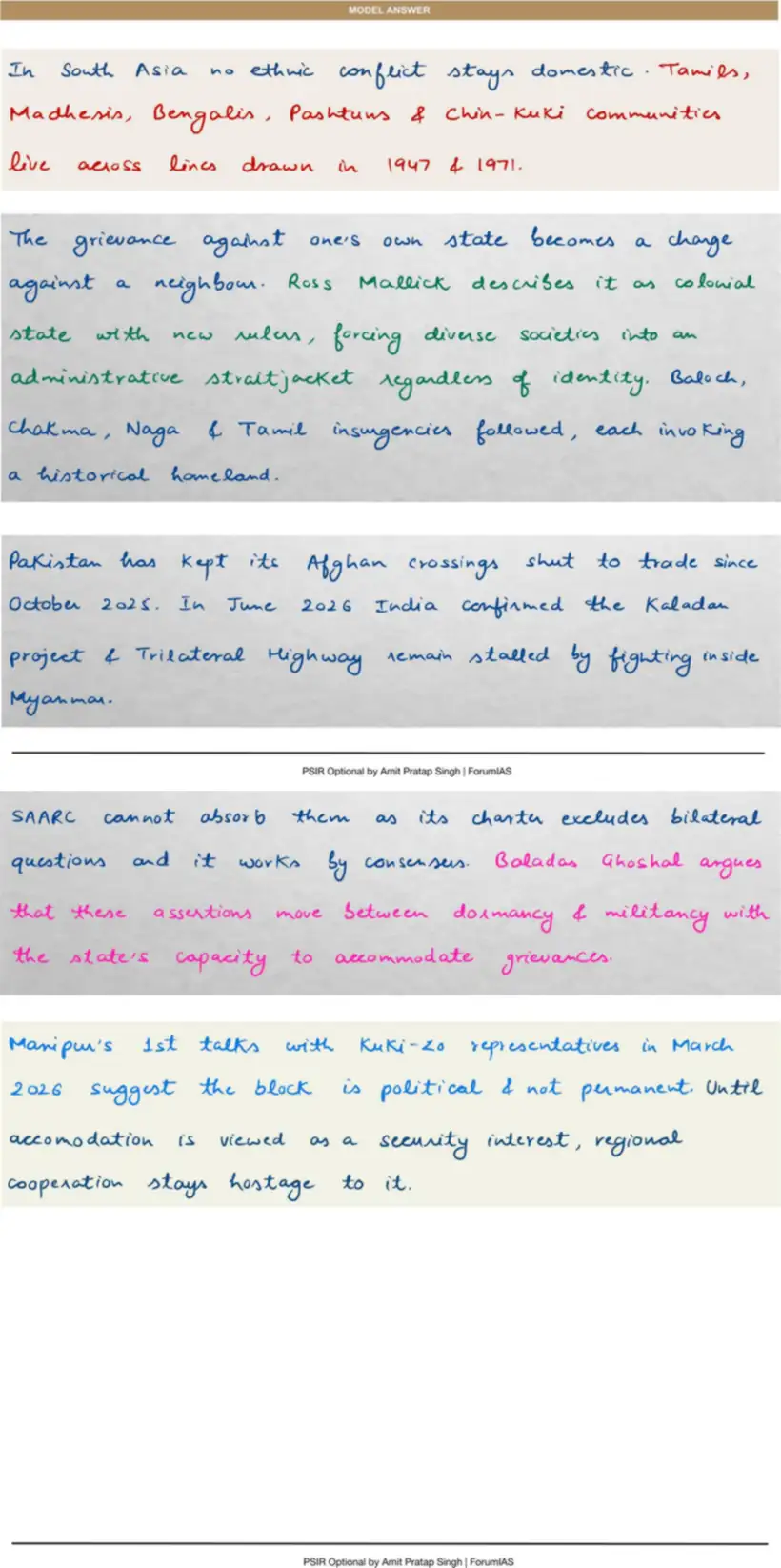
Route 1 no ethnic conflict in South Asia stays domestic → communities straddle the 1947 and 1971 lines → grievance against own state becomes charge against neighbour
Route 2 post-colonial state as colonial state with new rulers → centralisation regardless of identity → insurgencies invoking historical homelands
Mallick, administrative straitjacket → Baloch / Chakma / Naga / Tamil insurgencies, homeland claims → working links cut first → Pakistan’s Afghan crossings shut since Oct 2025 over the TTP → Central Asian transit stops with it → Kaladan and Trilateral Highway stalled inside Myanmar, June 2026 → SAARC charter bars bilateral questions + consensus rule
Ghoshal, dormancy to militancy turns on state capacity → Manipur’s first Kuki-Zo talks, March 2026 → block is political, not permanent
Route 1 cooperation stays hostage until accommodation is treated as a security interest
Route 2 the border cuts through the community, so the ethnic question is regional by structure — no state settles its minority alone
Model answer
Handwritten, in the form it would be written in the examination hall.
Also asked on this head
India and South Asia — 32 questions in the Vault.
- The island of Kachchatheevu remains an intractable issue in India-Srilanka relations. Comment.
- How does illegal cross border migration pose challenges to India’s security? Discuss the steps taken by the government in this direction and their effectiveness.
- Critically evaluate the important factors of India-Maldives relations on the eve of sixty years of diplomatic ties between the two countries.
How this is taught
The same flow snapshot, built for every head of the syllabus, with the answer written in class.
The first session of Foundation 2027 is published in full.
Six programmes across three levels.