
What are the implications of “Look-East’ Policy on the north-eastern region of India?
How the answer moves
The flow snapshot — the routes in, the body, the counter-view and the routes out.
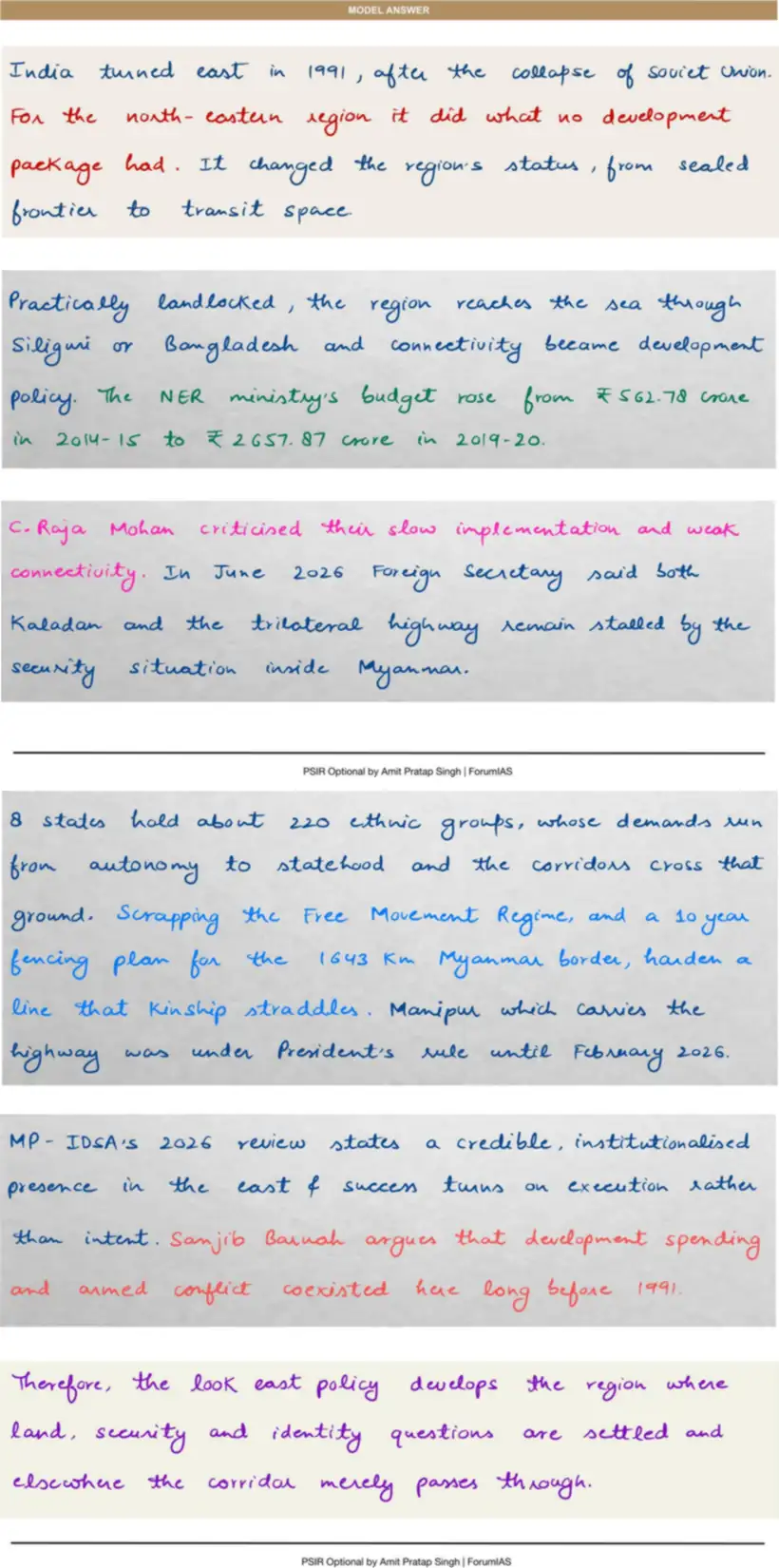
Route 1 1991 turn east after Soviet collapse → policy changed the region’s status, sealed frontier → transit space
Route 2 region practically landlocked → Look East made connectivity itself the Northeast’s development policy
first implication, economic: sea access via Siliguri or Bangladesh → DoNER budget ₹562.78 cr (2014–15) → ₹2,657.87 cr (2019–20) → second implication, dependence: future on corridors = future on territory India does not govern → Raja Mohan, slow implementation + weak connectivity → Misri, June 2026, Kaladan and trilateral highway stalled by security situation inside Myanmar → third implication, inward: ~220 ethnic groups, autonomy-to-statehood demands, corridors cross that ground → FMR scrapped + ten-year fencing plan, 1,643 km → line opened for cargo, hardened for kin → Manipur carries the highway, under President’s Rule till Feb 2026
policy not the culprit → MP-IDSA 2026: credible, institutionalised presence; success turns on execution, not intent → Baruah: development spending and armed conflict coexisted well before 1991
Route 1 change of status is real → develops the region only where land, security, identity are settled
Route 2 where they are not settled, the corridor merely passes through the region
Model answer
Handwritten, in the form it would be written in the examination hall.
Also asked on this head
India and South Asia — 32 questions in the Vault.
- The island of Kachchatheevu remains an intractable issue in India-Srilanka relations. Comment.
- How does illegal cross border migration pose challenges to India’s security? Discuss the steps taken by the government in this direction and their effectiveness.
- Critically evaluate the important factors of India-Maldives relations on the eve of sixty years of diplomatic ties between the two countries.
How this is taught
The same flow snapshot, built for every head of the syllabus, with the answer written in class.
The first session of Foundation 2027 is published in full.
Six programmes across three levels.