
Critically analyze the different phases of India’s foreign policy since independence. How justified, do you think, is S. Jaishankar’s classification of the current phase as the phase of ‘energetic diplomacy’?
How the answer moves
The flow snapshot — the routes in, the body, the counter-view and the routes out.
Route 1 evolution, not rupture → permanent factors (geography/history/culture) continuity vs dynamic factors change → strategic autonomy the constant yardstick
Route 2 six named phases = adaptation to circumstance → present phase the one to test → judge it against the constant thread
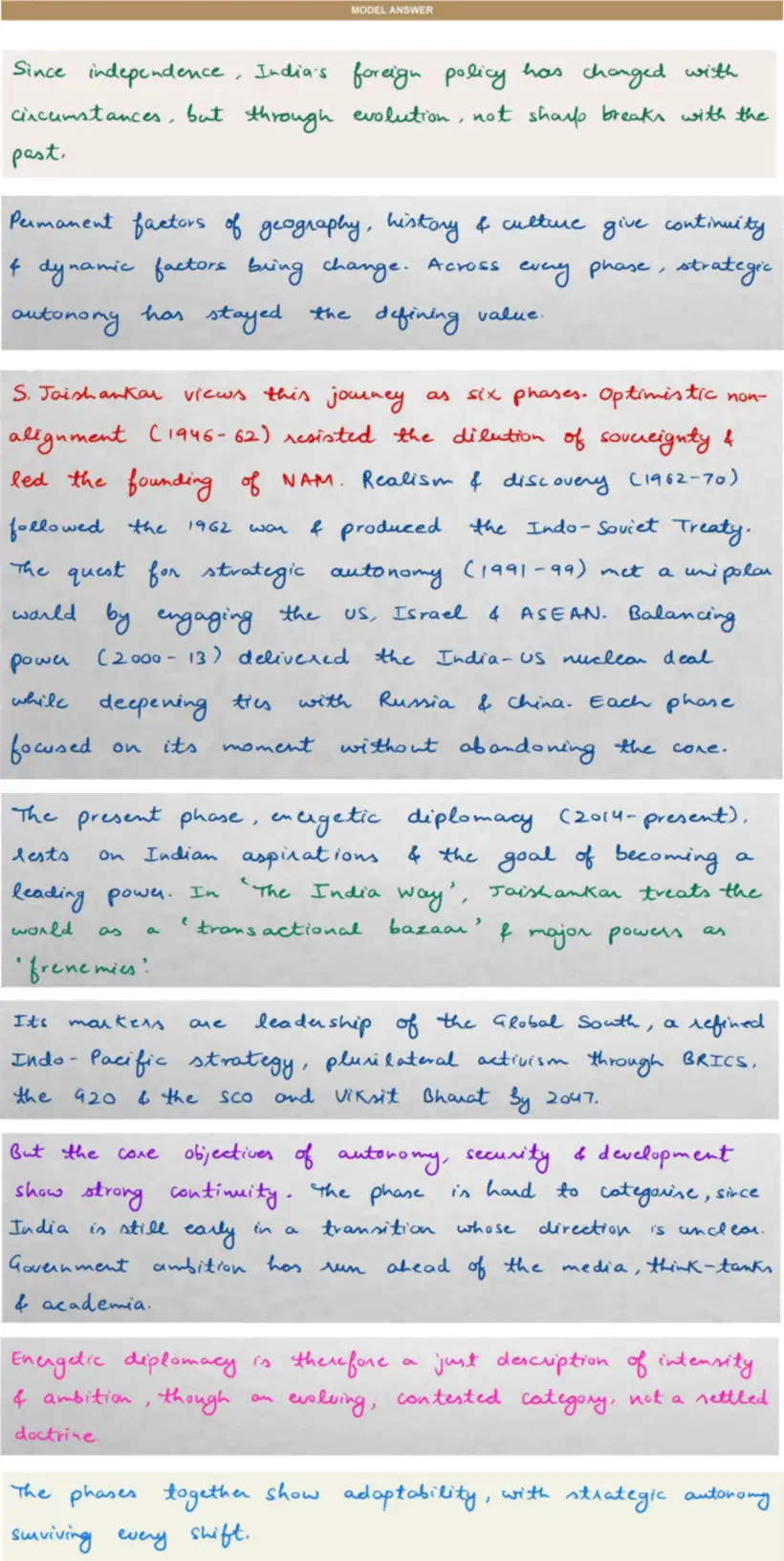
optimistic non-alignment (1946–62, NAM) → realism & discovery (1962–70, 1962 war → Indo-Soviet Treaty) → regional assertion (1971–91, Bangladesh, Pokhran) → strategic autonomy (1991–99, unipolar → US/Israel/ASEAN) → balancing power (2000–2013, India–US nuclear deal, Russia/China) → each answers its moment, core intact → energetic diplomacy (2014–present): leading-power aim → India Way (‘transactional bazaar’/‘frenemies’, interests over idealism) → engage America/manage China/reassure Russia → markers: Global South, Indo-Pacific, BRICS–G20–SCO, Viksit Bharat 2047
label captures activism + risk-taking vs strong continuity of core aims (autonomy/security/development) → hard to categorise, India early in transition → government ahead of Track-II (media/think-tanks/academia)
Route 1 ‘energetic diplomacy’ justified as tempo & ambition, not a settled doctrine
Route 2 phases show adaptability & pragmatism; strategic autonomy the value that survives every shift
Model answer
Handwritten, in the form it would be written in the examination hall.
Also asked on this head
Indian Foreign Policy — 17 questions in the Vault.
- India has adopted multi-alignment to fulfill its core values and interests in International relations. Discuss.
- What are the external determinants of the Foreign Policy of a State?
- How do the constituent states influence the foreign policy making process in India?
How this is taught
The same flow snapshot, built for every head of the syllabus, with the answer written in class.
The first session of Foundation 2027 is published in full.
Six programmes across three levels.